










LHO Trips in Nepal & the Himalayas
From the spiritual heights of the Himalayas in Nepal to the secluded valleys of Bhutan, our premium, curated adventures take you to some of the most awe-inspiring landscapes on earth. Our treks, multi-adventures and expeditions in these regions are designed with a strong focus on cultural immersion, skill development, and personal growth.
FIND YOURSELF IN NEPAL
Find Yourself in Nepal is an eight-day, non-technical adventure holiday combining a short Himalayan trek with rafting, paragliding, zip-lining, yoga and meditation. It is designed for first-time visitors who want culture, movement and reflection rather than a high-altitude objective. No previous experience is required; local specialists lead each activity while an LHO Team Leader coordinates the journey.
Curated by Rami Rasamny Reviewed by Shiva Raj Bastakoti
Traveller fit: Best for first-time visitors who want an active mix of culture, short Himalayan trekking, rafting, paragliding, zip-lining and wellbeing activities rather than a high-altitude objective. No previous experience is required, and individual activities may be skipped. This trip is not suitable for: travellers seeking a passive resort holiday, a specialist climbing course or guaranteed operation of every weather-dependent activity.
Planning your first Nepal adventure? Read our Find Yourself in Nepal questions and answers for the eight-day itinerary, activity experience, accommodation and extra costs.
CHECK IT OUT


EXPLORE MYSTICAL BHUTAN
Led throughout by a Bhutanese LHO Team Leader and delivered alongside trusted local activity guides, Explore Mystical Bhutan gives you more than a checklist of places. This is a journey into Bhutan’s landscapes, traditions, spirituality, hospitality, and way of life, with someone from the country helping bring that context to life from arrival to departure. Your Team Leader stays with the group throughout the experience, supporting the rhythm of each day while local activity guides lead specialist moments such as trekking, rafting, biking, and cultural visits. Participants are also supported at all times by LHO Base Camp, our office team, with direct access through the group WhatsApp. Together, this means the journey feels smooth, personal, and deeply connected to Bhutan, with on the ground care, local expertise, and the wider Life Happens Outdoors team behind you from start to finish.
CHECK IT OUT

ANNAPURNA BASE CAMP TREK
This is an eight-day guided trek from Kathmandu to Annapurna Base Camp at 4,130 metres, with five consecutive days on foot, tea-house accommodation, meals, permits, porters and airport-to-airport support. It suits active first-time Himalayan trekkers with no technical climbing experience, although steep stone steps, sustained ascent and altitude still require training. If you prefer a quieter ridge journey, compare the Mardi Himal trek.
Curated by Rami Rasamny Reviewed by Shiva Raj Bastakoti
Still choosing your first Himalayan trek? Use our Nepal trek chooser to compare Annapurna Base Camp with Mardi Himal, EBC and Gokyo by duration, terrain and accommodation.
Traveller fit: Best for active first-time Himalayan trekkers who will train for five consecutive days on foot, long stone stair sections, sustained ascent and descent, and altitude up to 4,130 metres. No mountaineering or technical climbing experience is required. This trip is not suitable for: anyone unwilling to prepare for long walking days, accept simple tea-house accommodation and shared facilities, or follow the trekking team’s pace and altitude decisions.
Thinking about a future Himalayan climb? Our Nepal progression guide explains what ABC can prepare you for, and which altitude experience and climbing skills still need to be developed and assessed.
A shorter itinerary still deserves serious preparation
- Five consecutive walking days, Days 2–6
- Prepare for repeated effort, not only one long day out
- Stone steps, substantial ascent and descent
- Practise hills, steps and controlled downhill walking
- An overnight at Annapurna Base Camp, 4,130 metres
- Treat altitude as its own consideration and follow the guide team's decisions
- Four mountain tea-house nights
- Be comfortable with simple accommodation and shared facilities
- Two Kathmandu hotel nights and one Pokhara hotel night
- The published hotel single-room upgrade applies to these nights, not the tea houses
- Guided logistics and porter support
- You still carry the daypack and personal items you need while walking
This can be a first Himalayan trek for an active person willing to train. It is not a technical climbing trip, and it is not an effortless introduction. The aim is to arrive ready for the walking, open to the community around you and realistic about mountain conditions.
Use the ABC versus EBC difficulty comparison if you are choosing between the two base camps.
For total spending beyond the departure price, use the Annapurna Base Camp budget guide. Work through the Nepal trekking insurance checklist before asking your insurer to confirm cover for the complete itinerary and optional activities.
Review the itinerary and available dates below. If you want to discuss the daily walking or your preparation time, talk to our team before reserving.


MARDI HIMAL TREK
The Mardi Himal Trek is a nine-day guided journey in Nepal’s Annapurna region, with six days on foot through forests and high ridges to a 4,120-metre viewpoint. It is non-technical and suitable as a first Himalayan trek for active people, but sustained ascent, steep steps, simple tea houses and altitude still require preparation. The trip includes local guides, porters, meals, selected accommodation, permits, domestic flights, photography and LHO support.
Curated by Rami Rasamny Reviewed by Shiva Raj Bastakoti
Choosing between a shorter trek and a longer Himalayan journey? Use our Nepal trek chooser to compare Mardi Himal with Annapurna Base Camp, EBC and Gokyo by duration, altitude and accommodation.
Traveller fit: Best for active first-time Himalayan trekkers who will train for six days on the trail, repeated steep ascent and descent, uneven paths and altitude up to 4,120 metres. No climbing skills are required. This trip is not suitable for: anyone expecting an easy walking holiday or unwilling to prepare for consecutive trekking days, simple tea houses and a long descent.
CHECK IT OUT
EVEREST BASE CAMP TREK
Life Happens Outdoors runs Everest Base Camp as a 16-day guided trip from arrival to departure in Kathmandu. The route reaches Everest Base Camp at 5,364 metres and includes two planned acclimatisation days, tea-house accommodation, meals on the trek, porter carriage of a personal duffle up to 12 kg per guest, permits, airport transfers, local ground transport and one helicopter sector between Kathmandu and Lukla. The other Lukla sector is normally completed by fixed-wing flight, subject to weather and airport operations. The 12 kg duffle allowance is per guest; it is not a porter’s total carrying limit.
Curated by Rami Rasamny Reviewed by Shiva Raj Bastakoti
This is a challenging, non-technical trek for prepared first-time high-altitude trekkers and experienced hikers who can walk for several hours on consecutive days. You do not need mountaineering skills, but you do need consistent training, patience with altitude, comfort with simple mountain accommodation and flexibility around Himalayan weather.
The live dates and prices below show the current departure options. International flights, visa, insurance, tips, personal equipment, trail extras and any optional high-altitude helicopter return are not included. Read the complete Everest Base Camp cost guide for the wider travel budget, or speak to us if you are unsure whether this is the right trip for you.
Still deciding how to approach the Khumbu? Use our Nepal trek chooser to compare EBC with Gokyo, Annapurna Base Camp, Mardi Himal and Three Passes by time commitment, altitude and terrain. Compare the quieter Gokyo Lakes route. If your next step is a first technical Himalayan summit, explore the Island Peak expedition. For departure planning, read when to trek to Everest Base Camp.
Shorten your return from Everest Base Camp
Add a helicopter return from Lobuche to Lukla for £1,700 per passenger on any public or private Everest Base Camp departure.
After reaching Everest Base Camp and completing the normal opportunity to visit Kala Patthar at sunset, you leave the standard trekking group the following morning. You descend from Gorak Shep to Lobuche, take the helicopter to Lukla and continue to Kathmandu on the trip’s included Lukla–Kathmandu sector. A seasonal aircraft change may be required in Pheriche.
This changes the planned trip length from 16 days to approximately 12 days. Mountain aviation remains weather dependent, so the shortened end date cannot be guaranteed.
Choose a departure and add at checkoutHow weather, baggage and refunds work
Traveller fit: Best for prepared first-time high-altitude trekkers and experienced hikers who can walk for several hours on consecutive days. No mountaineering skills are required, but consistent training, patience with altitude and comfort with simple mountain accommodation are essential. This trip is not suitable for: anyone unwilling to prepare, communicate altitude symptoms early, follow the trekking team’s pace and safety decisions, or accept weather-related itinerary and aviation changes.
Considering a climb after EBC? Use our Nepal trekking-to-climbing progression guide to review what your trek demonstrates, the technical skills still needed and the decision gates before Island Peak, Lobuche East, Mera Peak or a later expedition.
Understand the commitment before choosing your dates
- Who should consider it?
- A prepared walker who wants the Khumbu journey and can commit to repeated walking days, high altitude and simple mountain accommodation
- How much time is organised?
- 16 days in Nepal, including a 12-day mountain block and planned acclimatisation days in Namche and Dingboche
- Where do we stay?
- 12 tea-house nights and 3 Kathmandu hotel nights; the hotel single-room option does not cover tea houses
- What support is included?
- The LHO and local guide teams, porters, accommodation, meals, permits and transport listed in the full inclusions
- What does the helicopter inclusion mean?
- One sector between Kathmandu and Lukla, inbound or outbound according to operations, with a fixed-wing flight for the other sector
- What needs extra budgeting?
- International flights, entry costs, insurance, tips, personal equipment and services or changes outside the inclusions
The included Lukla helicopter sector is not a helicopter return from base camp and is not emergency evacuation cover. The optional upper-valley helicopter arrangement has its own price, route, baggage and weather conditions in the itinerary; read those terms before choosing it.
If a shorter journey may suit your time better, compare ABC and EBC by difficulty and commitment. If you are deciding among several routes, use the Nepal trek chooser.
Use the Nepal trekking insurance checklist to ask your insurer about the complete itinerary, optional high points, transport and disruption arrangements.
Before choosing your dates, work through EBC planning questions about the journey, accommodation and preparation.
Explore the day-by-day journey and departures below. To discuss your hiking background, time away or the transport options, speak to an Adventure Specialist.

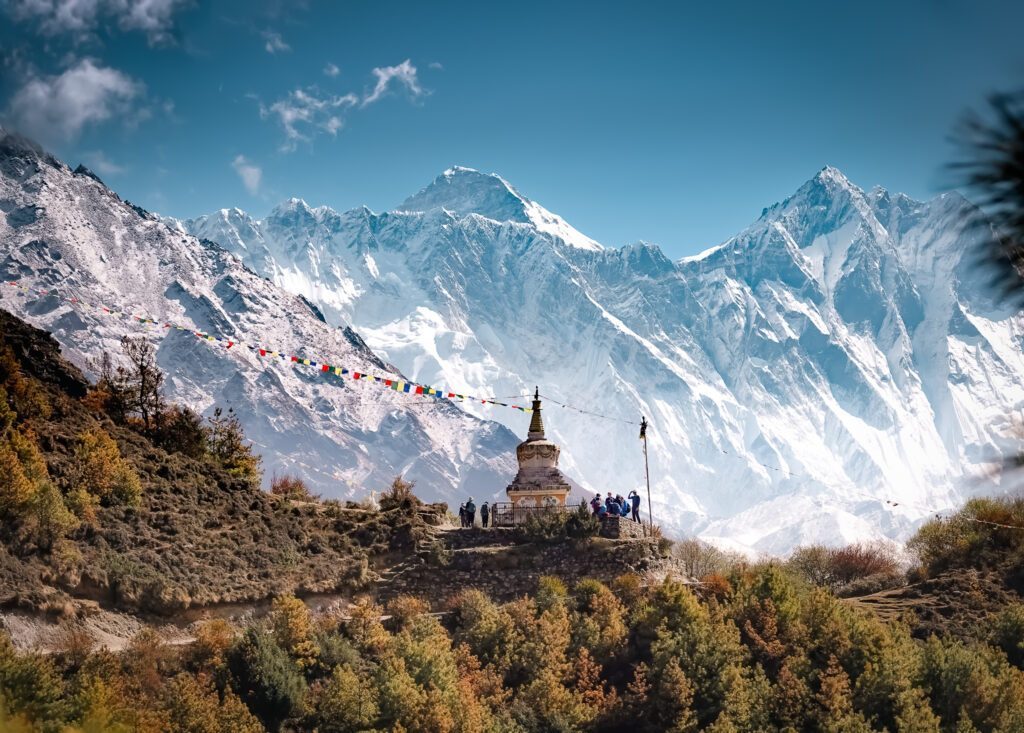
GOKYO LAKES TREK
The Gokyo Lakes Trek is a 16-day guided circuit through the quieter western Khumbu, reaching Gokyo village at 4,756 metres, Gokyo Ri at 5,357 metres and, when conditions allow, Renjo La at about 5,360 metres. It is a challenging, non-technical high-altitude trek for well-prepared walkers who want lakes, glaciers and broad Everest views rather than Base Camp itself. The trip includes acclimatisation, tea houses, meals, porters, permits and one helicopter sector between Kathmandu and Lukla.
Curated by Rami Rasamny Reviewed by Shiva Raj Bastakoti
Fly back from Gokyo Lakes
Add a helicopter return from Gokyo Lakes to Lukla for £1,800 per passenger on any public or private Gokyo Lakes departure.
After completing the normal opportunity to climb Gokyo Ri for sunset, you leave the standard trekking group the following morning. You fly from Gokyo Lakes to Lukla and continue to Kathmandu on the trip’s included Lukla–Kathmandu sector. A seasonal aircraft change may be required in Pheriche.
This changes the planned trip length from 16 days to approximately 12 days. Mountain aviation remains weather dependent, so the shortened end date cannot be guaranteed.
Choose a departure and add at checkoutHow weather, baggage and refunds work
Still weighing up the routes? Use our Nepal trek chooser to compare Gokyo with EBC, Three Passes and other Nepal treks by duration, altitude, terrain and accommodation.
Traveller fit: Best for well-prepared walkers who want a challenging, non-technical high-altitude circuit with long days, Gokyo Ri and, when conditions allow, Renjo La. This trip is not suitable for: anyone unwilling to train for sustained ascent and descent, use trekking poles on the steep Renjo La descent, accept simple tea houses, or remain flexible when altitude, weather or route conditions change the plan.
Looking beyond Gokyo? Our Nepal progression guide explains how to assess your trekking experience before a climbing objective. Record the route you actually completed, your recovery and altitude response; a high pass does not demonstrate glacier or rope competence.
CHECK IT OUT
ISLAND PEAK EXPEDITION
Island Peak is a 20-day guided first Himalayan climbing expedition combining an Everest Base Camp approach, two technical training days, a reserve summit day and a 6,189-metre summit attempt. It suits very fit trekkers ready to learn crampon, fixed-rope and glacier systems, but it remains a serious climb affected by altitude, weather and route conditions. If you already have stronger technical foundations, compare the Lobuche East expedition.
Curated by Rami Rasamny Reviewed by Lakpa Tsheri Sherpa
For a broader view of your next step, use our Nepal trek and peak chooser to compare Island Peak, Mera and Lobuche East alongside trekking routes by duration, terrain and traveller fit.
Traveller fit: Best for fit, well-prepared first-time mountaineers who are ready for repeated trekking days, altitude above 6,000 metres, glacier travel, fixed ropes, a steep headwall, an exposed summit ridge and a long descent. This trip is not suitable for: an untrained trekker, anyone unwilling to use crampons and fixed ropes after the included training, or anyone who needs a guaranteed summit or fixed end date.
Before choosing Island Peak, check the experience and skills gates in our Nepal progression guide. It explains how trekking experience, practical rope training, altitude response and descent competence inform a fresh guide assessment.
CHECK IT OUT


LOBUCHE EAST EXPEDITION
Lobuche East is a 19-day guided 6,119-metre climbing expedition approached through Everest Base Camp and Kala Patthar. It is a demanding progression for fit trekkers or climbers with strong high-altitude experience who are ready for crampons, fixed ropes, steep snow and exposed mixed terrain. The itinerary includes acclimatisation, technical training, high camps, contingency days and one helicopter sector between Kathmandu and Lukla. Read the complete Lobuche East climb guide or compare Island Peak and Lobuche East before choosing.
Curated by Rami Rasamny Reviewed by Lakpa Tsheri Sherpa
Still deciding whether to trek or climb next? Use our Nepal trek and peak chooser to compare Lobuche East with Island Peak, Mera and trekking routes by time commitment, terrain and traveller fit.
Traveller fit: Best for strong trekkers progressing into mountaineering. First-time mountaineers should join only if they are fit, already have high-altitude trekking experience and will prepare for sustained endurance; technical training is provided before the climb. This trip is not suitable for: an untrained trekker, anyone without prior high-altitude trekking experience, anyone unwilling to use crampons, an ice axe, fixed ropes and abseiling, or anyone needing a guaranteed summit or fixed end date.
Use our Nepal progression guide to review the Lobuche East experience gates, including high-altitude trekking, exposed terrain, rope transitions and descent competence. A lower quoted summit does not make it an easier next step.
CHECK IT OUT
MANASLU EXPEDITION: A GUIDED 8,163M CLIMB IN NEPAL
INQUIRE NOW
Curated by Rami Rasamny Reviewed by Lakpa Tsheri Sherpa
Traveller fit: Best for experienced high-altitude expedition mountaineers with multiple 6,000-metre expeditions, proven high-camp self-management, fixed-line and glacier competence, and a documented altitude history. Acceptance depends on a review of your recent expedition record and readiness. This trip is not suitable for: a first high-altitude expedition, a first 6,000-metre objective, anyone needing to learn basic rope systems during the trip, or travellers who need a guaranteed summit, rescue outcome or fixed operating schedule.
Assessing Manaslu as a future objective? Our Nepal progression framework sets out the expedition experience gates, including repeated high camps, dependable climbing systems and recovery through rotations. Ama Dablam is neither a compulsory step nor sufficient preparation on its own; discuss any 7,000-metre or equivalent experience requirement with the team.
CHECK IT OUT


AMA DABLAM EXPEDITION: A GUIDED TECHNICAL CLIMB IN NEPAL
INQUIRE NOW
Curated by Rami Rasamny Reviewed by Lakpa Tsheri Sherpa
Traveller fit: Best for experienced mountaineers with recent competence on steep rock, snow and ice, fixed ropes and independent abseiling, plus prior high-altitude expedition experience. Acceptance depends on a review of your recent climbing history and readiness. This trip is not suitable for: first-time mountaineers, anyone without recent fixed-line, crampon, abseil and high-altitude experience, or travellers who need a guaranteed summit or fixed operating schedule.
Preparing for Ama Dablam? Our Nepal progression framework explains the technical development required beyond a first 6,000-metre expedition. Review recent rock, snow and ice climbing, efficient descents and high-altitude experience with the guide team; one summit does not establish readiness.
Planning your expedition? Read our Ama Dablam climbing guide for a 25-day itinerary summary, experience requirements and how the application and quotation process works.
CHECK IT OUT