From Nepal treks to Himalayan climbs
Use your trekking experience to plan the skills, training and decisions behind your next mountain.
Completing Everest Base Camp, Annapurna Base Camp or Gokyo gives you useful experience to build on. Choosing a Himalayan climb means looking at how you coped, what you can demonstrate and what still needs practice.
Compare Island Peak, Lobuche East and Mera by their different demands, then explore the separate preparation needed for Ama Dablam and Manaslu. Every transition needs a fresh guide assessment. A completed trek or summit never guarantees readiness for the next objective.
Still choosing your first trek? Start with the Nepal trek chooser.
Start with the experience you have
Find the description closest to your recent mountain experience. It points to a useful conversation, not an acceptance decision.
| Your experience | What to examine | A useful next step |
|---|---|---|
| ABC or a first multi-day Himalayan trek | Recovery, descent, pacing and response to altitude | More mountain days or introductory climbing skills |
| EBC, Gokyo or comparable altitude trekking | The full ascent and return, symptoms and any support needed | Skills training and assessment for a matched 6,000m objective |
| A first 6,000m expedition | What you managed reliably, including the descent and camp routines | Consolidate skills across further climbs and conditions |
| Recent technical alpine climbing and altitude expeditions | Rock, snow, ice, rope transitions and efficient descents | A route-specific discussion about Ama Dablam |
| Repeated high-altitude expeditions and high camps | Recovery through rotations, self-care and dependable climbing systems | Review gaps with the Manaslu team; a 7,000m expedition or equivalent is preferred and may be required |
A map of possible next steps
Height is only one part of the commitment. The three 6,000m peaks are alternatives, and the two advanced branches develop different capacities.
Base camp · about 4,130m
Consecutive days, steps and recovery
Base camp · about 5,364m
Sustained altitude and a long return
Gokyo Ri · about 5,357m
Long days and steep descents
Mountain log · rope and glacier skills · fitness and recovery · altitude history · judgement
Reliable descent, technical movement, high-camp routines and decisions in varied conditions
05A · Technical development
Ama Dablam6,812m as published by LHO
Established rock, snow and ice competence, plus relevant high-altitude expedition experience
05B · Expedition development
Manaslu8,163m
Repeated 6,000m expeditions and high camps; 7,000m or equivalent preferred and may be required
At every stage: assess, train again, change the objective, postpone or turn back.
Elevations identify the named objectives. They are not difficulty scores, sleeping altitudes or a complete account of route maximums. Arrows show possible development, never automatic eligibility.
Download the one-page progression map (PDF)
Read the progression in five steps
- Build mountain-day experience: ABC, EBC or Gokyo. Record the experience, including descents and any illness.
- Learn and demonstrate climbing systems: supervised snow, ice, glacier and rope training; guide review of fitness, altitude history and judgement.
- Choose a matched 6,000m objective: Island Peak, Lobuche East or Mera. This is a choice between demands, not an altitude ranking.
- Consolidate across further climbs: repeat technical movement, high-camp living and reliable descent in varied conditions. A single successful expedition is a limited sample.
- Follow the relevant advanced branch: technical alpine climbing and expedition experience for Ama Dablam; repeated high-altitude expeditions, preferably including a 7,000m expedition or equivalent, for Manaslu.
At every gate, the outcome can be continue to assessment, train and reassess, choose a different objective, postpone or turn back. Arrows describe possible development, never automatic eligibility.
What your trek tells you
Annapurna Base Camp
ABC reaches about 4,130m. LHO’s itinerary includes five consecutive walking days with substantial stone steps and ascent and descent. It is a useful place to learn pacing, equipment management and recovery. It does not provide the same altitude exposure as a Khumbu trek, or evidence of glacier and rope competence. LHO ABC itinerary
Your next decision: If ABC used all your physical reserves, focus on hill endurance and consecutive-day recovery before adding a climbing objective. If you coped well, review your experience with a guide and choose appropriate skills training; additional high-altitude trekking may be the more useful next step.
Everest Base Camp
EBC reaches about 5,364m. LHO describes a non-technical trek with planned acclimatisation days. Completing it can reveal how you eat, sleep, pace yourself and recover on a long high-altitude journey. Walking to Base Camp does not demonstrate competence on the climbing terrain above it. LHO EBC itinerary
Your next decision: Review both the ascent and the return. Keep an honest log of sleeping elevations, symptoms, assistance and recovery. Any peak extension needs its own selection, training and on-trip assessment.
Gokyo Lakes
LHO’s Gokyo route reaches Gokyo village at about 4,756m, with Gokyo Ri at 5,357m and a conditional Renjo La crossing around 5,360m. Long, steep descents add a different test of balance and endurance. A high pass is not evidence of technical mountaineering skill. LHO Gokyo itinerary
Your next decision: Record what you actually completed. Gokyo Ri, Renjo La and Cho La are distinct objectives; do not assume that every Gokyo itinerary includes each one. If exposure, descending or recovery was difficult, address that gap before a technical climb.
The bridge from trekking to climbing
Before choosing a peak, bring five parts of your preparation into the conversation. These are questions for assessment with the guide team; LHO’s current trip requirements still apply.
Experience. Supply a recent mountain log: route, date, days out, highest point, highest sleeping elevation, carried load, support received, symptoms and turnaround decisions. Include unsuccessful attempts. Show that you can descend under control after a demanding day and recover for another day.
Technical skills. Learn with a qualified instructor. The relevant skills include fitting and checking equipment, crampon footwork, ice-axe use, moving as part of a roped glacier team, following the team’s crevasse procedures, ascending fixed ropes with an ascender, managing transitions and descending with the agreed abseil system. Practise with the gloves, boots and pack you will use. This is a syllabus, not a set of rope-work instructions.
Assessment. Ask the instructor to record which tasks you can perform reliably, which still need prompting and what terrain was used. Classroom attendance or a course certificate alone does not show that the skills remain reliable in cold, fatigue or exposure. Introductory instruction before Nepal is a prudent way to identify gaps; Adventure Consultants also recommends an introductory course for novices on its Island Peak, Mera and Lobuche East programmes. Operators’ entry requirements differ.
Fitness. Build sustained uphill work, controlled descent, leg and trunk strength, balance and recovery across consecutive days. Progressively practise with the expected personal load. Agree the terrain, duration, ascent, descent and load of a preparation outing with your guide or coach; there is no single running time, gym score or weekly mileage that establishes mountain readiness. LHO training guidance
Judgement. You must be willing to report symptoms, accept coaching, stop before reserves are exhausted and follow turnaround decisions. A plan is not ready if it only works when every flight, training session, acclimatisation day and summit window goes perfectly.
Choose the 6,000m objective by its demands
Compare the terrain and preparation behind each name. Confirm the route, intended summit and current requirements with the team.

Island Peak
The change from trekking: glacier travel, steep snow or ice, fixed ropes, an exposed summit ridge and a long descent. The route can change; crevasse crossings and any ladder requirements must be confirmed for the departure.
Who should consider it: LHO offers this as a first Himalayan climbing expedition for very fit, prepared trekkers, with previous high-altitude trekking strongly recommended and technical instruction included. Prior climbing is not presented as a universal booking requirement. Arriving with practised basics gives the guide more to assess than willingness alone.
Before you go higher: after training, can you use the team’s ascent and descent systems reliably and maintain safe movement and reserve? If essential skills or altitude response are inadequate, more instruction or a trekking-only outcome is appropriate. Included training days do not guarantee progression to summit day.
Explore LHO Island Peak and its preparation requirements. Route context: Adventure Consultants Island Peak.

Lobuche East
The change from trekking: steep snow, exposed mixed terrain, crampons, fixed ropes and abseiling. Its lower quoted summit altitude does not make it easier than Island Peak. Neither peak has a fixed difficulty that holds across every season and route condition.
Who should consider it: LHO requires strong previous high-altitude trekking experience and very high fitness. Its itinerary teaches climbing skills, so a carefully assessed first mountaineer may be accepted. Greater confidence on exposed terrain and practised rope transitions provide a stronger foundation.
Before you go higher: the guide must be satisfied with footwork, exposure tolerance and descent competence before committing higher. Confirm the intended summit and turnaround point in writing: an itinerary named Lobuche East is not a guarantee of reaching the true summit. Never relabel an earlier stopping point as that summit.
Explore LHO Lobuche East and its preparation requirements. Independent programme context: Adventure Consultants Lobuche East.

Mera Peak
The change from trekking: a remote approach, roped glacier travel, crevasses, cold, high camp and a long summit effort. Less sustained technical climbing on the usual route does not make Mera a walk or a low-risk climb.
Who should consider it: LHO can consider very fit first-time mountaineers and strongly recommends previous high-altitude trekking. Essential glacier skills are taught. Choose Mera for a matched combination of expedition endurance and glacier learning, not because it sits above Island Peak in an imagined ladder.
Before you go higher: assess glacier movement, cold management, recovery and reserve for the descent. Confirm the specific summit, route and fixed-line requirements with the guide; sources and operators do not always use the same Mera summit labels.
Explore LHO Mera and its preparation requirements. Glacier and programme context: Adventure Consultants Mera.
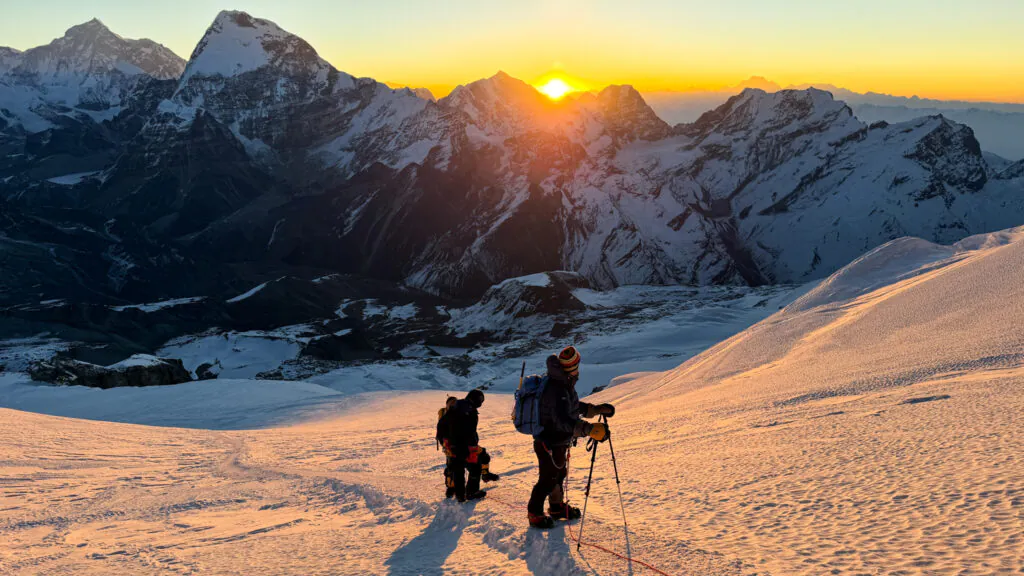
Photography: Life Happens Outdoors. Images illustrate the journeys; they do not establish current route conditions.
Consolidate before either advanced branch
Use the debrief after a 6,000m expedition to identify what the summit result conceals. Did the guide repeatedly manage your equipment? Did you lose control of footwork on descent? Could you eat, drink and look after yourself in camp? Did you recover between efforts? What happened when plans changed?
A further course, a repeat objective or a lower mountain with more relevant terrain can provide better development than immediately seeking a higher summit. Build a record of reliable movement, high-camp routines and sound decisions in more than one setting. The guide assessing the next expedition decides whether the experience is relevant and recent enough.
Ama Dablam
Ama Dablam’s normal southwest ridge demands established climbing ability on exposed rock, snow and ice. LHO requires recent technical and high-altitude expedition experience, with competent fixed-rope use and independent abseiling. It is not an introductory climb. LHO Ama Dablam requirements
What to show your guide: present recent technical alpine routes, efficient transitions and descents, comfort climbing in boots with a pack, and relevant high-altitude climbing. A rock grade achieved indoors cannot stand in for those combined demands. As an operator-specific comparison, Adventure Consultants asks for comfort on alpine AD routes and/or AUS15/US5.7 rock, together with steep rock and hard-ice skills and prior climbing around 6,000m. This is not an LHO acceptance threshold. Adventure Consultants preparation criteria
What to work on: develop technical rock, snow and ice skills on progressively appropriate terrain. LHO’s Chamonix rock course addresses part of that skill set; its Matterhorn Course is an advanced alpine option for climbers who meet that course’s own prerequisites. Neither is an automatic qualification for Ama Dablam.
Decision point: the lead guide reviews current route hazards, exposure, pace, weather and descent margins. Experience can support a decision to climb; it cannot remove falling-ice, rockfall or other objective hazards. Published elevations differ between sources; this framework uses LHO’s 6,812m and does not resolve the survey discrepancy.
Manaslu
Manaslu is an 8,000m expedition, not the Manaslu Circuit trek. LHO expects multiple multi-day 6,000m expeditions, high-camp experience and existing glacier and fixed-line competence. A 7,000m expedition or equivalent is strongly preferred and may be required after technical review. LHO Manaslu requirements
What to show your guide: demonstrate repeated high-camp living, recovery across rotations, reliable systems under cold and fatigue, and willingness to abandon the objective. Review altitude history, health information, recent training and oxygen-system experience with the expedition team. Ama Dablam is neither compulsory nor sufficient: technical climbing and extreme-altitude expedition experience develop different capacities.
What to work on: consolidate expedition skills over further seasons and select an intermediate expedition to address the actual gap. Adventure Consultants emphasises broad climbing skills, camp craft and self-care, and prefers previous ascents of 6,000-7,000m peaks. These are operator-specific criteria; they do not replace LHO’s requirements. Manaslu preparation criteria
Decision point: obtain the departure’s written oxygen, backup, staffing, communications, turnaround and evacuation arrangements before acceptance. Oxygen and guide support cannot replace missing experience or eliminate avalanche, crevasse, severe altitude-illness and rescue risks. Decisions are renewed through rotations and the summit window; rescue may be impossible.
Altitude is a separate gate
Altitude reviewed by Lakpa Tsheri Sherpa.
Fitness does not protect you from altitude illness, and a previous good response does not guarantee the same response on a new itinerary. Record sleeping elevations as well as maximum elevations. Acclimatisation depends on the current ascent and individual response, not a lifetime tally of high points.
For travel above 3,000m, CDC guidance generally limits the increase in sleeping elevation to about 500m per day and includes an extra acclimatisation day for each additional 1,000m. A high-altitude expedition needs a specific plan from its guide and medical team; this guidance is not a formula that certifies an itinerary as safe.
Report symptoms promptly. Do not ascend higher while experiencing altitude-illness symptoms. Worsening symptoms at the same altitude require descent. Confusion, loss of coordination or breathlessness at rest require urgent action: alert the guide, arrange assisted descent and emergency medical care. Discuss individual health concerns and any medication with a clinician experienced in altitude medicine. CDC Yellow Book: high-altitude travel and altitude illness
Five decisions before and during the trip
- Before booking: review the mountain log, health information, current skills and preparation time. Agree whether the objective fits and what evidence is still needed.
- Before departure: complete the agreed training, equipment check and relevant insurance verification. Confirm the exact route, intended summit, support model and contingency arrangements.
- After practical training: demonstrate the essential systems on appropriate terrain. If competence is missing, train again or change the objective.
- During the approach and rotations: reassess symptoms, pace, recovery, weather and route hazards. A booked itinerary does not require the group to move higher.
- Before and during the summit attempt: use the guide’s departure-specific turnaround criteria. Deteriorating conditions, inadequate reserve or an unsafe descent prospect can end an attempt even close to the summit.
These five gates are this framework’s editorial structure. They do not prescribe operating procedures for an expedition leader.
Assumptions to leave behind
These shortcuts leave out part of the assessment.
EBC completed → Island Peak approved.
Trekking experience is one input; technical competence and current altitude response remain separate.
Lobuche is lower → it is easier.
Terrain, conditions and descent demands matter more than a small height difference.
Mera is less technical → no climbing skills needed.
Glacier travel and cold high camps still require preparation.
One 6,000m summit → Ama Dablam.
The technical experience gap needs deliberate work and assessment.
Ama Dablam completed → Manaslu.
A technical achievement does not establish readiness for an 8,000m expedition.
High fitness, oxygen or a guide → safe outcome.
None removes the mountain’s hazards or guarantees rescue.
Fewer itinerary days → more efficient progression.
Removing acclimatisation, training or contingency can remove necessary margins.
Find the next useful step with LHO
If you are still choosing your first Nepal trek, start with the Nepal trek chooser. For a trekking foundation, compare ABC, EBC and Gokyo. For preparation, read fitness versus acclimatisation and high-altitude preparation.
LHO’s Mont Blanc Summit Course combines introductory alpine skills and acclimatisation with a conditional summit objective. It has its own fitness and acceptance requirements; discuss whether its syllabus addresses your gap. Advanced climbers can discuss the rock and Matterhorn courses linked above.
Bring your mountain log to an LHO Adventure Specialist and ask: “What evidence would you need to recommend this objective, and what should I work on first?” For current trip details, use the Nepal trip hub and individual trip pages. Availability, route plans and entry requirements can change.
What should you work on first?
Bring an Adventure Specialist your mountain log, recent training and the experience you want from Nepal. Ask what the guide team would need to see before recommending your chosen objective.
How this framework was checked
The research uses LHO’s published trip requirements and connected trip records, primary operator descriptions for comparison, and CDC altitude guidance. The progression gates are an editorial synthesis, not a validated risk score or an industry-wide standard. Differences between operators are retained rather than combined into invented universal prerequisites. No success rates, readiness percentages or claims of risk elimination are made.
Mountaineering content, including climbing routes, technical skills and progression, and the altitude section were reviewed by Lakpa Tsheri Sherpa. Trekking content, including ABC, EBC and Gokyo, was reviewed by Shiva Raj Bastakoti. Recheck before each Nepal season and whenever a route, incident, medical guideline or LHO programme changes.