Which Nepal Trip Is Right for You?
The right Nepal trip depends on whether you want a first adventure, a non technical Himalayan trek, your first summit or an advanced expedition. Choose Find Yourself in Nepal for culture and a softer introduction. Choose Mardi Himal or Annapurna Base Camp for a first trek. Choose Everest Base Camp for the iconic Khumbu journey, or Gokyo Lakes for a quieter route with exceptional views. Island Peak can be considered alongside Lobuche East and Mera Peak for a first Himalayan climb, depending on your preparation and guide assessment. The three peaks have different demands; Ama Dablam and Manaslu require further relevant mountaineering experience.
Use the comparison below to find the experience that fits your time, fitness and mountain background. For a closer look at duration, altitude, difficulty, accommodation and seasons, use our Nepal trek chooser to compare five treks and three peak progressions. If you are unsure, speak to an Adventure Specialist. We would rather help you select the right challenge than push you towards the biggest one.
Find the Nepal Trip That Fits You


START HERE
START WITH THE JOURNEY YOU WANT
MY FIRST MEANINGFUL NEPAL ADVENTURE
Choose Find Yourself in Nepal for culture, movement, reflection and connection rather than a high-altitude objective.
MY FIRST HIMALAYAN TREK
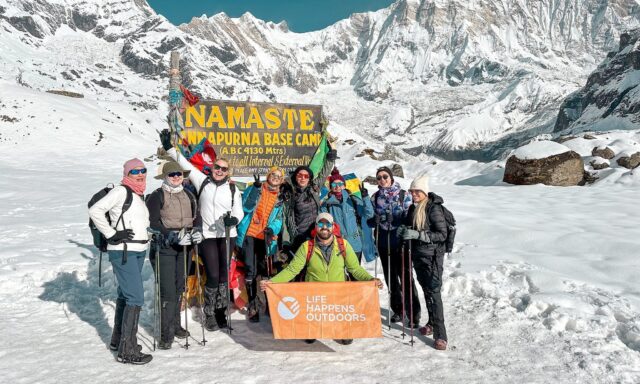
Choose Mardi Himal for a compact ridge trek or Annapurna Base Camp for a classic sanctuary journey.
AN ICONIC HIGH-ALTITUDE JOURNEY
Choose Everest Base Camp for the classic Khumbu route or Gokyo Lakes for quieter trails, turquoise lakes and a high pass.
A HIMALAYAN SUMMIT
Compare Island Peak, Lobuche East and Mera Peak by terrain, skills and altitude demands. Each needs guide assessment; Ama Dablam and Manaslu require separate, further preparation.
Compare Life Happens Outdoors Nepal Trips
This table is designed for selection, not detailed research. Trip pages remain the source of truth for current itinerary, dates, prices, inclusions and booking.
| Trip | Best for | Days | Experience | Next step |
| Find Yourself in Nepal | Culture, movement and a softer first Nepal adventure | 8 | Beginner | Explore trip |
| Annapurna Base Camp | A shorter classic base camp trek for active first timers | 8 | First trek | Explore trip |
| Mardi Himal | A compact first trek with forests, ridges and close mountain views | 9 | First trek | Explore trip |
| Everest Base Camp | The iconic Khumbu journey with sustained high altitude | 16 | Prepared trekker | Explore trip |
| Gokyo Lakes | A quieter Everest region trek with lakes and a high pass | 16 | Prepared trekker | Explore trip |
| Island Peak | A first serious Himalayan summit after strong trek preparation | 20 | First climber | Explore trip |
| Lobuche East | A more demanding 6,000 metre progression via Everest Base Camp | 19 | Progressing climber | Explore trip |
| Mera Peak | A remote expedition focused on altitude, scale and endurance | 21 | Progressing climber | Explore trip |
| Ama Dablam | A technical Himalayan objective for experienced climbers | 25 | Advanced climber | Explore trip |
| Manaslu | A fully supported 8,000 metre objective for experienced mountaineers | 45 | Expedition climber | Explore trip |
Would You Rather Trek or Climb?
Choose a Nepal trek
A Nepal trek follows established mountain trails and does not require technical climbing skills. The challenge comes from consecutive walking days, steep ascents and descents, simple mountain accommodation and altitude. Trekking is the right pathway if you want the rhythm of the trail and the scale of the Himalayas without a summit objective.
Choose a Nepal climb
A Nepal climb adds a summit objective, technical equipment, colder and more exposed terrain, and a greater need for mountain judgement. Some expeditions teach new skills, but none should be treated as simply a harder trek. Island Peak is one possible first Himalayan climb for prepared trekkers; Lobuche East and Mera Peak offer different technical, altitude and expedition demands; Ama Dablam and Manaslu are advanced expeditions. Your altitude history, confidence with exposure and preparation time matter as much as general fitness.
If you are deciding between the two most accessible Everest region peaks, compare Island Peak and Lobuche East before choosing.
When Is the Best Time to Visit Nepal?


SEASONAL FIT
CHOOSE THE SEASON THAT FITS THE OBJECTIVE
SPRING, MARCH TO MAY
Warmer days, flowering forests and a strong season for many treks and climbing objectives.
AUTUMN, LATE SEPTEMBER TO NOVEMBER
Clearer post-monsoon skies, crisp air and the most popular period for classic trekking.
WINTER, DECEMBER TO FEBRUARY
Quieter trails and colder conditions. Best considered for selected lower or shorter routes.
MONSOON, JUNE TO EARLY SEPTEMBER
More rain, cloud and disruption on many routes. Specialist itineraries need route-specific advice.
Planning for the final month of autumn? Read our Nepal trekking in November guide for weather, trail changes, route considerations and current departures.
Choose by Experience Level


YOUR PROGRESSION
YOUR NEXT STEP, NOT SOMEONE ELSE’S
START WITH NEPAL
Choose Find Yourself in Nepal for culture, movement and support without a major altitude objective.
BUILD TREKKING CONFIDENCE
Choose Mardi Himal or Annapurna Base Camp, then progress to Everest Base Camp or Gokyo Lakes.
MOVE INTO CLIMBING
Compare Island Peak, Lobuche East and Mera Peak as different options. Choose only after reviewing your mountain history, skills and preparation with the guide team.
PURSUE AN ADVANCED EXPEDITION
Ama Dablam is for experienced technical climbers. Manaslu is for experienced high-altitude mountaineers.
Why travel to Nepal with Life Happens Outdoors?
A premium Nepal journey is shaped by what happens before departure, who makes decisions on the ground and how a team responds when the original plan needs to change. This is the evidence behind the LHO approach.
A DECADE IN NEPAL
EXPERIENCE BUILT ON THE GROUND
SINCE 2016
Life Happens Outdoors has been taking community members to Nepal since 2016.
FIRST HAND LEADERSHIP
Founder Rami Rasamny has led and coordinated LHO teams across the Annapurna and Everest regions, from first trekking experiences to serious Himalayan expeditions.
RELATIONSHIPS THAT GROW OVER TIME
We continue to work with trusted local professionals and communities across the Annapurna and Everest regions. Familiarity strengthens communication, accountability and care.
JUDGEMENT BEFORE OUTCOME
Experience does not mean every journey follows the original plan. It means understanding when to continue, when to adapt and when the responsible decision is to turn back.
How your Nepal trip is supported
Local mountain expertise, an LHO Team Leader and Base Camp support each have a distinct role. They work as one team throughout the journey.
Local Nepal expertise
Experienced local trekking and climbing guides lead the route, interpret current conditions and manage the mountain specific elements of each journey. Technical expeditions add specialist high altitude climbing guides appropriate to the objective.
Your LHO Team Leader
Your Team Leader supports communication, daily briefings, group rhythm and individual check ins. They work alongside the local team so practical decisions and the human experience remain connected.
LHO Base Camp support
Before and during the trip, our Base Camp team coordinates preparation, equipment guidance, accommodation, permits, transport and operational changes. This support remains active when weather, flights or individual circumstances alter the plan.

SAFETY THROUGH DESIGN
ACCLIMATISATION, CONTINGENCY AND CLEAR DECISIONS
ACCLIMATISATION BUILT INTO THE ROUTE
There is no way to remove the risks of altitude. Our itineraries use gradual progression, steady pacing, planned acclimatisation and regular check ins. Higher objectives add technical training, recovery time, guide assessment and objective specific contingency. Fitness, previous altitude experience and planned acclimatisation do not guarantee adaptation or summit success.
DECISIONS MADE FROM THE FULL PICTURE
Weather, terrain, visibility, altitude response, team energy, transport, timing and safe turnaround options all shape decisions. The responsible response may be a slower pace, an additional recovery period, an adjusted route, an earlier descent or turning back.
DISRUPTION PLANNING
Every Life Happens Outdoors Nepal trip that uses Lukla includes one helicopter sector between Kathmandu and Lukla, with the direction decided according to weather and airport operations. These itineraries also retain their published buffer and bad weather contingency days.
NO FALSE PROMISES
These systems improve flexibility and decision making. They do not guarantee flights, routes, summits or an uninterrupted itinerary.
The people behind every Nepal journey
Experience is not only measured in years or summits. It is visible in the people an operator chooses to work with, and how those people are treated.
Long term local relationships
Our guides, porters, drivers and coordinators are not an anonymous supply chain. LHO works repeatedly with trusted local professionals and invests in the relationships behind our Annapurna and Everest journeys.
Porter and guide welfare
LHO commits to porter-protection guidance from the International Porter Protection Group (IPPG), as reproduced by the UIAA, and the UIAA Mountain Worker Initiative. Our commitment covers carrying loads, fair pay, equipment, food, shelter, medical care and insurance. Read our Nepal porter-welfare commitment. The 12 kg duffel allowance on our Everest Base Camp and Mera Peak trips is per guest; it is not a porter’s total carrying limit.
Climbing bonuses and discretionary tips
On our Mera Peak expedition, the trip price includes a summit bonus for the climbing guides. This is separate from porter pay. Additional tips for trekking guides and other staff are discretionary and are not included. Check your chosen expedition’s inclusions for its bonus arrangements.
Our Nepal porter-welfare commitment
Life Happens Outdoors commits to the IPPG porter-protection guidelines reproduced by the UIAA and the UIAA Mountain Worker Initiative principles. We apply this commitment through our Nepal operating partners.
- Carrying loads: IPPG gives 30 kg as the Nepal upper ceiling, with loads adjusted to individual capacity, altitude, trail and weather. Under LHO’s policy, the ceiling counts guest bags, shared equipment and the porter’s personal kit together. A lower limit applies whenever the individual or conditions require it. We commit to weighing and recording complete loads before departure and after changes, and redistributing excess weight.
- Equipment, food and shelter: We commit to suitable clothing, footwear and eye protection; dedicated overnight shelter and sleeping equipment; meals, safe drinking water and access to warm drinks appropriate to the route and season.
- Medical care and insurance: Our commitment includes the same standard of care expected for guests and life, medical and evacuation insurance suited to the worker’s role, route, altitude and season.
- Illness or injury: A worker must be assessed before an illness-related departure. Anyone needing descent must be accompanied by someone who understands their condition and speaks their language, with arrangements and funds for rescue and treatment.
- Fair pay and working conditions: We commit to fair agreed wages that provide a living without relying on tips, transparent terms, compensation for additional work, adequate rest and relevant training.
Guest baggage: The 12 kg duffel allowance on our Everest Base Camp and Mera Peak trips is each guest’s allowance. It is separate from the total-load ceiling above.
Commitment adopted: 15 September 2026. References: UIAA Medical Commission guidance, Appendix 2 (2012), and UIAA Mountain Worker Initiative principles (2021). For Nepal-based porter education and clothing-bank resources, see Kathmandu Environmental Education Project (KEEP).
Support for first time trekkers
Many people arrive in Nepal having never completed a major trek before. We begin with honest trip selection, looking at your fitness, experience, available preparation time, altitude history and confidence in mountain environments.
We then support you with training guidance, equipment advice, pre trip briefings, sustainable pacing and regular check ins. Previous technical experience is not normally required for our trekking trips.
Himalayan climbing expeditions are different. Some teach introductory skills, but they still require stronger preparation and must be matched to your fitness, altitude background and intended objective.
How to read our evidence
Our Nepal porter-welfare commitment describes the standards LHO commits to applying. Traveller reviews and community stories describe individual experiences; they do not establish a first-timer completion rate or an independent audit of every departure. Open the commitment and the official Life Happens Outdoors Trustpilot profile to assess these sources alongside the current trip’s support, inclusions and preparation requirements.
What our Nepal community says
Independent feedback and first hand stories offer a useful view of how the planning, support and group experience feel in practice.
LHO took care of all the logistics seamlessly.
We had come here as eight unique individuals and journeyed to this amazing place together as one.
It honestly felt like being taken care of by family in the middle of the Himalayas.
Read current independent feedback.
Ratings and review totals remain on Trustpilot so this page does not hardcode figures that can change.
Experience you can trace
These sources document early Nepal journeys, the founder story and a first hand account of Himalayan decision making.
Early Nepal community stories
Read Mosig’s 2017 Annapurna story and Kerry’s account of travelling with LHO in Nepal.
Founder experience in public
Rami and the Life Happens Outdoors story have been profiled by Entrepreneur Middle East and Esquire Middle East.
Himalayan judgement in practice
Read Rami’s first hand account for the Adventure Travel Trade Association about conditions, financial incentives and turning back on Ama Dablam.
Who owns and reviews these facts
Nepal route, local team, welfare, inclusion and prerequisite details are checked against current partner information and live commercial trip pages. Lakpa reviewed the hub’s Nepal mountaineering claims within his professional scope.
Operational facts last checked: 7 August 2026. Mountaineering review completed: 3 September 2026.
Continue Your Nepal Research
- You want a mountain journey but have no route in mind
- Use the Nepal trek chooser to compare time, terrain, altitude and commitment
- You are choosing between the two base camps
- Read ABC versus EBC: which trek is harder?
- You need to match the season to your plans
- Read the best time to visit Nepal and check the chosen trip’s actual departures
- ABC is your shortlist and you want a complete budget
- Use the Annapurna Base Camp cost guide
- You have an itinerary and need to check insurance
- Work through the Nepal trekking insurance checklist with your insurer
- You are considering a Himalayan summit
- Open the relevant climbing trip and discuss your skills, altitude history and preparation with the team
Support helps you prepare and respond to the journey; it does not remove the physical work or guarantee mountain conditions. Choose an experience you want to commit to, then use the team around you to prepare honestly.
For more detail, compare Island Peak and Lobuche East, guided and independent EBC trekking, getting to Annapurna Base Camp and progressing from Nepal treks to Himalayan climbs.
Nepal Trip FAQs
What is the best Nepal trip for a first timer?
Choose Find Yourself in Nepal for the gentlest entry. Active first-time trekkers can consider Mardi Himal or Annapurna Base Camp. Everest Base Camp is also possible for a well-prepared first timer, but it is longer and involves more sustained altitude.
Should I choose Annapurna Base Camp or Everest Base Camp?
Choose Annapurna Base Camp for a shorter first base camp trek with less overall altitude exposure. Choose Everest Base Camp for the iconic longer journey through the Khumbu. Read the full comparison before deciding.
Is Gokyo Lakes better than Everest Base Camp?
Neither is universally better. Everest Base Camp suits people motivated by the iconic destination. Gokyo Lakes suits people who prefer turquoise lakes, a quieter route and wide mountain views. Both require strong fitness and high-altitude preparation.
Which Nepal climb is best for a first Himalayan summit?
Island Peak, Lobuche East and Mera Peak may be considered by appropriately prepared first-time Himalayan climbers, subject to their different requirements. Lobuche East needs strong prior high-altitude trekking experience; Mera adds remoteness and altitude. Compare terrain, technical skills and recovery with a guide before choosing. No completed trek automatically establishes readiness.
Do I need previous climbing experience for Nepal?
Not for Mardi Himal, Annapurna Base Camp, Everest Base Camp or Gokyo Lakes. Climbing expeditions are different. Some teach new skills, while Ama Dablam and Manaslu require substantial previous experience. The commercial page for each climb sets the current entry requirements.
STILL NOT SURE WHICH NEPAL TRIP IS RIGHT FOR YOU?
Tell us how much time you have, what walking or climbing you have done recently and what draws you to Nepal. Speak to an Adventure Specialist and we will help you understand which journey fits your next step.
SPEAK TO AN ADVENTURE SPECIALIST
Choose the right challenge for your experience, available time and ambition.
BOOK A FREE CALL