Mountains & Peaks | BY Rami Rasamny | PUBLISH DATE: August 19 2025 | READ TIME: 12 mins | UPDATED DATE: September 09 2026
Island Peak vs Lobuche East: Which Is Right for You?
DOWNLOAD YOUR Lobuche East Expedition GUIDEBOOK
Choose Island Peak if this will be your first technical Himalayan climb and you want a structured introduction to glacier travel, crampons and fixed ropes. Choose Lobuche East if you already have strong high altitude trekking or alpine experience and want steeper, more exposed climbing on mixed terrain. For most first time Himalayan climbers, Island […]
Choose Island Peak if this will be your first technical Himalayan climb and you want a structured introduction to glacier travel, crampons and fixed ropes. Choose Lobuche East if you already have strong high altitude trekking or alpine experience and want steeper, more exposed climbing on mixed terrain. For most first time Himalayan climbers, Island Peak is the better first choice. Lobuche East is the stronger progression peak.
If you are also considering Mera Peak or another trek before climbing, compare Nepal treks and peak progressions by time commitment, terrain and the skills each journey asks of you.
Both are serious summits above 6,000 metres. Neither is simply a trek, and neither should be chosen by height alone.
Lobuche East is the permitted trekking summit of Lobuche Peak. Its higher neighbour, Lobuche West at 6,145 metres, is a full expedition climb and is not compared here.
Island Peak vs Lobuche East at a glance
| Comparison | Island Peak | Lobuche East |
| Best for | Fit trekkers taking their first step into Himalayan climbing | Experienced trekkers or progressing climbers seeking a sharper technical challenge |
| Overall recommendation | Best first Himalayan peak for most people | Best progression peak for people with a stronger mountain background |
| Technical character | Glacier travel, fixed ropes and a steep summit headwall | Mixed rock, snow and ice with steeper, more exposed fixed rope sections |
| Main physical challenge | A long summit day after a substantial approach | Sustained movement on steeper ground, followed by a long descent |
| Exposure | Present on the headwall and summit ridge | Generally greater, especially on the upper mountain |
| Previous experience | Strong trekking fitness is essential. Previous altitude experience is highly valuable | Previous high altitude trekking is strongly recommended. Alpine movement experience is a clear advantage |
| LHO itinerary | 20 days through the Everest Base Camp trail | 19 days via Everest Base Camp or Gokyo Lakes and Cho La Pass |
| Mountain atmosphere | The classic introduction to a Himalayan expedition | A quieter and more technical progression into Himalayan mountaineering |
The key difference is simple. Island Peak introduces more people to the systems of Himalayan climbing. Lobuche East asks you to use those systems with greater confidence on steeper and more exposed terrain.
Who should choose Island Peak?
Island Peak is the better choice if you are a fit trekker who wants to move beyond walking trails and experience a genuine Himalayan climbing expedition.
You do not need to arrive as an expert mountaineer. You do need the endurance for consecutive mountain days, the discipline to train consistently and the willingness to learn. During the climbing phase you will use crampons, an ice axe, a harness and fixed ropes. You will also move across glacier terrain and climb a steep headwall before reaching the summit ridge.
Island Peak is likely to suit you if:
- You have completed a demanding trek or regularly spend long days in the mountains.
- This will be your first climb above 6,000 metres.
- You want technical training to form part of the expedition.
- You are comfortable learning new systems while tired, cold and at altitude.
- You want to combine the Everest Base Camp trail with a summit objective.
The label introductory does not mean easy. It means the normal route provides a logical first step from trekking into mountaineering when it is supported by a suitable itinerary, training and experienced guides.
For a detailed look at the approach, summit route and expedition logistics, read the Island Peak climb guide.
If Island Peak is becoming your preferred choice, the Island Peak training guide explains how to prepare your endurance, strength and movement skills.
Who should choose Lobuche East?
Lobuche East is the better choice if you already know how you respond to sustained mountain effort and want your first or next Himalayan peak to feel more technical.
The upper mountain combines rock, snow and ice. The climbing involves fixed ropes, careful foot placement and a greater sense of exposure. Lobuche East is not reserved for elite climbers, but it gives less room for uncertainty than Island Peak. Strong fitness alone is not enough. You should also be able to remain calm, listen precisely and move with balance when the terrain feels steep or airy.
Lobuche East is likely to suit you if:
- You have completed a high altitude trek such as Everest Base Camp, Gokyo Lakes or Kilimanjaro.
- You have some experience using crampons, an ice axe or fixed ropes, or you are willing to gain that experience before departure.
- You are comfortable with scrambling and exposure.
- You want a more technical mountain rather than the most accessible first peak.
- You value a choice of approach through Everest Base Camp or the more remote Gokyo Lakes and Cho La Pass route.
If you have never completed a multi day trek, have no altitude experience and feel unsure around exposure, Lobuche East is probably too large a first step. That is not a judgement on your ambition. It is a reason to build the foundation that will make the climb more meaningful.
The complete guide to Lobuche East explains the route, preparation and mountain environment in more detail.

Which is harder, Island Peak or Lobuche East?
Lobuche East is generally harder in technical terms because its upper route is steeper, more exposed and more varied. Island Peak can feel harder in endurance terms because its summit day is long and includes glacier travel followed by the headwall. Conditions, team pace and your own strengths can change how either mountain feels.
This comparison page owns the relative question of which peak is harder. For a complete explanation of Island Peak on its own, including summit day, beginner suitability and the reasons people struggle, read the Island Peak difficulty guide.
Altitude and endurance
Both peaks rise above 6,000 metres, so the small difference in their published elevations should not decide your choice. At this height, normal movement becomes slower and small tasks require more effort. Your itinerary, acclimatisation and pacing matter more than which summit is listed slightly higher.
Island Peak has a long summit journey from Base Camp. You move over rocky ground, cross glacier terrain, climb the headwall and reverse the route on descent. It rewards steady endurance and the ability to keep working through a long night and morning.
The LHO Lobuche East route starts its summit push from a higher camp. The ascent is shorter in distance, but the terrain is steeper and more technical. The descent continues far down the valley, so the day still demands concentration and resilience.
Exposure and confidence
Exposure describes the feeling of being on steep or open ground where the space below or beside you is obvious. It is not the same as danger, but it can affect how calmly and efficiently you move.
Island Peak has exposure on the headwall and summit ridge. For many first time climbers, this is their first experience of moving on steep fixed ropes at altitude.
Lobuche East usually feels more exposed. Its mixture of icy rock, snow slopes and an airy upper mountain makes balance and composure especially important. If you already know that exposure makes you freeze or rush, Island Peak may offer the more suitable introduction.
Technical difficulty
Technical difficulty refers to the movement skills and equipment needed to climb the route. It is separate from fitness.
Both mountains can involve:
- Crampons, which are metal points fixed to your boots for grip on snow and ice.
- An ice axe for balance and security.
- A harness and safety attachments.
- Fixed ropes secured on steeper sections of the mountain.
- A jumar, which is a device that slides up a rope and locks when weighted.
- Controlled rope descents where required.
Island Peak concentrates much of its technical climbing around glacier travel and the summit headwall. Lobuche East introduces more mixed terrain and asks for stronger balance and footwork across a larger proportion of the upper route.
This is why Lobuche East is normally considered the more technical choice even though Island Peak may be listed slightly higher.
How the climbing experience differs
The Island Peak experience
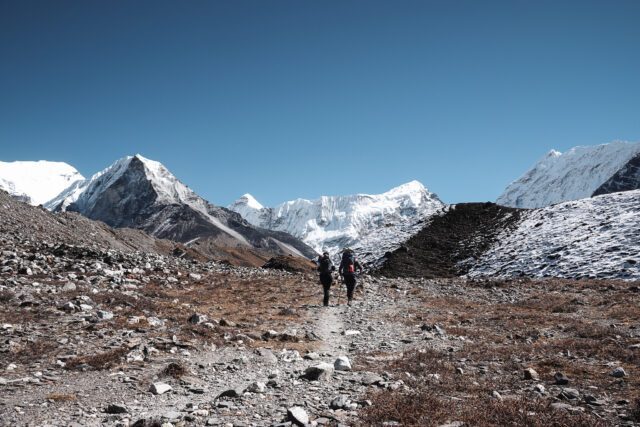
Island Peak creates a clear transition from trekking into mountaineering. The approach follows the Khumbu through villages, tea houses and the Everest Base Camp trail. The climbing phase then changes the rhythm. You move into tents, check equipment, practise technical skills and prepare for a midnight departure.
On summit day, rocky slopes lead to crampon point and the glacier. The route through the glacier can change with current conditions. Guides manage the line, rope systems, crossings and spacing. The headwall is the final sustained technical section before the summit ridge.
For a first time climber, the variety is part of the value. The expedition teaches you that mountaineering is not one dramatic move. It is a series of small, careful decisions made while managing fatigue and altitude.
The Lobuche East experience
Lobuche East feels more like a direct progression into technical Himalayan climbing. The approach can follow the classic Everest Base Camp route or pass through Gokyo Lakes and Cho La Pass before reaching the Lobuche camps.
Above camp, the terrain becomes steeper. Icy rock, snow slabs and consecutive fixed rope sections require deliberate footwork. The best movement comes from your legs and balance rather than pulling on the rope with your arms. This is more efficient and leaves you with greater control.
The mountain suits people who are excited by that precision. It is less suitable for someone who mainly wants a high summit and hopes the guide or rope will do the technical work for them.
The environment and sense of journey
Island Peak gives you the classic Everest region progression. You trek through the Khumbu, visit Everest Base Camp, build technical skills and then attempt a separate summit. It is varied, recognisable and particularly powerful for someone entering the Himalayas for the first time.
Lobuche East offers two distinct approaches. The Everest Base Camp route carries the history and energy of the classic trail. The Gokyo Lakes and Cho La Pass route feels more remote and varied. Both lead to a mountain with a sharper technical character.
If your priority is the broadest first Himalayan experience, Island Peak has the advantage. If your priority is the more technical climbing objective, Lobuche East has the advantage.
Can you combine Everest Base Camp with Island Peak or Lobuche East?
Yes. Both peaks can form part of a longer Everest region journey, but the way they fit into the itinerary is different.
The current Life Happens Outdoors Island Peak Expedition uses the Everest Base Camp trail and includes the option of Kala Patthar before the team continues towards Chukhung and Island Peak Base Camp. The trekking journey provides time in the Khumbu and progressive altitude exposure before the technical climbing phase begins.
Lobuche East can be approached through the classic Everest Base Camp and Kala Patthar route or through Gokyo Lakes and Cho La Pass. The Everest Base Camp option creates the most recognisable combination. The Gokyo option replaces that classic sequence with a quieter valley, glacial lakes and a high pass crossing before the Lobuche camps.
Adding a summit should not be treated as a shortcut to acclimatisation or as a small extension to an ordinary trek. The itinerary needs enough time for progressive altitude exposure, technical preparation, camp logistics and weather contingency. Fitness cannot guarantee acclimatisation, and visiting Everest Base Camp does not make either summit automatic.
Use the Island Peak climb guide and Lobuche East climbing guide for route depth. Use the live expedition pages for the current day by day itineraries, dates and inclusions.
For preparation depth, use How to Train for Island Peak and How to Train for Lobuche East.
A four question decision framework
1. Have you already been to high altitude?
If no, choose Island Peak only if you have a strong mountain background and a well paced itinerary, or complete a high altitude trek first.
If yes, continue to the next question.
2. Have you used crampons, an ice axe or fixed ropes?
If no, Island Peak is usually the better introduction.
If yes, Lobuche East may provide the stronger progression.
3. How do you respond to exposure?
If you are uncertain, Island Peak is generally the more suitable first step.
If you remain calm on steep, open ground, Lobuche East becomes a realistic option.
4. What do you want the mountain to teach you?
Choose Island Peak if you want to learn how a Himalayan expedition works.
Choose Lobuche East if you want to sharpen technical movement and confidence on more demanding terrain.
Final recommendation
For most fit trekkers choosing their first Himalayan peak in Nepal, we recommend Island Peak. It offers a clearer introduction to glacier travel, technical equipment, fixed ropes and expedition life while still demanding serious preparation and effort.
Choose Lobuche East if you have already completed a substantial high altitude trek, feel comfortable on exposed terrain and actively want the more technical objective. It is a better progression peak, and it can also be the right first Himalayan summit for someone who arrives with a strong alpine background.
The wrong way to choose is by asking which mountain sounds more impressive. The right way is to ask which mountain gives you the appropriate next step from where you are now.
Explore the expeditions
Island Peak Expedition
A carefully acclimatised 20 day journey through the Everest Base Camp trail, with technical training, Island Peak Base Camp and a guided summit attempt above 6,000 metres.
Lobuche East Expedition
A 19 day Himalayan climbing journey with a choice of approach through Everest Base Camp or through Gokyo Lakes and Cho La Pass, followed by technical training and a guided Lobuche East summit attempt.

Frequently asked questions
Which is better, Island Peak or Lobuche East?
Island Peak is better for most first time Himalayan climbers because it provides a structured introduction to glacier travel, fixed ropes and technical equipment. Lobuche East is better for experienced trekkers or progressing climbers who want steeper, more exposed and more varied climbing.
Is Lobuche East harder than Island Peak?
Lobuche East is generally harder technically because it involves steeper and more exposed mixed terrain. Island Peak can still be extremely demanding because of altitude, glacier travel and a long summit day. The harder mountain for you will depend on whether endurance, exposure or technical movement is your weaker area.
Is Island Peak suitable for beginners?
Island Peak can suit a first time mountaineer, but not a complete outdoor beginner. You still need strong endurance and experience of long mountain days. Read the Island Peak difficulty guide for the full beginner suitability assessment.
Can a beginner climb Lobuche East?
A first time Himalayan climber can climb Lobuche East if they already have strong high altitude trekking or alpine experience. It is not a suitable starting point for someone who has never completed a multi day mountain journey or who is unprepared for steep and exposed terrain.
Do I need mountaineering experience for Island Peak or Lobuche East?
You do not need to be an expert for either guided expedition, but experience changes which peak is appropriate. Island Peak is the more suitable place to learn the core systems. Lobuche East is better when you already have some familiarity with crampons, fixed ropes, scrambling or exposed mountain terrain.
Which peak has the better Everest views?
Lobuche East generally offers the more open view towards Everest and the surrounding Khumbu peaks. Everest itself is largely blocked from the Island Peak summit by the much closer wall of Lhotse. Island Peak still provides exceptional views of Lhotse, Ama Dablam and the surrounding valleys and glaciers.
Can Island Peak or Lobuche East be combined with Everest Base Camp?
Yes. The LHO Island Peak itinerary includes the Everest Base Camp trail as part of the acclimatisation journey. Lobuche East can also be approached through Everest Base Camp and Kala Patthar, or through Gokyo Lakes and Cho La Pass. Combining a trek with a peak creates a more gradual journey from trail walking into mountaineering.
What Comes Next
Once you have chosen the right peak, the next decision is how to combine the approach trek, acclimatisation journey and summit phase. A longer itinerary is not wasted time. It is where your body adapts, your confidence grows and the mountain becomes part of a complete experience rather than a single summit attempt.
The next question is how to combine an Everest region trek with a 6,000 metre peak, including the differences between an Everest Base Camp approach, a Gokyo Lakes approach and a dedicated climbing itinerary.
If you are still deciding between trekking and climbing objectives, use the Nepal trekking and mountaineering hub to compare how these peaks fit within the wider Nepal progression.
If you would rather make the decision with an expert now, speak to us and tell us what you have already done, what concerns you and what you want from the experience. We will help you choose your peak and build the right path towards it.
Ready to choose the right Himalayan peak?
Tell us what you have already climbed, your previous altitude, how you train and how you feel about exposure. We will help you choose the objective that matches your experience.
This article was reviewed for Nepal mountaineering accuracy by Lakpa Tsheri Sherpa, a senior Nepalese high-altitude guide and Nepal Mountaineering Association-registered Sardar (Registration No. 592).
CONTINUE YOUR RESEARCH



ABOUT THE AUTHOR

Rami Rasamny
Rami Rasamny is the founder of Life Happens Outdoors, a premium adventure travel company that uses the outdoors as a catalyst for human transformation. His work brings people into the mountains not only for challenge, but for clarity, confidence, and connection. He believes that when people answer the call to adventure truthfully, they come back different.