









Trip Planning for Treks & Climbs | BY Rami Rasamny | PUBLISH DATE: November 03 2026 | READ TIME: 9 mins | UPDATED DATE: November 03 2026
Joining the Tour du Mont Blanc Solo: What to Expect in a Small Group
DOWNLOAD YOUR Guided Tour du Mont Blanc Trek GUIDEBOOK
Joining the Tour du Mont Blanc without a companion does not mean hiking alone. Learn how LHO small group pacing, briefings, shared meals, rooming and personal space work on a guided TMB departure.
Yes, you can join the Tour du Mont Blanc without bringing a friend or partner. On an organised small group trip, you book as an individual but hike within a guided team. The route still asks for fitness, preparation and several demanding days on foot. What changes is that you arrive to a planned itinerary, professional guidance and a group that begins the journey together. You do not need to arrive with a ready made social circle, and you are not expected to be sociable every minute.
Solo traveller is not the same as solo hiker
Joining the TMB solo can mean two very different things. An independent solo hiker manages the route, accommodation, weather decisions, navigation and daily pacing alone. A solo traveller on a guided departure joins without a companion but walks within an organised group. This article is about the second experience.
If you are deciding whether to walk independently, read Is the Tour du Mont Blanc Safe for Solo Hikers?. It covers the additional judgement, planning and risk management involved when you are responsible for the journey yourself. For broader questions about joining any LHO trip alone, including the general room sharing policy, see Solo Adventure Holidays.
What the first day feels like
The first day is often the part people imagine most. You may be wondering whether everyone else will arrive with a companion, whether conversation will feel forced, or whether you will be the least experienced person in the room. Group composition varies, so LHO cannot promise a particular age mix, number of solo travellers or social outcome. What it can provide is a shared starting point.
On the current LHO Tour du Mont Blanc itinerary, the group meets for an evening dinner and briefing hosted by the Team Leader and lead guide. Gear checks also take place on arrival day. That structure matters. Instead of having to introduce yourself without context, everyone has the same practical questions to answer: what the next day involves, what to carry, how the group will move and what to expect from the route.
You can make the arrival easier by sharing anything the team should know before the briefing. That might be a dietary requirement, a rooming need, concern about pace or a question about the kit list. Raising it early gives the team a chance to respond calmly and privately.
How connection develops on the trail
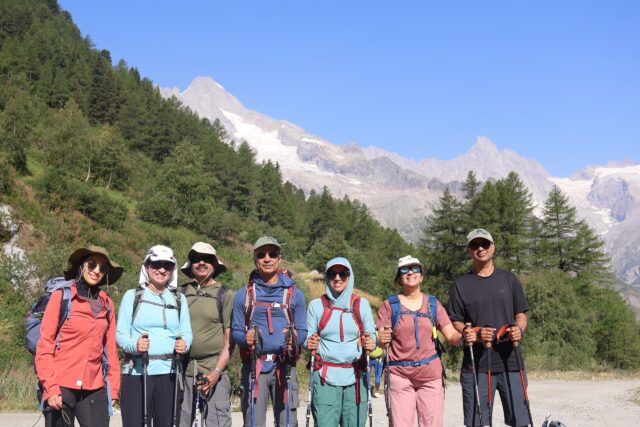
A small group trek creates repeated, low pressure opportunities to get to know people. You eat together, listen to the same briefing, climb the same pass and meet again at regroup points. Conversation has somewhere natural to begin because the group is sharing a real task.
That does not mean every group becomes close, or that you need to join every conversation. Some people talk readily from the first morning. Others settle in gradually or enjoy quiet stretches of walking. Both approaches can fit a respectful group. The useful expectation is not instant friendship. It is a shared rhythm in which connection has room to develop without being demanded.
Shared meals are an important part of that rhythm. On LHO’s current TMB programme, meals are included, and several nights use mountain accommodation where communal routines are part of the experience. A long day gives the table something genuine to talk about, but you can still step away, rest or have an early night when you need space.
The Team Leader, guide and group each have a role
The professional guide leads the route and the mountain specific decisions. The LHO Team Leader supports the wider experience through communication, check ins, group rhythm and practical care. These roles overlap in making the trip coherent, but they are not interchangeable.
For someone arriving alone, the Team Leader provides a clear person to approach if something feels awkward or uncertain. You do not need to solve every concern through the group. If you are nervous about the first hiking day, struggling to settle into a rooming arrangement or unsure how the next stage works, say so. Calm communication gives the team a better chance to help.
What group pacing means on the TMB
Guided group pacing is not a race led by the fastest walker. The guide and Team Leader establish a workable rhythm, use regroup points and monitor how the day is unfolding. That does not remove the physical challenge. You still need the preparation to handle repeated climbs and descents over several days.
People naturally move at different speeds on steep ground. A well managed day allows the group to spread within a controlled structure, then come together at appropriate points. The practical goal is a safe and steady team day, not identical spacing or a promise that nobody will ever feel stretched.
If pace is your main worry, describe your recent walking honestly before booking. Useful details include the longest hilly walk you have completed, how you manage sustained descents and whether you have walked on consecutive days. The live trip page owns the current itinerary and requirements, so compare your experience with the Guided Tour du Mont Blanc Trek rather than relying on a generic label.
Room sharing, huts and personal space
Rooming is the practical detail most worth clarifying before you pay. LHO’s general policy is twin sharing, normally pairing an individual traveller with another participant of the same sex. If you want to share and LHO cannot find a roommate, the general policy says LHO covers the extra room cost rather than charging you a supplement solely because a roommate was unavailable.
A private room can sometimes be requested in hotels, but a request is not a confirmation. Availability, cost and the nights covered can vary. Mountain huts are different from hotels. Shared sleeping rooms and shared bathrooms are common, and sleeping areas may not be divided by gender. Private rooms may not exist on those nights.
The current LHO itinerary combines hotel nights with selected mountain huts, so do not assume one rooming arrangement applies to the whole trip. The TMB accommodation, meals and luggage guide explains the living experience in more detail. Confirm the exact arrangement for your chosen departure before booking, especially if privacy, accessibility, sleep or gender related rooming is important to you.
Different ages, backgrounds and comfort levels
The shared point in a TMB group is the trip, not a guaranteed demographic. Participants may differ in age, profession, nationality, hiking experience and reasons for coming. Some may be travelling alone. Others may arrive as a pair. The current LHO product page says most groups typically range from 10 to 12 people, but the composition and final size of a particular departure must be confirmed on the live page or with LHO Base Camp.
You do not need to match everyone socially to belong on the trip. A better question is whether you are comfortable contributing to a considerate team: arriving on time, listening at briefings, communicating your needs and giving other people room to have their own experience.
If you are slower or nervous
Nerves before a major trek are not evidence that you will hold the group back. They are a reason to get specific. Are you worried about the fitness requirement, exposed terrain, keeping up, sharing a room or meeting new people? Each concern needs a different answer.
For fitness, use recent walking evidence and the current itinerary. For accommodation, confirm the room basis and hut nights. For the social side, remember that the group has a structured first meeting and repeated shared routines. If you need a little quiet time, say so without apology. Personal space and group participation can coexist.
A guided trip can reduce the burden of organising the route and daily logistics, but it does not make the walking easy. If your preparation is not yet sufficient for the itinerary, the responsible answer may be to train longer or choose a different departure. The Tour du Mont Blanc planning guide can help you understand the route before deciding.
Solo women in a guided group
The guided group experience should not be described through assumptions about what women want or fear. The useful questions are practical and individual: Who leads the trip? How are hotel rooms allocated? Which hut nights use mixed shared sleeping? Who should you contact if you are uncomfortable? What privacy can and cannot be provided?
LHO’s general rooming policy normally pairs individual travellers with another participant of the same sex in twin rooms, while mountain hut dormitories may not be gender segregated. Confirm the arrangement for the specific departure. Questions about walking the route independently belong in the separate solo hiker safety guide, because that is a different decision from joining a supported group.
Questions to ask before booking
A useful booking conversation is concrete. Ask about the departure you are considering, not an imaginary average group.
| Question | Why it matters | What to confirm |
|---|---|---|
| What is the room basis? | Hotel and hut nights may use different arrangements. | Twin sharing, hut dormitories, bathrooms and any mixed shared sleeping. |
| Can I request a private room? | A request may cover only certain hotel nights. | Availability, price, nights included and whether the request is confirmed. |
| What happens if no roommate is available? | This affects whether an extra room cost applies. | The current LHO policy for your departure and room type. |
| How does the group first meet? | A clear first meeting reduces arrival uncertainty. | Briefing time, dinner plan, gear check and arrival instructions. |
| How is pace managed? | Fitness and group rhythm both affect your week. | Daily demands, regroup points, guide approach and the experience you should have before joining. |
| Who supports non-technical concerns? | You may want a private conversation about nerves, rooming or group dynamics. | The Team Leader’s role and how to raise a concern during the trip. |
| How much personal space is realistic? | Meals and huts are communal, but constant socialising is not required. | Shared routines, quiet time and any personal requirement that must be arranged in advance. |
Who is likely to enjoy joining alone
Joining alone can suit someone who wants the challenge of the TMB but prefers not to organise every stage independently. It can also suit a traveller who values company without needing a constant social programme. The strongest fit is not a particular personality type. It is someone prepared for the walking, open to a varied group and willing to communicate clearly.
It may be a poor fit if you need guaranteed private accommodation every night, a guaranteed demographic, a fixed friendship outcome or complete control over the day’s pace. Those are not failures. They are useful preferences to recognise before booking.
Your next step
Read the live Guided Tour du Mont Blanc Trek for the current itinerary, dates, group information, inclusions and requirements. Then contact LHO Base Camp with the departure you are considering and the questions that matter to you. A clear answer about fitness, rooming and group routine is more useful than a promise that joining alone will feel a particular way.
CONTINUE YOUR RESEARCH





DISCOVER MORE ADVENTURES


ABOUT THE AUTHOR

Rami Rasamny
Rami Rasamny is the founder of Life Happens Outdoors, a premium adventure travel company that uses the outdoors as a catalyst for human transformation. His work brings people into the mountains not only for challenge, but for clarity, confidence, and connection. He believes that when people answer the call to adventure truthfully, they come back different.