EARLY BIRD! Moderately Challenging France, Italy and Switzerland
TRIP TYPE
Trekking

DURATION
8 Days

DESTINATION
France, Italy and Switzerland
LHO’s Tour du Mont Blanc is an eight-day guided journey with six selected walking stages and planned transport connections. You walk through contrasting sides of the Mont Blanc massif, cross mountain passes and share the experience with your group. This itinerary is not a continuous full circuit on foot: transfers connect parts of the route, allowing the journey to focus on the selected mountain stages described below.
Our all inclusive Life Happens Outdoors Tour du Mont Blanc delivers a world class hut to hut trekking experience across the French, Italian and Swiss Alps. We curate the route to showcase the most stunning sections of the TMB, including Lac Blanc, Val Veny and Champex Lac, giving you the highlights many standard itineraries miss. Your journey combines high mountain huts with charming Alpine villages, offering both authentic adventure and comfortable rest. Included meals add a memorable culinary touch throughout the trek. This is one of our most popular LHO adventures, known for its thoughtful pacing, spectacular viewpoints and community driven atmosphere that sets it apart from typical Tour du Mont Blanc packages. The original overview was reviewed by Lucía Guichot Martín, AMM trekking guide and IFMGA mountain guide, on 23 August 2026. Meet the qualified Tour du Mont Blanc trekking guides who work with LHO.
1
Experience the most spectacular sections of the Tour du Mont Blanc, including Lac Blanc, Val Veny and Champex Lac.
2
Enjoy a fully supported guided Tour du Mont Blanc with curated hut to hut routes and seamless logistics from start to finish.
3
Stay in a combination of high mountain huts and charming Alpine villages for an authentic and comfortable TMB trekking experience.


2027
DATE & STATUS
PRICE
AVAILABILITY
WHAT'S INCLUDED IN THIS TRIP
WHAT'S NOT INCLUDED IN THIS TRIP
SELECTED WALKING STAGES — ITINERARY OVERVIEW
The summary below sets out the walking stages in the published itinerary. Distances and ascent/descent are the page’s planning figures, not measurements of the transport sections. The guide may adapt the plan to conditions and group needs; your trip information will identify any scheduled alternative.
Day 2 — L’Index–Lac Blanc–Argentière area
Walking distance: 8.5 km · Ascent / descent: 148 m / 1,299 m
Transport: Public transport and lifts access the walking start
Day 3 — Le Tour–Col du Balme–Trient
Walking distance: 13 km · Ascent / descent: 832 m / 1,019 m
Transport: A bus connects to Le Tour if the group stayed in Argentière
Day 4 — Trient–Bovine–Champex Lac
Walking distance: 14 km · Ascent / descent: 972 m / 805 m
Transport: The published stage is walked between the overnight areas
Day 5 — La Fouly–Grand Col Ferret–Italian-side descent
Walking distance: 9.8 km · Ascent / descent: 770 m / 788 m
Transport: Private transfer to La Fouly; local bus onward to Courmayeur
Day 6 — Val Veny–Col de la Seigne–French-side descent
Walking distance: 14.4 km · Ascent / descent: 856 m / 790 m
Transport: Bus access at the start and a bus connection to Les Chapieux after the walk
Day 7 — Les Chapieux–Col de la Croix du Bonhomme–Col du Bonhomme–Notre-Dame de la Gorge
Walking distance: 18.65 km · Ascent / descent: 957 m / 1,303 m
Transport: Private transfer from the walking finish back towards Les Houches and Chamonix
The listed stages total approximately 78.35 km of walking, with 4,535 m of ascent and 6,004 m of descent. These are sums of the published stage figures, not a complete TMB circuit distance or a promise that every departure follows an identical line. On selected departures, Day 7 may instead use the Bionnassay–Les Houches stage; the totals above do not describe that alternative. Arrival and departure occupy Days 1 and 8. Prepare for consecutive mountain days and sustained descents as well as the kilometre totals. Our TMB training plan and accommodation guide help you understand the preparation and overnight rhythm.
DAY 1: WELCOME TO CHAMONIX
Our Tour du Mont Blanc experience begins with your arrival in the Chamonix Valley. If you are flying into Geneva airport, our transfer partners will meet you and bring you directly to our hotel in Chamonix. Airport transfers are included between 6:30 am and 7:30 pm, and we ask all community members to share their arrival and departure times with LHO Base Camp in advance.
If you are meeting us at the hotel, your LHO Team Leader will be there to welcome you. Hotel check in starts at 3 pm, but early arrivals are welcome to store their bags and explore the town. Your Team Leader will share suggestions for things to do in Chamonix, a place deeply connected to the history of the Tour du Mont Blanc trek.
If you need to rent or buy trekking gear, plan to arrive early, as most Chamonix outdoor shops close around 7 pm. This ensures you have everything you need before our early start the following morning.
In the evening, we gather for a team dinner and briefing at 7:30 pm, hosted by your Team Leader and lead mountain guide. Gear checks will be completed throughout the day depending on your arrival time.
For more insight into what to expect on the trail and how to prepare, you can explore our Tour du Mont Blanc Planning Guide, which offers helpful context for the journey ahead.
DAY 2: THE SPECTACULAR LAC BLANC
Distance: 8.5 KM | Ascent: 148 M | Descent: 1299 M | Max Altitude: 2,595 M
Our first day on the Tour du Mont Blanc trail begins with one of the most beautiful viewpoints in the Chamonix region. After breakfast, we take public transport to the Flegere cable car and continue up to l’Index, the high point where today’s trekking stage begins. From here, the Mont Blanc massif rises across the valley while the Aiguilles Rouges stand above us, creating a dramatic introduction to the TMB.
We head east toward Lac Blanc on a well marked alpine trail that typically takes around two hours. This is one of the most iconic locations on the Tour du Mont Blanc, known for its turquoise water and striking reflections of the surrounding peaks. Weather permitting, Lac Blanc becomes our picnic stop, offering time to enjoy the scenery and take photos.
After lunch, we begin our long descent toward the valley floor and continue to Argentiere, a peaceful village east of Chamonix. The descent is steady and can be challenging, so trekking poles are recommended for comfort and knee support.
We end the day in Argentiere or nearby Le Tour with hot showers and a well earned dinner, marking a strong start to our Tour du Mont Blanc trek.
DAY 3: OVER THE PASS INTO SWITZERLAND
Distance: 13 KM | Ascent: 832 M | Descent: 1019 M | Max Altitude: 2,201 M
We begin the day with an early bus from Argentiere to Le Tour, allowing us to skip a less scenic road section and start directly on the trail. If we spent the previous night in Le Tour, no transfer is required. From the village, we begin our first major ascent of the Tour du Mont Blanc, climbing steadily toward Col du Balme, the natural border between France and Switzerland.
As we ascend, Mont Blanc rises behind us while the Swiss Alps come into view ahead. The trail passes through open berry fields, grazing pastures and winding paths that offer a constant view of the Le Tour glacier to our right. This section is a favourite for many hikers, with wide panoramas unfolding as we climb. At the mountain pass, we often pause for a coffee break if the weather allows.
A picnic lunch follows in one of the open meadows overlooking the glacier. From Col du Balme, we begin our descent into Switzerland along a forested trail that gradually leads us toward Trient. The pink church of Trient appears as we reach the valley, marking our arrival in this peaceful village surrounded by high alpine walls.
We spend the evening in Trient, a quiet and welcoming stop on the Swiss section of the Tour du Mont Blanc.
DAY 4: FOLLOWING THE BLACK COWS TO THE LAKE
Distance: 14 KM | Ascent: 972 M | Descent: 805 M | Max Altitude: 2,043 M
After breakfast, we begin the day with a steady ascent to Col de la Forclaz. Many Life Happens Outdoors community members look forward to the berry cakes at the café on the pass, so we make this a planned stop whenever the weather allows. After the break, we continue along the trail as it enters a deep forest and rises toward the Bovine region, named for the black cows that graze across these open pastures.
As we approach the high point of the day, the forest opens into wide meadows with sweeping views of the Swiss Alps. We pause here for lunch in a quiet clearing before beginning our descent toward Champex Lac. The descent winds through shaded woodland similar to the previous day, with the forest becoming denser as we approach the valley.
The trail concludes with a gentle incline leading into Champex Lac, a peaceful lakeside village surrounded by mountains and pine forests. This is our final stop in Switzerland on the Tour du Mont Blanc, offering a calm and scenic finish before we cross into Italy the following day.
DAY 5: BUONGIORNO ITALIA!
Distance: 9.8 KM | Ascent: 770 M | Descent: 788 M | Max Altitude: 2,537 M
Our day begins with a one hour private van transfer to La Fouly. We skip this section of the traditional route as it follows the roadside and would require adding an extra day to the itinerary. From La Fouly, we set off through wide open pastures with clear views toward the Grand Col Ferret, the high mountain pass that marks the border between Switzerland and Italy.
As we climb, the pointed summit of Mont Dolent rises above the pass, marking the only peak shared by France, Switzerland and Italy. Behind us, the Swiss Italian summit of Grand Combin dominates the horizon, while ahead the dramatic walls of the Italian side of Mont Blanc begin to appear. This is one of the most memorable panoramic transitions on the Tour du Mont Blanc.
The descent from the col is steep in places but manageable at a steady pace. As we drop into Italy, the landscape changes and the language shifts from bonjour to buongiorno. At the base of the descent, a small Italian refuge offers our first espresso on the Italian side of the TMB.
We follow the trail for another hour before taking a short local bus ride to Courmayeur. Our hotel in the heart of this stylish mountain town is a welcome treat after three full days of trekking. The afternoon is a chance to rest, explore, and enjoy the coffee, gelato and Aperol spritzes Courmayeur is known for. Dinner is hosted by your LHO Team Leader and guide at a local Italian restaurant.
DAY 6: THE INCREDIBLE VAL VENY
Distance: 14.4 KM | Ascent: 856 M | Descent: 790 M | Max Altitude: 2,516 M
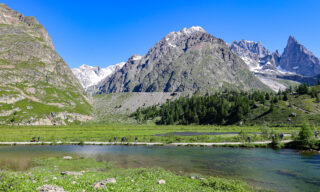
This day is a favourite among our LHO Team Leaders and one of the most scenic stages of the Tour du Mont Blanc. It offers sweeping views of the Italian side of Mont Blanc and brings us through forests, open pastures, mountain streams and glacier fed lakes. After breakfast, we take a short bus ride west and reach the trail quickly, following a rushing river through dense woodland.
As we ascend, the trees thin and the valley opens, revealing the southern slopes of the Mont Blanc massif. The rivers and lakes here are fed directly by glacier melt, creating a landscape that feels both wild and peaceful. We cross wetlands and streams before tackling a steady ascent toward Col de la Seigne, the high mountain pass that marks the border between Italy and France. The climb can feel long, but alternating steep and flatter sections make the rhythm comfortable. If the weather allows, we enjoy a picnic at the pass, though it can be windy at the top.
On descent, buongiorno shifts back to bonjour as we re enter France. The trail leads us into the Beaufort region, known for its cheese and wide open alpine valleys. The long winding descent offers views that many consider among the best on the entire Tour du Mont Blanc. At the valley floor, we follow a gentle farming road to a small bus stop and take a short ride to Les Chapieux, our home for the night.
Les Chapieux is a remote hamlet with limited services and no mobile phone coverage, so it is best to inform loved ones ahead of time. Our Base Camp team remains reachable if needed throughout the stay.
DAY 7: THE FINAL WALKING STAGE AND RETURN TO CHAMONIX
Distance: 18.65 KM | Ascent: 957 M | Descent: 1,303 M | Max Altitude: 2,477 M
After breakfast, we return to Les Chapieux, where our final walking stage begins. The trail climbs steadily towards Col de la Croix du Bonhomme before continuing across the high route to Col du Bonhomme, linking the Beaufortain and Les Contamines sides of the massif.
This is the final major mountain stage of our journey around Mont Blanc. Open Alpine terrain, rocky paths and expansive views accompany us as we cross the western side of the circuit. After pausing for our packed lunch, we begin the long descent into the Val Montjoie.
The trail eventually enters the forest and follows the gorge towards the historic church of Notre-Dame de la Gorge. Here, our walking stage ends and a private transfer connects us with Les Houches and the Chamonix Valley, completing our journey around the Mont Blanc massif.
The distance and elevation figures shown above cover the walking stage from Les Chapieux to Notre-Dame de la Gorge only. The transfer back to the Chamonix Valley is not included in the walking distance.
On selected departures, an alternative final stage from Bionnassay to Les Houches may be used. Your trip information will confirm which Day 7 route is scheduled.
Back in Chamonix, warm showers and time to explore await. In the evening, we gather for a celebratory team dinner hosted by your LHO Team Leader, with the first round of drinks on us.
DAY 8: DEPARTURE DAY
Our final day together is dedicated to airport transfers and goodbyes. Breakfast is included at the hotel, and we ask all community members to provide accurate departure details when completing the team details form. This helps ensure a smooth and timely journey back to Geneva airport. Our shared transfers operate for flights departing between 9:30 am and 11:00 pm. If your flight falls outside these hours, we can arrange a private transfer at an additional cost. If your travel plans change, please inform your LHO Team Leader as early as possible so the appropriate arrangements can be made. As the journey comes to a close, take time to reflect on the mountain stages, changing landscapes and people you have shared them with. Across six selected walking days and planned transport connections, the itinerary reveals the French, Swiss and Italian sides of the Mont Blanc massif. It is a journey around the massif, with a defined combination of walking and transfers, rather than a continuous full circuit on foot. For a deeper look at the places visited and the wider history of the route, explore our Tour du Mont Blanc Planning Guide.





OUR COMMITMENT
We are dedicated to ensuring that everyone involved in our services receives a fair living wage in their respective countries. We invest in our team members, fostering upward mobility within the adventure travel industry, expanding educational opportunities, and offering support wherever we can. By joining an LHO adventure you are directly impacting the incredible people and the remote communities that make these life-changing experiences possible.
LEARN MORE
HEALTH & SAFETY GUIDELINES
Safety is central to every Life Happens Outdoors Tour du Mont Blanc experience. The TMB is a well marked route, but it still involves alpine weather, varied terrain and long trekking days. Our AMM certified guides monitor conditions daily, adjust plans when needed and set a steady pace to keep the group safe and comfortable. All LHO leaders are trained in mountain first aid, emergency response and group management, supported by our valley based coordination team for real time updates and logistical assistance. With experienced leadership, thoughtful preparation and clear communication, the Tour du Mont Blanc becomes both a safe and deeply enjoyable journey for trekkers with a good fitness foundation.
LEARN MORE
Doing the Mont Blanc Tour with LHO was a great experience, thanks to Rami, one of the most enthusiastic and encouraging people you could hope to have along with you on a trek :) I highly recommend this trip (and LHO in general)!
Doing the Mont Blanc Tour with LHO was a great experience, thanks to Rami, one of the most enthusiastic and encouraging people you could hope to have along with you on a trek :) I highly recommend this trip (and LHO in general)!
EXPANDRacha Mourtada

I did the TMB circuit and it was a life time experience. LHO team was amazing and exceeded my expectation by putting our needs first. The whole trip from the minute I was picked up from the airport to when I left was full of care, love and excellent service. For me personally, this trip was on my radar since years and LHO made it happen easily and smoothly. LHO had a dynamic way in communicating with the group and keep us posted. I strongly wish and recommend this experience to all my friends and loved ones. Thank you Jad and Rami for your service of excellence.
I did the TMB circuit and it was a life time experience. LHO team was amazing and exceeded my expectation by putting our needs first. The whole trip from the minute I was picked up from the airport to when I left was full of care, love and excellent service. For me personally, this trip was on my radar since years and LHO made it happen easily and smoothly. LHO had a dynamic way in communicating with the group and keep us posted. I strongly wish and recommend this experience to all my friends and loved ones. Thank you Jad and Rami for your service of excellence.
EXPANDHala Salha

Best thing I have ever did in my life. Never regret it!
Best thing I have ever did in my life. Never regret it!
Zainab Alnajar

One of the best experiences I've ever done. A great way to fall in love with mountaineering. LHO was not only a great facilitator of the experience, but the most wonderful company to have on this trip. To more adventures together!
One of the best experiences I've ever done. A great way to fall in love with mountaineering. LHO was not only a great facilitator of the experience, but the most wonderful company to have on this trip. To more adventures together!
EXPANDRay Yafi

Definitely a life changing experience. I have met so many great people on the trail, and got to challenge my physical fitness. The scenery was unreal, like a dream or fairytale. Highly recommend taking this trip, especially with LHO. They are a great human based organization, will definitely join other trips with them.
Definitely a life changing experience. I have met so many great people on the trail, and got to challenge my physical fitness. The scenery was unreal, like a dream or fairytale. Highly recommend taking this trip, especially with LHO. They are a great human based organization, will definitely join other trips with them.
EXPANDHi everyone, I just wanted to take a moment to thank you all for an unforgettable week on the trail, I walked away feeling deeply grateful to have shared the journey with such a wonderful, kind, and supportive group of people. A special thank you to our incredible guides Rand, Bader and Elodie. Your professionalism, passion for the mountains, and genuine care made all the difference. You kept us safe, inspired us to push forward, and helped us appreciate every breathtaking view along the way. Thank you all for the memories, I hope our paths cross again on the trails or beyond.
Hi everyone, I just wanted to take a moment to thank you all for an unforgettable week on the trail, I walked away feeling deeply grateful to have shared the journey with such a wonderful, kind, and supportive group of people. A special thank you to our incredible guides Rand, Bader and Elodie. Your professionalism, passion for the mountains, and genuine care made all the difference. You kept us safe, inspired us to push forward, and helped us appreciate every breathtaking view along the way. Thank you all for the memories, I hope our paths cross again on the trails or beyond.
EXPANDKhawla
Tour du Mont Blanc with Life Happens Outdoors was genuinely transformative. The team was flawlessly professional and organized, yet still warm and encouraging , so I always felt safe enough to push my limits. It’s the perfect environment to test your limits and physical tolerance. Every detail was dialed in, letting us focus on the breathtaking alpine views and the shared challenge. If you’re after real mental + physical growth in a supportive community, look no further.
Tour du Mont Blanc with Life Happens Outdoors was genuinely transformative. The team was flawlessly professional and organized, yet still warm and encouraging , so I always felt safe enough to push my limits. It’s the perfect environment to test your limits and physical tolerance. Every detail was dialed in, letting us focus on the breathtaking alpine views and the shared challenge. If you’re after real mental + physical growth in a supportive community, look no further.
EXPANDAysha Buqais

Unforgettable memories and amazing experience. Professional team taking care of the slightest detail from airport pick up, during the tour, to drop off. I’m already planning my second adventure with LHO.
Unforgettable memories and amazing experience. Professional team taking care of the slightest detail from airport pick up, during the tour, to drop off. I’m already planning my second adventure with LHO.
EXPANDLamia

The great value wasn’t only in the trekking, it was in sharing stories, lessons, motivating others and the inspiration .. Thanks LHO 😊
The great value wasn’t only in the trekking, it was in sharing stories, lessons, motivating others and the inspiration .. Thanks LHO 😊
Aishah
If these selected stages and the supported group experience fit what you want, review the current departures and inclusions above. If your goal is to walk a complete circuit without connecting transfers, compare that ambition with the itinerary before booking. You can read our TMB planning guide or ask LHO about the walking plan for your departure to clarify the choice.
Come for the shared challenge, the changing mountain landscapes and the people beside you. Come back different.
What is the Tour du Mont Blanc?
The Tour du Mont Blanc, often called the TMB, is one of the world’s most famous long distance treks. It circles the entire Mont Blanc Massif through France, Switzerland and Italy, covering about 170 kilometers of alpine terrain. The route features high mountain passes, panoramic ridgelines, glacier-fed valleys and traditional villages, making it a bucket list experience for hikers worldwide.
At Life Happens Outdoors, we offer a curated version of the Tour du Mont Blanc that highlights the most spectacular and rewarding sections of the trail. Our itinerary combines iconic viewpoints, authentic mountain huts and rich cultural moments across all three countries. If you want a full breakdown of the route, terrain and stages, our Tour du Mont Blanc Planning Guide provides an in depth overview.
Are there Luggage Transfer Services on the Tour du Mont Blanc?
Yes. Life Happens Outdoors includes luggage transfer for a supplied 40-litre duffel weighing up to 10 kg between the applicable accommodations. You walk with a daypack containing essentials such as water, food and spare layers.
This support allows you to concentrate on the six mountain walking stages while travelling on a complete journey around the Mont Blanc massif through France, Switzerland and Italy.
When is the best time to hike the Tour du Mont Blanc?
Plan for the main summer trekking season, usually late June to mid-September. July and August generally provide the broadest range of operating huts and transport services. Earlier or later dates need closer checks of snow conditions, service opening dates and daylight. Mountain weather can change throughout the season.
Compare the months in our guide to the best time to hike the Tour du Mont Blanc, then confirm conditions and availability for your chosen dates.
How long is the Tour du Mont Blanc?
Our guided Tour du Mont Blanc programme lasts eight days, with six trekking days. The itinerary includes selected transfers rather than walking every section of the full circuit. See the day-by-day itinerary for the planned distances, ascent and descent. The guide may adapt the route to conditions and the group.
How hard is the Tour du Mont Blanc?
Life Happens Outdoors classifies this supported itinerary as Moderately Challenging. It is a fully supported multi-day Alpine trek requiring good general fitness. Our itinerary uses selected cable cars and transfers to focus on the most rewarding walking sections. Where conditions, schedules and logistics allow, some sections can also be shortened or skipped using local transport.
You should still expect sustained ascents, long descents and consecutive trekking days.
Can I skip parts of the trail and still catch up with the group on the Tour du Mont Blanc?
Where conditions, schedules and logistics allow, some sections can be shortened or skipped using local transport. Your guide will assess the available options during the trip.
Shortened alternatives are subject to operating conditions and transport availability and may involve additional costs. They are operational alternatives, not guaranteed inclusions.
How should I train for the Tour du Mont Blanc?
Preparation should focus on walking endurance, sustained ascent and controlled descending with a daypack.
Guests intending to complete every scheduled walking stage should be comfortable covering about 15 km with approximately 900 m of ascent and 1,000 m of descent, followed by a similar effort the next day. Uphill and downhill hiking, supported by cardiovascular and leg-strength training, is the most relevant preparation.
This benchmark is intended to prepare you for completing all six scheduled walking stages.
For a structured preparation plan, see our Tour du Mont Blanc training plan.
How long does it take to hike the Tour du Mont Blanc?
Walking the traditional Tour du Mont Blanc trail commonly takes around 7–10 days, depending on the route, pace and variations selected.
The Life Happens Outdoors experience runs for eight calendar days and includes six trekking stages. Day 1 is the arrival day, Days 2–7 are trekking days and Day 8 is the departure day.
The itinerary completes a journey around the Mont Blanc massif by linking selected walking stages with cable cars, public transport and private transfers. This allows guests to experience the French, Swiss and Italian sides of Mont Blanc within one fully supported trip.
Compare this supported programme with walking the full Tour du Mont Blanc in six days before choosing your itinerary.
Where does the Tour du Mont Blanc start?
The traditional Tour du Mont Blanc walking trail commonly starts in Les Houches, although the circuit can be joined at several locations.
On the Life Happens Outdoors itinerary, Day 1 is the arrival day. The first walking stage begins on Day 2 at the top of L’Index after travelling to Les Praz and taking the Flégère cable car and L’Index chairlift. The route then walks via Lac Blanc to Argentière.
From there, the journey continues around the Mont Blanc massif through France, Switzerland and Italy, using selected transport connections between the six walking stages.
How does the Life Happens Outdoors itinerary travel around Mont Blanc?
The Life Happens Outdoors itinerary makes a complete journey around the Mont Blanc massif, visiting its French, Swiss and Italian sides.
Six mountain walking stages are linked by selected cable cars, public transport and private transfers. This concentrates the walking on rewarding Alpine sections while allowing guests to experience the changing landscapes, cultures and viewpoints found around Mont Blanc.
The itinerary follows a generally clockwise sequence, and all transport-connected sections are clearly distinguished from the sections completed on foot.
For a comparison of both directions, read our clockwise versus anti-clockwise Tour du Mont Blanc guide.
What sections of the Tour du Mont Blanc does the LHO itinerary cover?
Our itinerary covers all of the most scenic and meaningful sections of the Tour du Mont Blanc, including Lac Blanc, the Aiguilles Rouges balcony trail, Col du Balme, Bovine, Champex Lac, Grand Col Ferret, Val Ferret, Col de la Seigne and Col de la Croix de Bonhomme. We skip a few road heavy or less rewarding segments so the trip remains focused on high quality mountain terrain, panoramic passes and culturally rich areas of France, Italy and Switzerland.
What is the daily distance and elevation gain on the LHO Tour du Mont Blanc?
Walking distance, ascent and descent vary by stage. Please review the day-by-day itinerary for the planned figures and prepare for consecutive mountain walking days. The guide may adapt the route to conditions and the group.
How fit do I need to be for the LHO Tour du Mont Blanc?
Guests intending to complete every scheduled walking stage should be comfortable covering about 15 km with approximately 900 m of ascent and 1,000 m of descent carrying a daypack, followed by a similar effort the next day.
This is a preparation benchmark for completing every stage, not a guarantee of completion. Shortened alternatives remain subject to operating conditions, transport availability and the guide’s assessment.
Do I need previous trekking experience to join the LHO TMB?
Previous trekking experience is helpful but not essential. Many community members complete the LHO Tour du Mont Blanc as their first multi day trek. Our AMM and IFMGA guides set a supportive pace, help with technique and ensure the route remains accessible and enjoyable. Good fitness and a positive mindset matter more than prior long distance trekking experience.
Is September a good time to hike the Tour du Mont Blanc?
Early September can suit hikers seeking cooler conditions and quieter trails. Shorter days, colder weather and possible snow require flexible plans. Hut and transport closing dates vary, so September should not be treated as a guarantee that all services remain open or that the weather will be settled.
Check your departure details and our guide to the best time to hike the Tour du Mont Blanc before choosing dates.
What qualifications do LHO guides have for the TMB?
Life Happens Outdoors works with AMM certified (Accompagnateur en Moyenne Montagne) mountain leaders and IFMGA certified guides. These are the official professional qualifications for guiding in the Alps. Our guides bring extensive experience in mountain safety, navigation, group management and the varied terrain of the Tour du Mont Blanc.
What are the mountain huts like on the LHO Tour du Mont Blanc?
Mountain huts on the LHO route are comfortable and welcoming, offering shared dormitory style rooms, hearty meals and a warm social atmosphere. They provide a genuine alpine experience with stunning views right from the doorstep. Our selection balances comfort with authenticity, ensuring restful nights throughout the trek.
Do TMB huts have showers and electricity?
Many mountain huts on the Tour du Mont Blanc offer hot showers and limited electricity for charging small devices, though availability can vary depending on the refuge and the season. To ensure consistent comfort, the Life Happens Outdoors itinerary includes hotel nights in Chamonix, Argentiere and Courmayeur, spaced throughout the trek. This means you always have access to full showers, private facilities and reliable charging at least every other night, even when staying in high mountain refuges on the trail.
Can vegetarian, vegan, or dietary needs be accommodated on the TMB?
Yes, most huts can accommodate dietary needs including vegetarian, vegan and gluten free meals when requested in advance. Life Happens Outdoors manages all dietary communication with hut staff, and our guides ensure your needs are met throughout the trek. Options may be simpler in remote locations but are always sufficient for a full day of trekking.
What is included in the LHO TMB experience?
The LHO Tour du Mont Blanc includes certified guides, a dedicated team leader and photographer, hotel nights in Chamonix, Argentiere and Courmayeur, selected mountain huts, all meals, all cable car and train passes within the itinerary, luggage transfer up to ten kilograms, a forty litre duffel, airport transfers, all local transportation, fitness and nutrition guides, gear support and full LHO Base Camp assistance. It is an all inclusive trek designed for a seamless, supported experience.
Why choose a guided Tour du Mont Blanc instead of a self guided trek?
A guided Tour du Mont Blanc removes the complexities of navigation, bookings, logistics and daily planning. With Life Happens Outdoors, you benefit from experienced guides, curated routes, reliable luggage transfer, hand picked accommodation and a supportive community environment. This allows you to focus fully on the scenery, the journey and the enjoyment of each day rather than the logistics.
Dive deeper into the pros and cons of guided or self-guided Tour du Mont Blanc treks in our Tour du Mont Blanc Planning Guide.
What is the group size on the LHO TMB?
Group sizes are deliberately kept small to maintain safety, pacing and connection. Most LHO Tour du Mont Blanc groups range from ten to twelve community members, supported by a dedicated team leader and certified guide.
Can beginners join the LHO Tour du Mont Blanc?
Yes. Previous trekking experience is helpful but not essential, and many guests complete the LHO Tour du Mont Blanc as their first multi-day trek. Good general fitness, preparation and a positive mindset remain important.
The itinerary is fully supported, with expert guiding, luggage transfer and selected cable cars and transfers. Where conditions, schedules and logistics allow, some sections can also be shortened or skipped using local transport.
PAYMENT PLANS AVAILABLE
£2975
DOWNLOAD YOUR TRIP GUIDEBOOK


INQUIRE NOW
This adventure is only available as a private trip and is customized to your requirements, experience and skill level. To get started, please fill out the form below. We’ll be in touch soon to put it together for you.
"(Required)" indicates required fields
CONTACT US
We’re passionate about guiding you to epic adventures and beyond. If you have any questions at all, don’t hesitate to reach out. We’d love to hear from you.