Mountains & Peaks | BY Elie Abi Akar | PUBLISH DATE: May 06 2025 | READ TIME: 4 mins | UPDATED DATE: September 23 2026
Is Kilimanjaro Easier than Everest?

DOWNLOAD YOUR Climb Kilimanjaro GUIDEBOOK
By Hazem El Shamy | Senior Expeditions Coordinator at Life Happens Outdoors You’ve seen the pictures. Maybe you’ve even dreamt the dream. Snow-capped peaks rising above the clouds. The sense of standing on top of the world. For many, that dream starts with Kilimanjaro. For others, it’s Everest. But here’s the question every aspiring adventurer […]
By Hazem El Shamy | Senior Expeditions Coordinator at Life Happens Outdoors
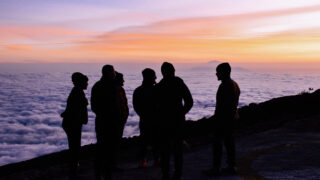
You’ve seen the pictures. Maybe you’ve even dreamt the dream. Snow-capped peaks rising above the clouds. The sense of standing on top of the world. For many, that dream starts with Kilimanjaro. For others, it’s Everest. But here’s the question every aspiring adventurer has asked at some point: Is Kilimanjaro easier than Everest?
The short answer? Yes. But—as always when it comes to the mountains—it’s complicated.
Let’s unpack it.
Defining “Easy” in the Mountains
When people ask if one mountain is “easier” than another, they’re often asking: Will I make it to the top? Will I suffer less? Will it be safer, shorter, or cheaper?
Fair questions. But each mountain is different, and no mountain is easy.
Altitude: The Great Equalizer
Mount Kilimanjaro stands tall at 5,895 meters (19,341 ft). It’s the highest mountain in Africa and the highest freestanding mountain in the world. And yes—it’s technically a trek, not a climb. No ropes. No crampons. No crevasses.
Everest, on the other hand, wears a crown few dare even to chase: 8,848 meters (29,032 ft). And whether you’re heading to Everest Base Camp (EBC) or attempting the summit, altitude is the name of the game.
So, in terms of sheer elevation, Everest wins—and not in a way you’ll celebrate if you’re struggling to breathe at 5,500m. The higher you go, the more punishing the effects of altitude.
But here’s the twist: Kilimanjaro can feel harder because it happens so fast.
Time on the Trail
Most Kilimanjaro treks last between 6 and 9 days. That’s a quick gain of nearly 6,000 vertical meters, often with only a couple of real acclimatization days. You can go from sea level to summit in a week—and that’s where the mountain bites.
Compare that to Everest Base Camp, a 12-14 day roundtrip that includes planned acclimatization stops and a more gradual ascent. While the air is thinner, your body has more time to adjust.
So yes, Everest is higher, but Kilimanjaro can feel more brutal because of the pace. If you’re not well-acclimatized or if your operator rushes the itinerary, Kili can hit hard.
Technical Difficulty
Here’s where Kilimanjaro earns its “entry-level” reputation: no technical climbing is required. It’s a high-altitude trek. A very challenging one—but still a walk, not a climb.
Everest Base Camp is also a trek. Rugged, sure. Rocky. But still non-technical. However, summiting Everest is a whole different beast. You’ll face icefalls, fixed ropes, ladders, oxygen tanks, and the notorious death zone. It’s not comparable.
So if we’re talking EBC vs. Kilimanjaro? It’s a closer call.
If we’re talking Kilimanjaro vs. Everest summit? Kili is easier, full stop.
Logistics, Cost, and Comfort
Kilimanjaro is a one-country operation. You fly into Tanzania, get your permits through a local operator, and off you go. No visa puzzles. No domestic flights. No icefall doctors.
It’s also cheaper. Even a premium Kilimanjaro experience costs a fraction of what you’d pay for a guided Everest expedition (which can run $40,000 to $100,000 or more).
Everest Base Camp is more affordable than the summit, but it still involves long logistics, porters, flights into Lukla, and plenty of tea house negotiations.
Kili is more straightforward, but also more primitive in some ways. You’ll sleep in tents, sometimes in rain, wind, and hail. On EBC, you’ll sleep in lodges. Tradeoffs.
Final Thoughts
Kilimanjaro is easier in every technical and logistical sense. But don’t underestimate it. Altitude sickness, mental fatigue, and the cold can break you if you’re not ready.
If Everest is your dream, Kili can be your classroom. Think of it as a high-stakes training ground where you learn to respect your limits—and expand them.
Whatever you choose, remember this: the mountains don’t care about your gear, your Instagram, or your résumé. They care about your preparation, your humility, and your willingness to suffer a little for something extraordinary.
So lace up. Breathe deep. And go find your summit.
This article was reviewed for Kilimanjaro accuracy by Emmanuel Matinde Asseno, a Tanzanian mountain guide licensed by Tanzania’s Ministry of Natural Resources and Tourism (Mountain Guiding Licence No. 037979) and a current Board Member of the Kilimanjaro Guides Association.
Expert review
Reviewed by
Dr. Nima Namgyal Sherpa
Mountaineering guide and expedition doctor
Dr. Nima is LHO’s high-altitude and wilderness medicine reviewer. He has reviewed the altitude-related medical and physiological guidance in this article.
CONTINUE YOUR RESEARCH






ABOUT THE AUTHOR

Elie Abi Akar
Elie is the Base Camp Chief at Life Happens Outdoors, orchestrating every adventure from first step to summit. He believes the outdoors offer something essential which is a space to disconnect from routine and reconnect with what truly matters. His mission is simple: to make every journey feel meaningful and unforgettable.