Adventure Travel Destinations | BY Rami Rasamny | PUBLISH DATE: September 22 2026 | READ TIME: 11 mins | UPDATED DATE: September 22 2026
Alta Via 1: Route Options, Difficulty and Planning Your Trek
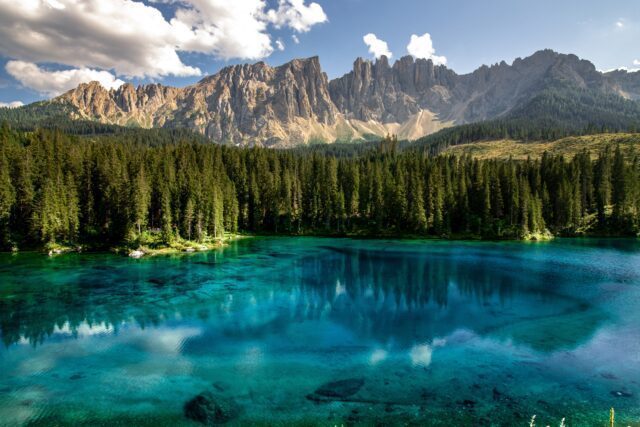
Choosing an Alta Via 1 itinerary starts with its route, walking demands and carrying requirements. Understand the choices before planning your Dolomites hut trek.
Alta Via 1 is a demanding mountain walking journey through the Italian Dolomites, but its difficulty and duration depend on the route you choose. The starting and finishing points, daily ascent and descent, terrain, hut sequence and amount you carry all matter. LHO’s eight-day programme selects highlights of the route across six planned walking days, with arrival and departure days at either end. It should be assessed as that particular itinerary, rather than as a shortened description of the entire historical crossing.
For someone considering their first Dolomites hut trek, the useful question is which version fits their recent walking experience and available time. This guide explains the differences, the demands to compare and the practical questions to settle before booking.
Which Alta Via 1 route are you considering?
Alta Via 1, also called Alta Via Uno, is a long-distance route through the Dolomites. It is associated with a north-to-south journey beginning at Lago di Braies and linking mountain huts, known locally as rifugi. Yet two holidays described as “Alta Via 1” may cover different ground.
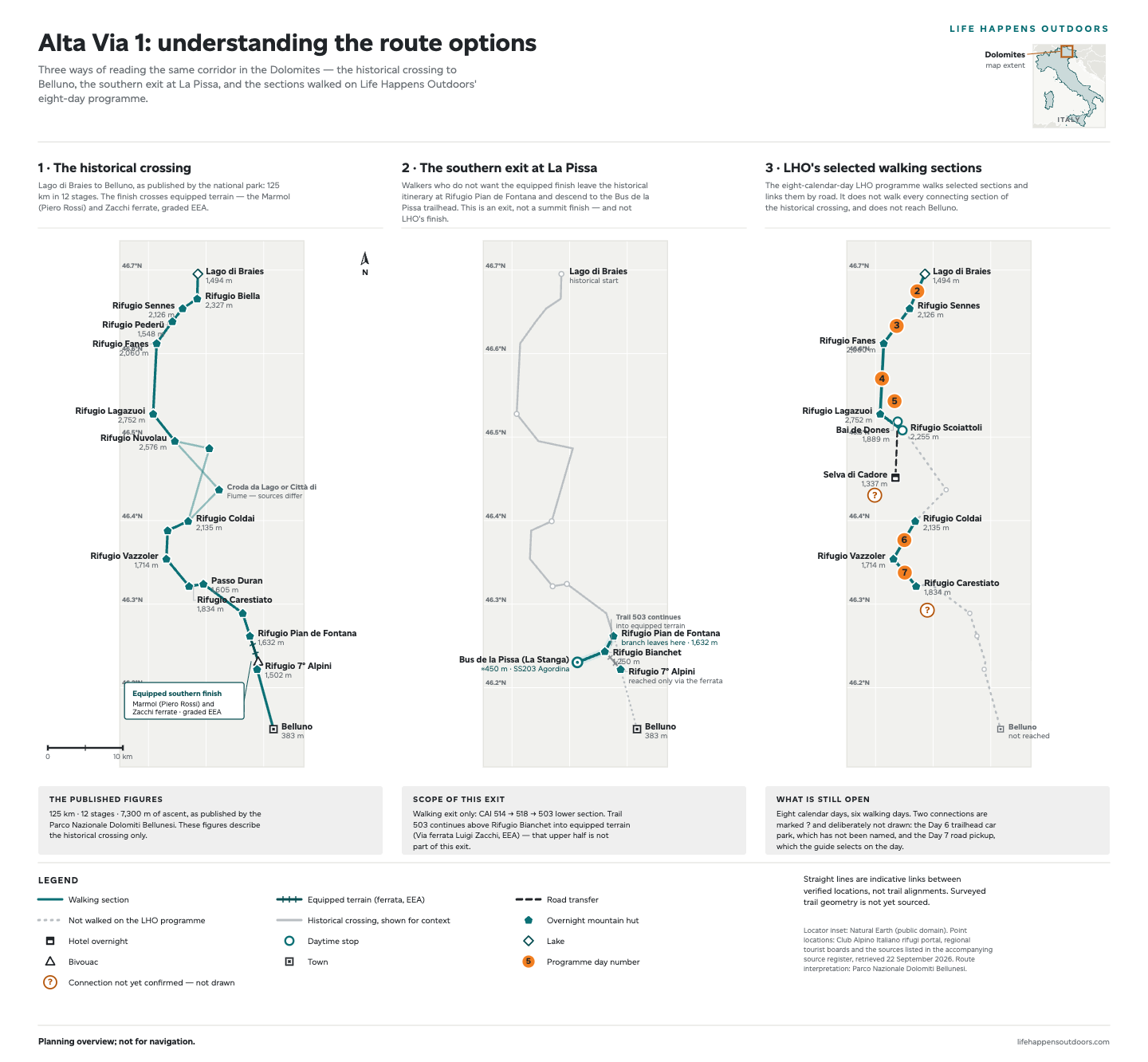
The Dolomiti Bellunesi National Park describes the historical crossing from Lago di Braies to Belluno as 125 kilometres in 12 stages. Its southern finish includes demanding equipped terrain. Longer walking itineraries that leave the mountains by a different exit, such as La Pissa, have a different scope. A highlights programme may select several sections and connect them with road transfers or lifts. Distance and day counts are meaningful only when those choices are explained.
| Route option | What it means | What to check |
|---|---|---|
| Historical crossing to Belluno | The national park’s 125 km, 12-stage description, including the equipped southern finish. | The exact final stages, technical requirements and experience needed. |
| Longer itinerary with a different southern exit | A sustained hut trek whose endpoint and variants differ from the historical Belluno crossing. | Start and finish, included paths, hut spacing and whether optional technical sections are included. |
| LHO’s eight-day highlights programme | Six planned walking days within eight calendar days, combining selected AV1 sections, huts, hotels and transport. | The walking profile of each retained day, transfer points and gaps between luggage reunions. |
When comparing programmes, ask for the overnight stops and a map showing walking separately from transport. The number on the holiday title cannot tell you whether two routes offer the same experience. If you are still choosing between regions or trails, start with our broader guide to guided hiking tours in the Alps.
How difficult is Alta Via 1?
Difficulty has three parts: the physical effort, confidence on the terrain and any technical requirements of the selected path. A strong walker can still find exposure uncomfortable. Someone who enjoys steep ground on a short outing may find consecutive days with overnight kit more demanding than expected. Assess each part separately.
Consecutive days, ascent and descent
A mountain day involves more than kilometres. A route that climbs between huts can take sustained effort even when its horizontal distance looks modest. Descending also requires attention and control, particularly on loose or uneven ground. The effect becomes clearer after several days, when you need to begin another stage rather than head home to recover.
For scale, LHO’s currently published Fanes-to-Lagazuoi day is estimated at about 13 kilometres, with 1,050 metres of ascent and 450 metres of descent. The following day is described as approximately 9 to 10 kilometres, with 250 metres of ascent and 950 metres of descent. These are published itinerary estimates, not timed field measurements or a promise of the exact route used on a departure. They illustrate why a shorter distance can still represent a substantial mountain day.
Compare that pattern with walking you have done recently: the length of the outing, ascent and descent, conditions underfoot, what you carried and how you felt the next morning. A distance recorded on flat paths is useful context, but it does not answer all of those questions.
Rocky footing and confidence around exposure
Dolomites routes can involve rough limestone, loose stones, steep descents and paths where a drop beside the trail affects how comfortable you feel. The amount of exposure depends on the actual stage and variant. A photograph of an open meadow or a broad path does not describe the whole journey.
If heights concern you, describe the situations you have encountered to the team. There is a useful difference between feeling cautious near a viewpoint and finding it difficult to keep moving on a narrow mountain path. Ask which sections of the proposed itinerary are most likely to test your confidence and how route decisions are made.
Does Alta Via 1 require via ferrata skills?
There is no reliable answer without identifying the route. The historical southern finish and optional equipped variants cannot be treated as ordinary walking simply because other AV1 sections are commonly trekked. Equally, choosing a walking itinerary does not automatically mean every path is free of exposure.
Lagazuoi needs particular attention when comparing programmes. The official mine-tunnel description calls that route an atypical via ferrata and specifies equipment. LHO’s published itinerary mentions the First World War tunnels, so confirm the exact path, whether an alternative is available, and the equipment and experience required for your departure. A general skills label on a trip page is not a substitute for that route-specific discussion.
How many days do you need?
Begin with the journey you want to make. A longer continuous traverse gives you more days of moving from hut to hut. A selected highlights itinerary can fit a shorter holiday by omitting sections or using transport. Compressing the same walking route into fewer days is a different decision again, because it can increase daily effort.
Count walking days separately from arrival, departure and any hotel or transfer days. Check how the first mountain day follows the journey to the trailhead, and how the final walk connects with the return transfer. Leave the flight and meeting-time details to the current trip instructions rather than assuming that every eight-day programme has the same travel arrangements.
Hut availability also shapes the schedule. A bed at one hut does not secure the next night, and changing an overnight stop can alter both adjacent walking days. For an independent trek, build a workable sequence before treating the itinerary as fixed. For a guided trip, ask how accommodation substitutions could affect the route.
How LHO’s eight calendar days work
The current LHO Alta Via 1 itinerary combines four hut nights with three hotel nights. Days 2 to 7 contain the planned walking, while Days 1 and 8 cover arrival and departure. The route takes in the Sennes and Fanes areas, Lagazuoi, Cinque Torri and the Civetta area, with a hotel break in Selva di Cadore.
The overview below reflects the programme published on 22 September 2026. It explains the holiday’s structure; final trailheads, path choices, transfers and accommodation should be checked against the arrangements confirmed for your departure.
| Day | Published programme overview | Overnight | Luggage access shown |
|---|---|---|---|
| 1 | Arrive in the Venice area, meet the team and prepare for the trek. | Hotel | Organise stored luggage and the bags needed during the programme. |
| 2 | Transfer to Lago di Braies and walk to Sennes. | Rifugio Sennes | No main-luggage access. |
| 3 | Continue from Sennes through the Fanes area. | Rifugio Fanes | No main-luggage access. |
| 4 | Walk from Fanes to Lagazuoi. | Rifugio Lagazuoi | No main-luggage access. |
| 5 | Lagazuoi and Cinque Torri, then a descent or lift and road transfer to Selva di Cadore. | Hotel | Reunion with luggage. |
| 6 | Return to the Civetta area and walk towards Vazzoler. Confirm the transfer destination and full walking approach. | Rifugio Vazzoler | No main-luggage access. |
| 7 | Walk through the Moiazza area towards Carestiato, then return to the Venice area. Confirm the road pickup point. | Hotel | Reunion with luggage. |
| 8 | Departure. | None | Follow the confirmed departure arrangements. |
A transfer described using a hut’s name needs careful interpretation. Rifugio Coldai’s official access information states that the hut is reached on foot. For Day 6, establish where the vehicle journey ends and how the approach is included in the day’s walking. The same principle applies to the final day: a stop at a hut and a road pickup are separate points unless the operating plan confirms otherwise.
What the luggage schedule means for your pack
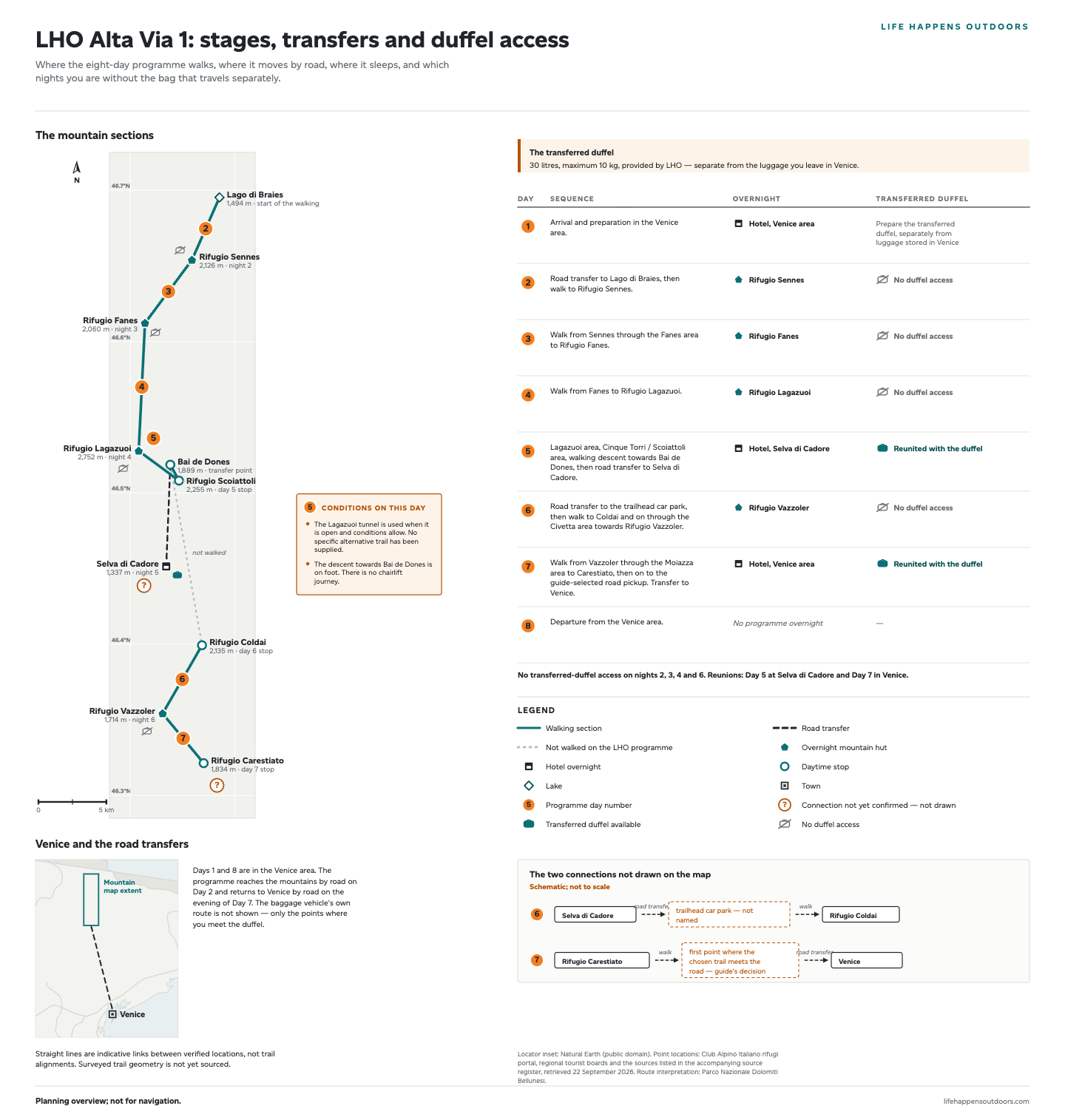
Luggage transfer does not mean access to your main bag at every hut. The published LHO schedule states that luggage is unavailable on Nights 2, 3 and 4, with a reunion at the hotel in Selva di Cadore on Day 5. Your walking pack therefore needs to accommodate the clothing and personal essentials required for three hut nights, alongside the equipment needed during the day.
There is another separation for the night at Vazzoler on Day 6, followed by a reunion in the Venice area on Day 7. Check which bag remains stored in Venice, which bag is transferred, and what you must keep with you between each reunion. Those are more useful planning questions than asking only whether baggage transfers are included.
Use the trip’s confirmed equipment guidance to decide what goes in each bag. A detailed packing list, the permitted transfer allowance and any technical equipment depend on the operating arrangements. Before choosing the trip, establish whether you are comfortable walking consecutive mountain days with the pack the itinerary actually requires.
Plan around huts, access and mountain conditions
Staying in a rifugio puts the next stage close to your doorstep and gives the journey its hut-to-hut rhythm. It also means adapting to the facilities and routines of each hut. Room arrangements, washrooms, showers, charging and payment facilities can vary. Confirm what your booked accommodation provides, especially if a particular requirement affects your ability to join.
If this style of travel is new to you, our introduction to what hut-to-hut trekking involves explains the appeal. For AV1 planning, concentrate on the actual overnight sequence, the shared-living arrangements and the carrying gaps. A hotel night partway through the programme is also an opportunity to reorganise the kit needed for the next section.
Choose dates around the operating season of the huts and transport required by your route, then check conditions closer to departure. Snow, weather, closures and changes to lift services can affect a planned stage. An advertised itinerary describes the intended journey; the route used in the mountains still depends on conditions and the group.
Access to Lago di Braies also deserves a current check. Use the official Braies access information for the relevant season and confirm the arrangements for your transfer. Rules published for one summer should not be assumed to apply to the next. For an independent trek, connect the start and finish with realistic transport plans as carefully as you connect the huts.
Decide whether the itinerary fits you
A useful readiness conversation starts with examples. “I am reasonably fit” leaves much more unanswered than an account of your recent walks, the terrain you enjoyed or found difficult, and how you managed a second day. Use the prompts below to prepare that conversation with the team. They are discussion prompts, not a fitness test or a guarantee of suitability.
| Consider | Bring a real example | Discuss with the team |
|---|---|---|
| Consecutive walking | Your recent mountain days, including ascent, descent and how you felt the following morning. | How these compare with the proposed stages and where more preparation may be needed. |
| Footing and exposure | Rocky paths, loose descents or narrow trails you have encountered. | Which sections may challenge your confidence and what route alternatives exist. |
| Available time | The calendar days you can commit, including travel. | Whether you want a longer traverse or a selection of highlights, and how the travel days work. |
| Carrying and hut stays | Your experience walking with overnight essentials and sharing mountain accommodation. | The three-night carrying gap, the later hut night and any accommodation needs. |
A first hut trek can be a meaningful next step for someone with suitable walking experience, but “first time” alone says little about readiness. Guided support helps with the organisation and route decisions; the walking and carrying still belong to you. Be specific about what you can currently do and what remains unfamiliar.
If another Alps route remains on your shortlist, use its own planning information to compare the actual demands. Our Tour du Mont Blanc planning guide is a useful next read. Whichever journey you choose, the aim is to arrive understanding the days ahead, with enough preparation to take part in them fully.
Expert review
Reviewed by
Lucía Guichot Martín
IFMGA Mountain Guide
Lucía is a Spanish IFMGA mountain guide and an accredited LHO reviewer for Alps trekking and mountaineering content. She has worked with Life Happens Outdoors since 2019.
Is this Alta Via 1 itinerary right for you?
Explore the current Alta Via 1 itinerary and ask the team whether its walking and carrying requirements suit you.
CONTINUE YOUR RESEARCH





ABOUT THE AUTHOR

Rami Rasamny
Rami Rasamny is the founder of Life Happens Outdoors, a premium adventure travel company that uses the outdoors as a catalyst for human transformation. His work brings people into the mountains not only for challenge, but for clarity, confidence, and connection. He believes that when people answer the call to adventure truthfully, they come back different.