Trip Planning for Treks & Climbs | BY Elie Abi Akar | PUBLISH DATE: May 21 2025 | READ TIME: 4 mins | UPDATED DATE: August 23 2026
Where Do You Sleep on Kilimanjaro?

DOWNLOAD YOUR Climb Kilimanjaro GUIDEBOOK
By Hazem El Shamy | Senior Expeditions Coordinator at Life Happens Outdoors If you’re planning to climb Kilimanjaro, you’ve probably thought about the gear, the altitude, the training—and yes, where on earth you’ll sleep up there. Spoiler: there are no five-star hotels at 5,000 meters, but what you’ll find instead is something much more raw, […]
By Hazem El Shamy | Senior Expeditions Coordinator at Life Happens Outdoors
If you’re planning to climb Kilimanjaro, you’ve probably thought about the gear, the altitude, the training—and yes, where on earth you’ll sleep up there. Spoiler: there are no five-star hotels at 5,000 meters, but what you’ll find instead is something much more raw, real, and unforgettable.
Welcome to your mountain home.
Tents, Stars, and a Thin Strip of Earth
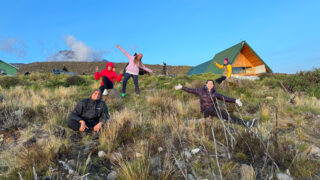
On Kilimanjaro, your bed is usually a tent pitched on rugged terrain somewhere between dense rainforest and alpine desert. Whether you’re on the popular Machame, Lemosho, or Rongai routes, you’ll sleep in mobile camps that move with you as you ascend. Each night, porters race ahead of your group to set up camp before you arrive—your tent waiting like a little beacon of rest after hours on the trail.
Most outfitters use two-person, four-season tents designed to handle wind, rain, and even snow. They’re surprisingly cozy, and with a good sleeping bag and pad, they can be downright comfortable. Inside, it’s you, your gear, and the muffled sounds of a mountain shifting around you. It’s basic. It’s intimate. And somehow, it becomes enough.
What’s Camp Life Like?
Each campsite is a small village of trekkers, guides, porters, and cooks. Tents are arranged in tidy rows, and there’s usually a dining tent where you eat hot meals served at a folding table with chairs—yes, chairs! It’s more organized than most people expect. Some even say it’s a bit surreal to eat a three-course meal with a headlamp on while watching clouds tear across the sky like racing ghosts.
Camps are lively in the evenings. You’ll hear laughter, stories, sometimes singing in Swahili from the porters. Then, as the sun drops and the temperature follows, the mountain goes quiet. The stars above Kilimanjaro aren’t just bright—they feel closer. You’ll fall asleep to the rhythm of your own breath and the knowledge that the summit is waiting.
The One Place with Beds: Kibo Huts on the Marangu Route
The Marangu Route—often called the “Coca-Cola route”—is the only path where you sleep in wooden huts instead of tents. Each stop has dorm-style huts with bunk beds and basic mattresses. You still need a sleeping bag, but there’s a roof over your head. Some climbers love this; others miss the wildness of sleeping under canvas.
Marangu is a popular choice for those who want more infrastructure and a bit more “comfort,” but it also tends to be more crowded and less scenic compared to other routes.
Sleeping at High Altitude: What to Expect
Here’s the truth: sleeping on Kilimanjaro isn’t always easy. The higher you climb, the thinner the air. You may wake up gasping, have vivid dreams, or struggle to fall asleep at all. It’s totally normal.
Altitude affects everyone differently, and the key is to rest even if you can’t sleep. Your body still recovers. Drink lots of water. Don’t stress if you’re tossing and turning. Just lay back, close your eyes, and remind yourself—you’re on freakin’ Kilimanjaro. That thought alone can carry you through the restless nights.
Summit Night: The Sleepless Push
On your final night before the summit—usually at Barafu Camp or Kibo Hut—you’ll try to sleep around 7 p.m., but wake around 11 p.m. to start your summit push. It’s cold, dark, and feels like a dream. You climb by headlamp, hour after hour, until you reach the roof of Africa at sunrise.
That night, you don’t really sleep—you rest just enough to do the hardest thing you’ve ever done.
The Takeaway
Sleeping on Kilimanjaro is about embracing discomfort, letting go of expectations, and discovering how little you actually need. It’s not about thread count or plush pillows—it’s about zipping up your tent, lying back in the silence of 13,000 feet, and realizing you’re part of something vast and alive.
It may be cold. It may be loud with wind or echoing silence. But you’ll never forget a single night.
Because on Kilimanjaro, sleep is not just rest—
It’s part of the journey.
This article was reviewed for Kilimanjaro accuracy by Emmanuel Matinde Asseno, a Tanzanian mountain guide licensed by Tanzania’s Ministry of Natural Resources and Tourism (Mountain Guiding Licence No. 037979) and a current Board Member of the Kilimanjaro Guides Association.
CONTINUE YOUR RESEARCH

Machame Route Itinerary: A Seven Day Kilimanjaro Journey Designed For You To Come Back Different



ABOUT THE AUTHOR

Elie Abi Akar
Elie is the Base Camp Chief at Life Happens Outdoors, orchestrating every adventure from first step to summit. He believes the outdoors offer something essential which is a space to disconnect from routine and reconnect with what truly matters. His mission is simple: to make every journey feel meaningful and unforgettable.