







Trip Planning for Treks & Climbs | BY Rami Rasamny | PUBLISH DATE: April 14 2025 | READ TIME: 10 mins | UPDATED DATE: October 31 2026
Tour du Mont Blanc in 8 Days: What the Experience Actually Feels Like
DOWNLOAD YOUR Guided Tour du Mont Blanc Trek GUIDEBOOK
Eight calendar days and eight walking days are different commitments. Understand how a curated Tour du Mont Blanc journey balances six mountain stages, planned transport and time together before choosing your pace.
Yes, you can experience the Tour du Mont Blanc in 8 days. The important question is what those eight days contain. Life Happens Outdoors combines arrival, six selected mountain walking days and departure, with planned transport connecting parts of the journey. You travel around the Mont Blanc massif through France, Switzerland and Italy, but you do not walk every kilometre of the classic circuit.
For a fit person with limited time, that distinction matters more than the headline duration. A curated journey and a continuous circuit ask different things of you. Both can be rewarding. Choosing well starts with understanding the experience you want to have.
How long does the Tour du Mont Blanc take?
The classic Tour du Mont Blanc is roughly 170 km, with variations affecting the line you follow. The official Tour du Mont Blanc website describes a range of seven to twelve walking days, with nine or ten offering a balanced pace and eleven or twelve allowing a slower rhythm. Travel and any additional rest days need to be counted separately.
There is no contradiction between that range and an eight day supported experience. They describe different structures. One spreads the full walking circuit across your available days. The other chooses mountain stages and connects them with transport. An eight day trip could also mean eight walking days with travel added, so never assume every operator is counting time in the same way.
Before comparing programmes, separate three things: the number of calendar days, the number of walking days and whether the route is continuous on foot. Those answers tell you far more than an isolated distance or a promise to show you the highlights.
What an eight day LHO experience contains
The current LHO Tour du Mont Blanc programme has a clear structure: an arrival day, six consecutive walking days and a departure day. The walking is concentrated on selected Alpine stages, with lifts, buses and private transfers used for particular connections. Mountain and valley accommodation give the journey a changing overnight rhythm.
Arrival has a practical purpose. It gives you time to meet the people you will walk with, understand the plan and organise your kit before the first mountain stage. It is not an additional full trekking day. Departure also belongs to the trip calendar without belonging to the walking total.
The six days between them are still mountain days. A supported format reduces some of the planning and carrying burden, but it does not turn the route into a succession of gentle sightseeing walks. The exact stages, daily figures and arrangements belong on the current trip page, where they can be checked against the programme being operated.
Why curation matters more than a kilometre total
A kilometre through a valley settlement and a kilometre descending a rough mountain path can make very different demands. Distance does not show how much you climb, how long you descend, how the ground changes or how tired you feel when the next day begins.
Intelligent curation means making deliberate choices about those demands and the places you reach. In the LHO format, selected walking stages retain the movement between the French, Swiss and Italian sides of the massif. Transport is part of that design, rather than an invisible detail to discover after booking.
That creates a useful question for your own decision: would you feel satisfied knowing some connections were made by vehicle or lift? If the answer is yes, you can judge the journey by its mountain walking, cultural changes and shared experience. If completing every section under your own power is central to the goal, a continuous circuit deserves serious consideration.
Neither choice needs defending as the better way to travel. The classic circuit offers the continuity of following a long trail from one stage to the next. A curated journey offers a defined selection within a shorter trip calendar. The value depends on what you want to remember.
Six consecutive days change the physical rhythm
The challenge is repetition. On the first morning, your legs are fresh and everything is new. Later in the week, you are starting another ascent after previous climbs and descents. Good general fitness helps, but your ability to repeat the effort matters more than one impressive outing.
Long descents deserve attention alongside the uphill work. A day with less climbing can still involve sustained concentration on uneven ground and a substantial descent. A lift connection at the start of a stage does not tell you that the rest of the day will be easy.
Think of recovery as part of the walking plan. Time to eat, organise the next day’s kit and rest can influence how you experience the following stage. Hotels and huts offer different evenings, but neither guarantees that you will wake fully recovered. There is no separate rest day built into the six walking days.
Use the Tour du Mont Blanc difficulty guide to assess the physical demands. This duration article helps you choose a rhythm; the difficulty guide answers the fuller readiness question.
Where lifts, buses and transfers fit
Transport has two distinct roles. Planned connections are part of the itinerary and make its selected stages fit together. Possible shortened alternatives are a separate matter. They depend on conditions, schedules, available services and the guide’s assessment, and may involve additional costs.
That distinction protects your expectations. A supported trek does not mean you can stop at any point and expect a vehicle to collect you. Roads and operating lifts do not reach every part of a mountain path. Prepare for the walking stages you intend to complete, then treat any available adjustment as an operational option.
Check the current programme before committing, particularly if you are relying on flexibility. Ask which connections are planned, how alternatives are assessed and what your chosen departure requires. There is little value in building confidence around a transport option that may not operate when you need it.
Eight days versus six days or nine to eleven
These options only become comparable when their counting systems are clear. The table distinguishes an eight day trip from plans measured in walking days. It describes formats, not a booking itinerary.
| Format | Walking and travel structure | Main decision |
|---|---|---|
| Six walking days, full circuit | Six compressed walking days. Add arrival, departure and any rest time. | Whether you already have the experience and repeatable endurance for a fast circuit. |
| Eight calendar days, LHO format | Arrival, six selected walking days and departure. Planned transport connects sections. | Whether a supported selection suits your time and goals. |
| Nine to eleven walking days | More days to distribute the full circuit. Add travel and check whether rest days are included. | Whether continuous walking and a longer trail rhythm matter most. |
A full circuit in six walking days concentrates the effort into a demanding schedule. Our six day Tour du Mont Blanc guide owns that decision and explains the compressed option in detail.
With nine to eleven walking days, you have more scope to divide the circuit into shorter stages, depending on accommodation and your chosen route. Extra days can support a different pace, but the number alone does not prove that every day is easier or that a rest day is included. Read the structure before judging the comfort.
What the journey feels like across three countries
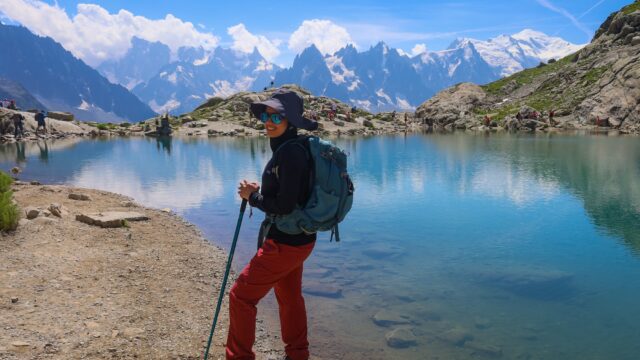
The changing sides of the massif give the TMB much of its character. The French side brings views across the Chamonix Valley towards Mont Blanc. Swiss forests, pastures and lakeside settlements offer another setting. Italy brings the southern mountain walls, open valleys and the town life of Courmayeur.
These changes are more than additions to a photograph collection. A pass can connect one landscape with another. Arriving in a village brings a different language, meal and atmosphere. Even within a selected itinerary, you are moving through inhabited places with their own daily life, rather than remaining at one viewpoint.
Group travel can add another thread. There is time to learn how others approach the challenge, share a meal and notice what each person sees in the landscape. You may enjoy company on the trail and still want quiet moments. Connection does not require every hour to be sociable.
This is where presence becomes a useful aim. Prepare well enough, and choose a structure that suits you, so you can pay attention to the place as well as the next climb. That is a possibility the journey creates, not a promise about how you will feel.
Who the eight day format suits
It can suit someone who has good general fitness, is willing to prepare for consecutive mountain days and wants the practical support of a guided group within a defined travel window. It also asks you to be comfortable with selected stages and planned transport rather than treating every kilometre as the objective.
A longer continuous circuit may suit you better if completing the whole trail on foot is the main reason for going, or if you want more time to distribute the walking. A shorter holiday is not automatically the easier physical choice, and guided support cannot substitute for the preparation your route requires.
Check your readiness before choosing your dates
Start with recent evidence: how you handle sustained climbing, rough descents and another useful walking day afterwards. Test the footwear and daypack you plan to use, and look beyond flat distance when comparing your preparation with the programme.
The Tour du Mont Blanc training plan develops that preparation without turning this page into another training article. For the wider choices around season, accommodation and support, continue with the Tour du Mont Blanc Planning Guide for First-Time Trekkers. Our Hiking in the Alps guide helps if you are still comparing destinations.
Once the rhythm feels right, check the current trip page for its operating itinerary, requirements, dates and inclusions. Choose the journey you can prepare for and want to experience. Answering the call to adventure starts with that honest decision.
If you are comparing the related Alps treks below, LHO’s current Tour du Mont Blanc and Alta Via 1 formats each contain eight calendar days and six walking days. The Walker’s Haute Route contains ten calendar days and eight walking days. It is a more demanding progression, requiring previous multi day trekking experience and confidence on rough Alpine terrain. Check each current trip’s requirements before treating it as an alternative.
Technical reviewer: Lucía Guichot Martín, AMM Trekking Guide and IFMGA Mountain Guide. Technical approval confirmed 12 October 2026.
CONTINUE YOUR RESEARCH





DISCOVER MORE ADVENTURES

ABOUT THE AUTHOR
Rami Rasamny
Rami Rasamny is the founder of Life Happens Outdoors, a premium adventure travel company that uses the outdoors as a catalyst for human transformation. His work brings people into the mountains not only for challenge, but for clarity, confidence, and connection. He believes that when people answer the call to adventure truthfully, they come back different.