Training for Hiking, Treks & Climbs | BY Rami Rasamny | PUBLISH DATE: February 05 2025 | READ TIME: 3 mins | UPDATED DATE: August 19 2026
How Fit Do You Need to Be to Climb Mont Blanc?

DOWNLOAD YOUR Climb Mont Blanc GUIDEBOOK
Short answer: you should arrive with a strong endurance base, recent uphill and downhill training and the ability to recover across consecutive mountain days. No single run, gym test or fitness score proves that you are ready for Mont Blanc, and sea-level fitness does not prove how you will respond to altitude. This page owns […]
Short answer: you should arrive with a strong endurance base, recent uphill and downhill training and the ability to recover across consecutive mountain days. No single run, gym test or fitness score proves that you are ready for Mont Blanc, and sea-level fitness does not prove how you will respond to altitude.
This page owns measurable fitness benchmarks only. For the full preparation system, use Training for Mont Blanc. For the broader decision about suitability, use the Beginner Readiness guide.
A practical entry benchmark
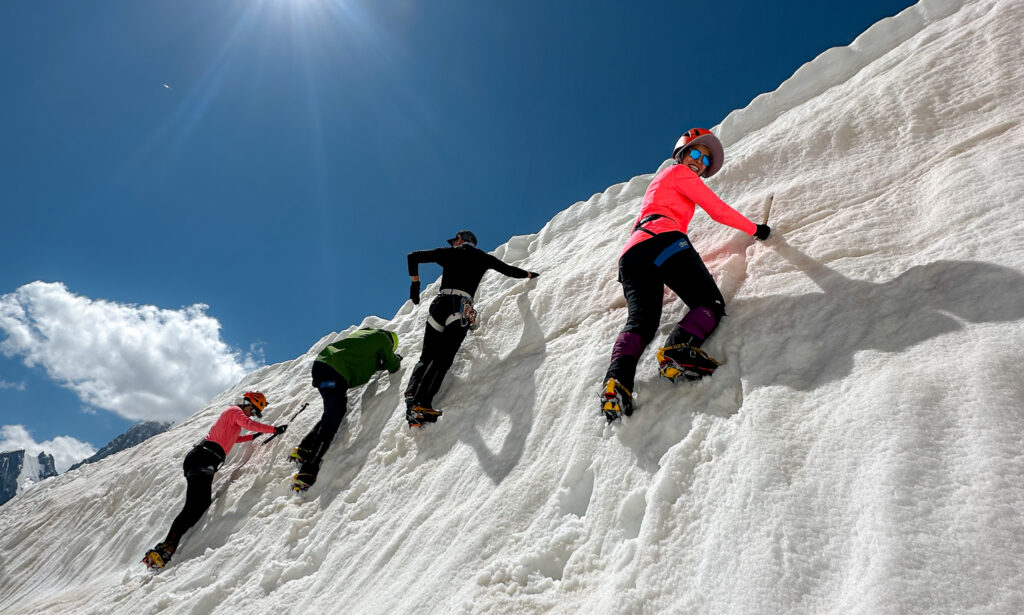
Before joining an appropriate guided course, aim to complete six to eight hours of mountain hiking on consecutive days, with about 1,000 metres of ascent on at least one day, while carrying a day pack and maintaining controlled movement.
This is an entry benchmark, not a simulation of Mont Blanc, a pass-or-fail test or a summit guarantee. Terrain, weather, altitude, technical movement and guide judgement add demands that a training day cannot reproduce exactly.
What controlled movement looks like
Completing the distance is not the only measure. A useful mountain day should show that you can:
- keep a steady pace without repeated surges and long stops;
- eat, drink and manage layers without losing control of the day;
- move accurately on uneven ground as fatigue builds;
- descend for several hours without rushed foot placement;
- remain attentive enough to follow instructions; and
- recover overnight and move competently again the next morning.
Finishing one exceptional day exhausted is weaker evidence than completing two well-paced days with usable reserves.
Train for ascent and descent
Uphill work builds aerobic capacity and climbing-specific endurance. Long descents test the calves, thighs, balance and concentration in a different way. Both belong in the benchmark.
Use hiking and hill walking as the main test whenever possible. Running, cycling, rowing and swimming can support aerobic fitness, but there is no universal time or distance in those sports that proves Mont Blanc readiness.

If you do not live near mountains
Stairs, an inclined treadmill and repeated local hills can build useful climbing volume. Long walks with a sensible day pack can help you practise pacing, food, water and foot care. These tools do not reproduce broken terrain, snow, exposure or rope-team movement, so include relevant outdoor days when you can.
Increase volume progressively enough that you can recover. Individual coaching, injury rehabilitation and medical advice belong with an appropriately qualified professional.
Strength supports the benchmark
Strength work can support the legs, hips, calves and trunk for climbing and descending. Step-ups, split squats, calf work and controlled trunk exercises may be useful, but the exercise list is not the goal. The goal is better movement across sustained mountain days.
Strength training does not replace hiking evidence, technical instruction or acclimatisation.
What fitness cannot decide
Fitness does not guarantee altitude tolerance, technical competence, safe conditions or a summit. The guide may adapt the pace, objective or plan according to individual readiness, group ability, access, weather or mountain conditions.
Use the Altitude guide for general acclimatisation context and the Summit Training owner to turn these benchmarks into a complete preparation system.
When you are ready to compare the benchmark with the live programme, review the Mont Blanc Summit Course.
CONTINUE YOUR RESEARCH






ABOUT THE AUTHOR

Rami Rasamny
Rami Rasamny is the founder of Life Happens Outdoors, a premium adventure travel company that uses the outdoors as a catalyst for human transformation. His work brings people into the mountains not only for challenge, but for clarity, confidence, and connection. He believes that when people answer the call to adventure truthfully, they come back different.