Adventure Travel Destinations | BY Rami Rasamny | PUBLISH DATE: September 30 2025 | READ TIME: 16 mins | UPDATED DATE: October 08 2026
Can I Climb Mont Blanc as a Beginner?

DOWNLOAD YOUR Climb Mont Blanc GUIDEBOOK
Short answer: Mont Blanc can be a first alpine summit for a fit, well prepared beginner on a structured guided programme. It cannot be the beginning of your training. You still need a strong hiking base, time to prepare and the willingness to turn around. That distinction matters. In this guide, “beginner” means that you […]
Short answer: Mont Blanc can be a first alpine summit for a fit, well prepared beginner on a structured guided programme. It cannot be the beginning of your training. You still need a strong hiking base, time to prepare and the willingness to turn around.
That distinction matters. In this guide, “beginner” means that you are new to alpine climbing, not new to fitness or mountain days. You may never have worn crampons or joined a rope team, yet still arrive with the endurance, balance, judgement and humility needed to learn. If both mountaineering and long days in the hills are new to you, build that foundation first.
Plan the next steps with our Mont Blanc training guide and climb duration and acclimatisation guide. If you are weighing up support, read whether you need a guide to climb Mont Blanc.
I have accompanied more than 30 Life Happens Outdoors teams on Mont Blanc as expedition coordinator alongside IFMGA mountain guides. I have seen first time alpinists learn quickly, settle into the rope team and move well. I have also seen weather, altitude, heat and route conditions make “not today” the right answer, however well someone has prepared. A guided course can teach, support and assess you. It cannot remove the mountain’s hazards or guarantee a summit.

What “beginner” means on Mont Blanc
Here, “beginner” means someone who has little or no previous alpine climbing experience but already has a strong base as a hiker or endurance athlete. You must also be ready to learn, accept an honest assessment and turn around if necessary.
A beginner who may be ready to consider Mont Blanc usually:
- has experience of long, sustained days in the mountains;
- can train consistently for several months;
- moves with balance on steep, rough terrain while carrying a day pack;
- can stay composed around exposure and follow instructions immediately;
- is willing to learn crampon, ice axe, rope team and glacier travel skills before any summit attempt; and
- accepts that conditions, altitude response or guide judgement may change the objective.
Starting from zero is different. If a mountain day lasting six hours is new to you, if you have never hiked on steep or broken ground, or if your plan depends on willpower carrying you through, Mont Blanc is not your next step yet. That is not a permanent no. Build your hiking capacity, learn introductory alpine movement, complete a lower or less committing objective, then reassess.
The five part Mont Blanc readiness framework
Think about readiness in five separate parts. Being strong in one does not cancel a gap in another. This framework can help you ask better questions, but it cannot replace a guide’s assessment of you and the conditions.
1. Physical readiness
Before joining a Mont Blanc course, aim to complete mountain days of six to eight hours on consecutive days, with roughly 1,000 metres of ascent on at least one day, while carrying the pack you expect to use. You should finish tired but controlled, recover overnight and move steadily again the following morning.
This is an entry benchmark, not a simulation of Mont Blanc and not a promise of success. According to La Chamoniarde, the Chamonix mountain safety organisation, the normal Goûter route can involve 10 to 12 hours of climbing and descending on summit day. Your fitness needs to leave enough spare capacity to listen, balance and make good decisions when you are cold, tired and at altitude.
2. Technical readiness
You do not need advanced rock or ice climbing experience to join an appropriate introductory programme. You do need to learn and demonstrate the foundations before a summit attempt:
- walking efficiently in crampons on snow and firm or icy terrain;
- using an ice axe for balance and knowing the purpose and limits of self arrest practice;
- scrambling on rock in mountain boots and, when conditions require it, in crampons;
- moving with a tight, efficient rope on glaciated terrain;
- keeping pace and spacing in a rope team; and
- responding immediately to a guide’s instructions to move, stop or change the plan.
These skills can be introduced over several training days, but learning a movement once is not the same as performing it reliably when tired. The guide must decide whether your movement is efficient and safe enough for the conditions and route.

3. Exposure readiness
Mont Blanc includes steep ground and exposed ridges. Exposure is not the same as technical difficulty: the moves may be straightforward while the consequences of a slip are serious. Before committing to the summit, you should know how you respond to narrow paths, steep snow and large drops.
If you freeze, rush or lose coordination around exposure, practise first in a controlled setting. A guided scrambling day, an introductory ridge, or a progressive alpine skills course gives you information without forcing the biggest objective too soon.
4. Altitude readiness
Fitness does not predict exactly how you will respond near 4,800 metres. A sound itinerary includes progressive altitude exposure and time to observe how you feel before the summit attempt. Headache, nausea, unusual weakness, poor coordination or worsening symptoms are not tests of character.
The UIAA’s medical guidance says not to ascend with symptoms of altitude illness. Your guide and, where relevant, a medical professional should make individual decisions. If you have a health condition, a recent illness or any uncertainty about exertion at high altitude, seek appropriate medical advice before booking.
5. Readiness for mountain hazards
Mountaineers use the term “objective hazards” for dangers that come from the mountain rather than from your personal ability. They include rockfall, crevasses, avalanches, serac fall, hard ice, sudden weather changes and poor visibility. Training can improve how the team moves and makes decisions, but it cannot eliminate these hazards.
Readiness therefore includes accepting a different route, an alternative summit or no summit at all. On the Goûter route, the Grand Couloir is exposed to rockfall. The Three Monts route has its own crevasse, avalanche and serac hazards. A route described as normal, or a climb led by a guide, is not without risk.
Are you ready to discuss Mont Blanc now?
| Signal | Ready to discuss | Prepare first | Wait |
|---|---|---|---|
| Endurance | Mountain days of six to eight hours on consecutive days feel controlled. | You can manage one long day but fade badly on day two. | Six hours or 1,000 metres of ascent is currently beyond you. |
| Movement | You are balanced on steep, rough ground and learn movement skills quickly. | You are fit but inexperienced on broken or snowy terrain. | You regularly trip, rush, freeze or need direct support on exposed ground. |
| Technical skills | You have basic skills or will complete several training days before assessment. | You need an introductory snow, crampon and rope course first. | You expect the guide to compensate for skills you have not learned. |
| Altitude plan | Your itinerary includes progressive acclimatisation and flexibility. | Your plan is compressed and needs more altitude exposure. | You intend to go directly from low altitude to a rapid summit attempt. |
| Decision mindset | You will treat a safe turnaround or alternative summit as a good outcome. | You are emotionally attached to the summit and need to reset expectations. | You intend to continue despite guide, health or condition concerns. |
On a small screen, scroll sideways to compare every column.
If any “wait” statement describes you, do not use the other columns to bargain with it. Choose the preparation path that closes the gap, then reassess.
Clear reasons to wait
Postpone Mont Blanc if:
- you cannot yet complete long mountain days on consecutive days with controlled pacing;
- you are relying on general gym fitness without the endurance that mountain days require;
- you have no time for progressive training, technical instruction and acclimatisation;
- exposure causes panic, freezing or unsafe rushing;
- you have a current injury, illness, medical contraindication or unresolved health concern;
- you are unwilling to turn around or accept an alternative summit;
- your itinerary has no flexibility for weather or conditions; or
- you are choosing a programme mainly because it is shorter or cheaper while omitting preparation and assessment.
Waiting is not failure. It is how mountaineers protect the future objective.
Useful preparation paths if Mont Blanc is not your next step
If you are starting from zero mountain fitness
Build a consistent hiking base first. Progress from shorter walks to long hilly days, then to mountain days on consecutive days with a pack. Add leg and core strength, but let hiking remain the main test of whether your training transfers to the mountain.
If you are fit but new to alpine skills
Take an introductory alpine course covering crampons, ice axe handling, rope team movement and glacier travel. A training summit such as the Aiguille du Tour, or another objective selected by a qualified guide for the conditions, can show whether your skills remain reliable over a full day.
If exposure is the gap
Use progressive scrambling, climbing or guided ridge days to practise calm footwork and communication. The goal is not to suppress fear; it is to learn whether you can move accurately while feeling it.
If altitude is the unknown
Choose an itinerary with gradual altitude exposure and a lower or less committing acclimatisation objective. Gran Paradiso is often used as a first progression to 4,000 metres, but its suitability and hazards still depend on conditions and the individual.
If conditions rule out Mont Blanc
Aiguille du Tour, Gran Paradiso, Weissmies or another summit selected by your guide can provide a meaningful alpine objective. It is not a consolation prize or an automatic substitute. The right choice depends on the weather, mountain conditions, team and logistics at the time.
Bring a useful picture of your experience to the conversation
You do not need to know all the answers before speaking with us. It helps to describe what you have actually done and what still feels unfamiliar. Prepare a short note covering:
| Tell us about… | Useful detail to include |
|---|---|
| Recent mountain days | Where you walked, the time on your feet, ascent and descent, and the pack you carried |
| Consecutive-day experience | How you felt on the next day, not only at the end of one successful outing |
| Alpine skills | Any guided experience with crampons, an ice axe or moving in a rope team; say clearly if these will be new |
| Exposure | Terrain where you felt comfortable and terrain where you needed support or chose to turn back |
| Altitude | Your previous experience, including uncertainty or problems you need to discuss privately with the team and, where appropriate, a clinician |
| Preparation time | The weeks available before your intended course and the opportunities you have to practise in suitable terrain |
This is a starting point for a readiness conversation, not a test that guarantees admission or a summit. Be specific about gaps. They help the team explain whether the course is an appropriate next step or whether another experience would be more useful first.
If your ambition is to spend several days walking around the Mont Blanc massif rather than attempt its summit, compare the Tour du Mont Blanc planning guide. Trekking around the mountain and climbing it are different experiences with different preparation demands.
What a guided Mont Blanc course should do
A course should not sell certainty. It should create time to teach, observe and decide. Look for:
- IFMGA mountain guides;
- clear ratios between guides and clients for the summit attempt;
- multiple training and acclimatisation days;
- an assessment before committing to Mont Blanc;
- route and objective flexibility;
- clear turnaround authority; and
- a worthwhile alternative plan if Mont Blanc is not appropriate.
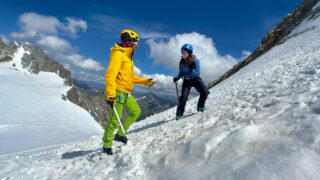
On the Life Happens Outdoors Mont Blanc Summit Course, you spend several days acclimatising and building skills before any summit decision. IFMGA mountain guide Pavlos Tsiantos has used these days to teach self arrest, crampon movement, glacier travel and ridge skills. Each new skill is then practised in real mountain terrain, where the guide can see how you move, learn and respond as the day unfolds. This gives you a fair opportunity to improve and gives the guide time to make an informed decision. It does not mean that every beginner will be ready for Mont Blanc.

Technical skills on an LHO Mont Blanc course
Read the five readiness areas above alongside this course overview. Skills practice does not remove the need for guide assessment or make a summit certain.
So, can a beginner climb Mont Blanc?
Yes, Mont Blanc can be a first alpine summit for some fit, prepared and well supported people. No, it should not be your first step from zero.
Arrive with strong mountain fitness. Learn and demonstrate the technical foundations. Find out how you respond to exposure and altitude. Most importantly, accept that the mountain or your guide may change the plan. If you are not there yet, choose the next useful step rather than forcing the final one.

If you want to understand each demand in more detail, read How Hard Is It to Climb Mont Blanc?.
Frequently asked questions
Can Mont Blanc be my first alpine summit?
It can be for a strong mountain hiker on a structured guided programme with training, acclimatisation and a guide assessment before the summit attempt. It should not be your first experience of long mountain days.
Do I need previous technical mountaineering experience?
Not necessarily before joining an appropriate course. You do need to learn and demonstrate crampon, ice axe, rope team and glacier movement skills before attempting the summit.
How fit should a beginner be?
Before joining a course, aim to complete six to eight hours of mountain hiking on consecutive days, with about 1,000 metres of ascent on at least one day, while carrying a day pack and maintaining controlled movement. This is an entry benchmark, not a guarantee.
Can a few training days make me ready?
Training days can teach and assess technical movement. They cannot create several months of endurance, predict your altitude response or remove objective hazards. Fitness must be built before arrival.
What should I do if I am not ready?
Build mountain fitness, take an introductory alpine skills course and complete a lower or less committing objective selected by a guide. Then reassess against the same five readiness categories.
Safety sources
- La Chamoniarde: Mont Blanc ascent, preparation, route demands and objective hazards
- FFCAM: official public booking rules for the Mont Blanc normal route huts
- UIAA Medical Commission: altitude illness prevention and response
Start with support that continues into the mountains
Use our Mont Blanc training guide to organise the preparation you can do before arrival. Then read the eight-day guided Mont Blanc course to understand the training days, guide support and conditional summit phase. If the course looks relevant, discuss your experience and preparation with LHO. Bring the notes above so the conversation starts with your real circumstances.
Meet the certified guides who work with LHO in Chamonix and see the qualifications and experience behind that mountain support.
For the wider planning picture, use the Mont Blanc planning guide to connect beginner readiness with routes, difficulty, training, altitude, cost, guide choice and the Summit Course.
The reviewer attribution below applies to the earlier version of this article.
Expert review
Reviewed by
Dr. Nima Namgyal Sherpa
Mountaineering guide and expedition doctor
Dr. Nima is LHO’s high-altitude and wilderness medicine reviewer. He has reviewed the altitude-related medical and physiological guidance in this article.
CONTINUE YOUR RESEARCH







ABOUT THE AUTHOR

Rami Rasamny
Rami Rasamny is the founder of Life Happens Outdoors, a premium adventure travel company that uses the outdoors as a catalyst for human transformation. His work brings people into the mountains not only for challenge, but for clarity, confidence, and connection. He believes that when people answer the call to adventure truthfully, they come back different.