Mountains & Peaks | BY Rami Rasamny | PUBLISH DATE: March 12 2024 | READ TIME: 10 mins | UPDATED DATE: August 19 2026
Goûter Route on Mont Blanc: Stages, Hazards and Access

If you are trying to picture the Goûter Route for the first time, think of six connected stages rather than one summit push. The journey climbs from the valley to Tête Rousse, crosses the Grand Couloir, reaches the Goûter Hut, continues over high glaciated terrain and the Bosses Ridge, then asks you to make a […]
If you are trying to picture the Goûter Route for the first time, think of six connected stages rather than one summit push. The journey climbs from the valley to Tête Rousse, crosses the Grand Couloir, reaches the Goûter Hut, continues over high glaciated terrain and the Bosses Ridge, then asks you to make a long descent when you are already tired.
Goûter is Mont Blanc’s most-used normal route and, in typical summer terrain, normally the least technically difficult of the classic lines. That does not make it easy. This stage-by-stage guide will help you understand what the route asks of a prepared climber. It is not a navigation guide, a live conditions report or a promise that the line will be viable. Current decisions should be based on information from La Chamoniarde / Office de Haute Montagne, FFCAM, the hut team and a qualified mountain guide.
Goûter Route at a glance
| Normal starting access | Les Houches or Saint-Gervais lifts to the Nid d’Aigle area. Lift and rail operations must be checked for the planned dates |
|---|---|
| Typical hut sequence | Nid d’Aigle / Tête Rousse / Goûter Hut, depending on itinerary and bookings |
| Planning figures | About 1,428 metres of ascent and five to six hours from Nid d’Aigle to Goûter Hut. Then about 1,015 metres of ascent to the summit and 10 to 12 hours from Goûter Hut to the summit and down to Nid d’Aigle |
| Technical character | Scrambling, crampon travel, roped glacier movement and exposed snow ridges. Normally less technical than Trois Monts |
| Main hazards | Grand Couloir rockfall, slips or falls, ice, wind, altitude, crowding and fatigue on descent |
| Access rule | Named hut booking evidence is required. Bivouacking is prohibited in the protected area between Col du Mont Lachat and the summit |
For a fit hillwalker, the biggest change is not simply the number of hours. It is learning to move efficiently in crampons, manage a rope, stay composed on exposed ground and make good decisions while cold, tired and at altitude. If you are still deciding between routes, start with Mont Blanc Climbing Routes Explained. This page stays focused on Goûter.
Watch the Goûter Route overview
Stage 1: valley access to Tête Rousse
The approach uses the Les Houches or Saint-Gervais side of the valley to reach the Nid d’Aigle area. From there, the mountain journey continues on foot towards the Tête Rousse Hut. The first hours can feel more like a long mountain walk than an alpine climb, which is why pacing matters. This is the time to eat, drink and protect energy for the ground above.
Tête Rousse sits below the Grand Couloir and gives teams a place to organise food, water, equipment and timing before the route changes character. A hut booking is part of the normal-route access system, not simply an optional comfort. Lift and tramway timetables, construction, weather and seasonal opening dates can also change the approach, so old schedules should not be used as current planning information.
Stage 2: the Grand Couloir
The Grand Couloir is a gully crossed below the Aiguille du Goûter. It is where the route’s objective danger becomes most obvious: rockfall can occur without warning and is influenced by recent snow, freezing and thawing, temperature and other mountain conditions. There is no evergreen “safe” crossing time. A familiar rule of thumb is not a same-day assessment.
For a first-time climber, the lesson is calm efficiency rather than bravado. Teams need clear communication, spacing and a decision about whether the exposure is acceptable at all. Waiting, turning around or abandoning the route may be the right decision. A guide can manage the team and reduce time in an exposed place, but no guide can remove objective danger.

Stage 3: Aiguille du Goûter to the Goûter Hut
Beyond the couloir, the climb becomes steeper and more exposed as it follows the Aiguille du Goûter towards the hut. This section is often described as scrambling, but snow, ice, verglas, a thin glaze of ice on the rock, loose stones, traffic and fatigue can all change how it feels. Climbers may need crampons on mixed terrain and must keep moving precisely around other teams.
The Goûter Hut sits at about 3,835 metres. Reaching it can feel like a major milestone, but the day is not finished. Teams still need to eat, drink, organise equipment and rest as well as altitude allows before an early start. Booking terms, arrival requirements and opening dates should be checked directly with FFCAM.
Stage 4: Dôme du Goûter and Vallot
Summit day begins in darkness and moves onto glaciated terrain towards the Dôme du Goûter. The route then loses a little height at the Col du Dôme before climbing past the Vallot emergency shelter. A broad snow slope can look simple in a photograph, but darkness, wind, cold and poor visibility make rope travel, crampon technique, pacing and navigation active skills.

Vallot is an emergency shelter, not a planned accommodation stop. By this height the team has already accumulated altitude exposure and hours of effort, and the summit ridge and full descent still remain.
Stage 5: the Bosses Ridge and summit
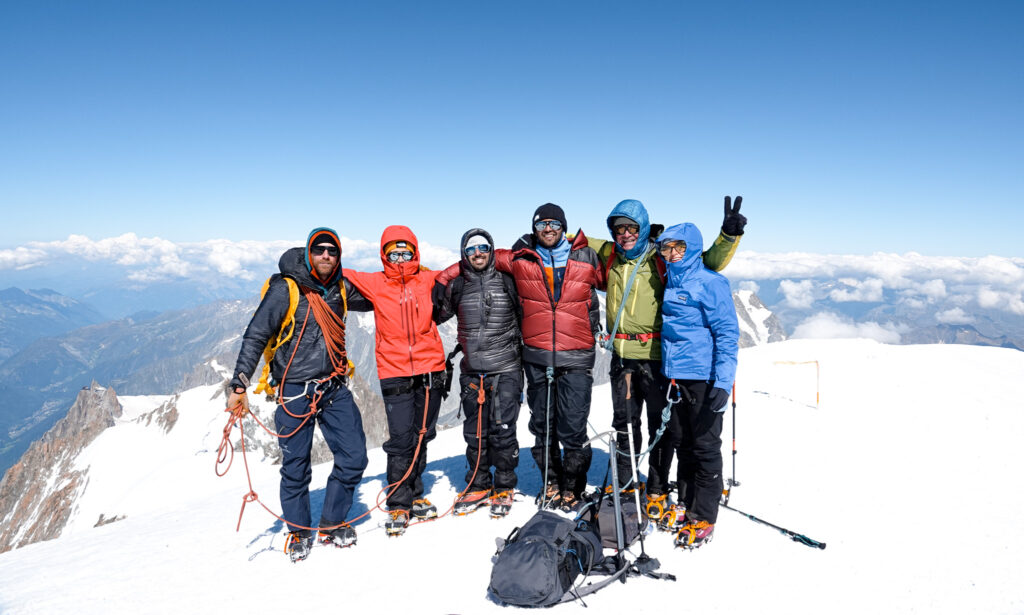
Above Vallot, the route crosses the Grande Bosse and Petite Bosse and continues along an exposed ridge towards the summit. For many first-timers, this is the most emotionally intense part of the climb. The top feels close, but the ridge may be narrow, wind-affected or icy, with rope teams moving in both directions. At nearly 4,809 metres, even simple movement becomes harder as altitude and fatigue reduce coordination.

Reaching the summit is only the turnaround point. Time spent celebrating, visibility, wind and the condition of each climber all affect the margin available for the descent.
Stage 6: the descent is not an afterthought
Most itineraries reverse the high route and continue back towards the huts and valley. The 10 to 12-hour planning figure from Goûter Hut to the summit and Nid d’Aigle includes a very large descent. This is one of the most important lessons for a first-time climber: reaching the summit is only the turnaround point. Fatigue can reduce foot placement, rope discipline, hydration and decision quality just when the team must recross exposed ground.
Why Goûter is called the normal route
“Normal route” means the standard or most commonly used line. It does not mean a normal hike, a safe route or a guaranteed summit. Goûter is normally less technical than the Trois Monts Route and has more infrastructure than the Italian Normal Route, which is why it is often the first route discussed with prepared first-time alpinists.
The better phrase is “least technically difficult classic route in typical conditions”. Even that must be qualified. Heat and rockfall can make the couloir unacceptable, wind or ice can change the high ridge, and access may be limited by huts, lifts or authorities.
Skills and fitness the route demands
A strong hiking background is useful, but the Goûter Route also asks for mountaineering movement and the ability to look after yourself over consecutive days. A prepared climber should be building towards:
- Efficient uphill and downhill endurance across consecutive mountain days
- Confident crampon use on snow, ice and mixed terrain
- Ice-axe handling and secure movement on exposed slopes and ridges
- Roped glacier movement and awareness of crevasse hazards
- The ability to eat, drink, pace and make conservative decisions at altitude
- The judgement to turn around without treating the summit as an entitlement
For the wider difficulty model, read How Hard Is It to Climb Mont Blanc? For the current regulatory framework, use our Mont Blanc rules and hut-booking guide as orientation and confirm the official wording with FFCAM.
Goûter Route bookings and access
Under FFCAM’s current terms, climbers on the normal route must be able to show proof of a named hut booking, and identity checks may take place. La Chamoniarde also states that bivouacking is prohibited in the protected area between Col du Mont Lachat and the summit.
Do not treat this summary as the rule itself. Booking procedures, opening dates, arrival times, lift services and authority measures can change. Check FFCAM’s current normal-route terms and the operating information for each hut and lift before travel.
What good preparation changes
Good preparation does not make the Grand Couloir safe or guarantee a summit. It helps you move more efficiently, understand instructions, conserve energy and contribute to sound team decisions. The Mont Blanc Summit Course combines progressive skills, acclimatisation, IFMGA guiding and alternative-objective planning so the experience is built around readiness rather than a fixed-route promise.
Official sources
- La Chamoniarde: Mont Blanc and the Goûter normal route
- La Chamoniarde: Safety Basics for Mont Blanc (PDF)
- FFCAM: normal-route hut booking terms and administrative provisions
Source check: 11 August 2026. Changing conditions are intentionally not described as evergreen advice.
Goûter Route FAQ
Is the Goûter Route easy?
No. It is normally the least technically difficult classic route on Mont Blanc, but it remains a serious alpine climb with objective hazards, altitude and a long descent.
What is the hardest part of the Goûter Route?
There is no single answer for every climber. The Grand Couloir creates objective rockfall exposure; the climb to the hut requires precise movement; and the high ridge and descent test fitness and concentration at altitude.
Do I need a hut booking?
Yes, the normal-route access system requires named booking evidence under the current FFCAM terms. Verify the latest procedure and carry the required confirmation and identification.
Can conditions make Goûter harder than another route?
Yes. Rockfall, ice, wind, snow and access can change the comparison. Route choice must be made from current information, not from a permanent ranking.
Prepare for the whole Goûter journey
Life Happens Outdoors helps first-time alpine climbers prepare for more than the summit moment. Our Mont Blanc Summit Course develops fitness, alpine skills and acclimatisation, then places those foundations within IFMGA guidance and a genuine alternative-objective plan. The Goûter Route and the summit are never guaranteed. The value is becoming a more capable mountain participant, making better decisions with your team and coming back different from the experience.
CONTINUE YOUR RESEARCH








ABOUT THE AUTHOR

Rami Rasamny
Rami Rasamny is the founder of Life Happens Outdoors, a premium adventure travel company that uses the outdoors as a catalyst for human transformation. His work brings people into the mountains not only for challenge, but for clarity, confidence, and connection. He believes that when people answer the call to adventure truthfully, they come back different.