EARLY BIRD! Enduring France and Italy

TRIP TYPE
Summit

DURATION
8 Days

DESTINATION
France and Italy
Six guided mountain days: a dedicated glacier-skills school at a maximum of 1:6, two applied alpine training days at a maximum of 1:3, and a three-day Mont Blanc phase at 1:2. Life Happens Outdoors' eight day Mont Blanc Summit Course is designed for fit, prepared first time alpine climbers who want structured acclimatisation, mountain skills training and a guided attempt via the Goûter route. It is not a beginner fitness programme: you must arrive ready for long mountain days and sustained ascent and descent at altitude.
Reviewed by Pavlos Tsiantos
IFMGA-certified guides lead the mountain days, with a maximum of two clients per guide throughout the three-day Mont Blanc phase. Each departure has a maximum of six participants. The eight-day itinerary is designed with flexibility and safety margins. Progression to the summit phase is conditional on fitness, technical readiness, weather, mountain conditions, access and guide judgement. The guides may change the objective or turn the team around when conditions or readiness do not support a Mont Blanc attempt. A summit is never guaranteed. Meet the IFMGA mountain guides who work with LHO in Chamonix and learn how their qualifications and Alpine experience support the technical leadership on our mountain days. In 2026, we ran 14 Mont Blanc courses with a total of 56 participants. Exceptional heat led us to redirect six of the 14 courses (approximately 43%) in full, with Monte Rosa and Weissmies as alternative destinations. Read a first-hand account from our 2026 Mont Blanc course.1
Eight days combining acclimatisation, glacier-skills preparation and a conditional guided attempt on Mont Blanc via the Goûter route.
2
Suitable as a first alpine course for participants who already have the fitness, mountain-day resilience and commitment to prepare properly.
3
IFMGA-led mountain days, a maximum of two clients per guide throughout the three-day Mont Blanc phase, and guide authority to change the plan, select an alternative objective or turn the team around.


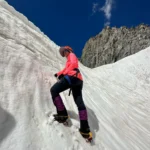
LHO uses activity-specific guide ratios. The first guided mountain day is a dedicated glacier-skills school at Torino Hut, with a maximum of six participants per IFMGA guide and no summit objective. Participants practise crampon technique, ice-axe handling, rope work and safe glacier movement before applying those skills on moving alpine terrain.
The maximum then reduces to 1:3 for two applied alpine training days and to 1:2 throughout the three-day Mont Blanc phase. LHO never guides Mont Blanc at 1:6 or 1:3.
Learn. Apply. Climb. — six guided mountain days
Dedicated glacier-skills school
Glacier terrain accessed from Torino Hut. Practise crampon technique, ice-axe handling, rope work and safe glacier movement. No summit objective.
Maximum 1:6
One IFMGA guide for up to six participants
Two applied alpine training days
Apply skills while moving in rope teams across glacier and alpine terrain. Training peaks and ridge objectives depend on conditions and guide judgement.
Maximum 1:3
One IFMGA guide for up to three participants
Entire three-day Mont Blanc phase
Approach, conditional summit attempt and descent on the planned Goûter itinerary. Progression depends on readiness, conditions, access and guide judgement.
Maximum 1:2 throughout
One IFMGA guide for up to two participants
Ratios mean one guide to the stated maximum number of participants. Itinerary Day 1 is arrival in Chamonix; Guided Mountain Day 1 is itinerary Day 2. Mountain plans and progression remain subject to participant readiness, conditions, access and guide judgement.
Departure prices and responsibilities
Early-bird bookings
Early-bird pricing applies to bookings made more than six calendar months before your trip's start date. Each departure has its own early-bird cutoff.
What your course price includes
Six guided mountain days, three hotel nights in Chamonix, mountain hut accommodation, all meals, scheduled return transfers between Geneva Airport and Chamonix, and itinerary cable cars, trains and transport. LHO Team Leader and Base Camp support includes preparation and trip coordination. LHO also covers additional accommodation, transport and guiding costs arising from guide-directed changes to the whole group’s itinerary.
Budget separately for
Flights, visas, personal gear and rentals, insurance, gratuities and costs arising from individual itinerary changes. Read the full inclusions and exclusions before choosing your departure.
Read these distinctions alongside the full inclusions, exclusions and booking terms. They help you compare the actual support and responsibilities, rather than treating every advertised course price as directly equivalent.
2027
DATE & STATUS
PRICE
AVAILABILITY
WHAT'S INCLUDED IN THIS TRIP
WHAT'S NOT INCLUDED IN THIS TRIP
DAY 1: ARRIVAL IN CHAMONIX
Arrival, equipment preparation and the welcome briefing. The six guided mountain days begin on itinerary Day 2. Your Mont Blanc adventure begins as you arrive in the Chamonix Valley, the heart of alpine mountaineering and the perfect base for your climb. If you’re flying into Geneva Airport, our trusted transfer partners will meet you and bring you directly to our hotel in Chamonix. Airport transfers are included for flights arriving at Geneva Airport (GVA) between 07:00 and 19:35. Alternative arrangements can be made through LHO, but additional charges may apply. To ensure a smooth arrival, please share your flight details with LHO Base Camp ahead of time.
If you’re joining us directly at the hotel, your LHO Team Leader will be there to welcome you. Hotel check in usually begins at 3 pm, but guests arriving earlier can store their bags and explore Chamonix. Your Team Leader will share a curated list of recommended spots around town, from scenic walks to cafés and gear shops.
For those needing to rent equipment, we highly recommend arriving early on Day 1. Gear shops in Chamonix typically close by 7 pm, and having everything ready tonight ensures we can make an early start tomorrow. Gear checks will be coordinated throughout the day to make sure everyone has what they need for glacier travel and the high alpine environment.
At 7:30 pm, the full team gathers for a welcome dinner and the first official briefing of the expedition. This is your chance to meet your fellow climbers, your Team Leader, and your lead IFMGA mountain guide. You’ll review the plan for the week, discuss the itinerary’s flexibility and key decision points, and run through the essential preparation for the days ahead.
Before departure, review route context, acclimatisation principles and summit-day expectations in our Mont Blanc climbing guide.
DAY 2 / GUIDED MOUNTAIN DAY 1: DEDICATED GLACIER-SKILLS SCHOOL AT TORINO HUT, MAXIMUM 1:6
This is Guided Mountain Day 1. Based at Torino Hut, today’s dedicated glacier-skills school has no summit objective and operates with a maximum of six participants per IFMGA guide (1:6). Practise crampon technique, ice-axe handling, rope work and safe glacier movement before applying those skills on the next two alpine training days.
Our first full day together marks the beginning of your high-altitude training and acclimatisation for climbing Mont Blanc. After breakfast, we leave the hotel and travel through the Mont Blanc tunnel to Courmayeur. From there, we ride the Skyway Monte Bianco to Punta Helbronner, one of the most spectacular viewpoints in the Mont Blanc range and an essential gateway for glacier travel and early mountaineering training.
Once we reach the top station, we take the elevator down and follow the enclosed walkway to the Torino Hut, our base for the next two nights. This hut sits at an ideal altitude for acclimatisation and offers immediate access to the glacier, making it a high-altitude base with direct access to glacier terrain used for acclimatisation and practical training. Its position allows us to train and climb without long approaches and provides several nearby peaks for warm up objectives.
After checking in and enjoying a light snack, we step onto the glacier for our first technical session. This is where you begin learning the essential skills for climbing Mont Blanc, including crampon techniques, ice axe handling, rope work, and the fundamentals of safe glacier movement. These skills are relevant to the planned Mont Blanc ascent via the Goûter route, but progression remains conditional on participant readiness, weather, mountain conditions and guide judgement.
In the evening we return to the Torino Hut for dinner and a short briefing about the next day’s plan. You will have time to rest, hydrate, and settle into the rhythm of high-altitude life as you prepare for the climbs ahead.
See how these glacier skills fit into the wider preparation in our Mont Blanc training and acclimatisation guide.
DAY 3 / GUIDED MOUNTAIN DAY 2: APPLIED ALPINE TRAINING, MAXIMUM 1:3
Today is the first of two applied alpine training days, with a maximum of three participants per IFMGA guide (1:3). Apply glacier and rope-team skills on moving alpine terrain, with an optional training summit selected according to conditions and participant readiness.
Training base: Torino Hut, 3,375 m. This is the hut elevation, not a fixed maximum for Day 3. The day’s maximum altitude, distance, ascent and descent depend on the training route and any optional summit selected by the guides.
Our second day in the high mountains begins with an unhurried start that allows everyone to settle into the rhythm of alpine life. Breakfast is served at 7 am and we aim to be outside by 9 am if the weather allows. Today is one of the most important stages in the Mont Blanc itinerary because it focuses on skills relevant to the planned Mont Blanc ascent.
Once we step onto the glacier, we begin training in rope teams and learn how to move efficiently across glaciated terrain. Your guides introduce the techniques used to navigate crevasses, manage mixed snow and ice and maintain steady progress as a team. This is also our first summit opportunity of the trip. Depending on conditions and participant readiness, the guides may select Petit Flambeau (3,440 m) or Aiguille de Toule (3,534 m), also known as Toula. These are optional training summits; neither is guaranteed. Summit elevations follow the IGN topographic map.
The pace is thoughtful and supportive with plenty of time for hands on learning. Many community members say this is the moment when the experience begins to feel real. The glacier becomes familiar, the gear feels natural and the skills gained during training start to come together with purpose.
We carry packed lunches so we can spend a full day on the glacier, taking breaks in incredible surroundings. In the afternoon, we return to the Torino Hut for dinner and rest. This day plays a key role in your acclimatisation and prepares you for the bigger objectives ahead.
DAY 4 / GUIDED MOUNTAIN DAY 3: APPLIED ALPINE TRAINING, MAXIMUM 1:3
The second applied alpine training day operates with a maximum of three participants per IFMGA guide (1:3). Glacier travel and a ridge objective such as the Marbrées Traverse put the skills into practice, subject to conditions and guide judgement.
Our final morning at the Torino Hut begins with a training climb in the Mont Blanc region. Conditions permitting, we cross the Glacier du Géant toward the Aiguilles Marbrées, a granite ridge positioned between the Dent du Géant and the Grandes Jorasses. This objective is close to the hut and can provide a combination of glacier travel, ridge climbing and exposure at altitude. The guides select the objective and route according to current weather, mountain conditions and participant readiness.
We begin by crossing the glacier and gaining the east ridge. The ascent is steady and engaging, with a mix of easy scrambling and movement over rock and snow. If conditions allow, we continue past the summit and follow the ridge toward the south side, where a short abseil provides a more direct return route and reduces the distance we would otherwise travel across the glacier. If weather or snow conditions do not support the full traverse, we simply retrace our ascent route.
We usually return to the Torino Hut in time for lunch. After gathering our equipment and taking a short break, we board the cable car and descend to Courmayeur before driving back to Chamonix. The night is spent at our hotel in the valley where rest and recovery become the priority. Dinner is hosted at a local restaurant or at the hotel, giving the team time to relax and prepare for the next stage of the Mont Blanc itinerary.
DAY 5 / GUIDED MOUNTAIN DAY 4: MONT BLANC PHASE, MAXIMUM 1:2
The three-day Mont Blanc phase begins today. A maximum of two participants per IFMGA guide (1:2) applies throughout the approach, conditional summit attempt and descent on itinerary Days 5–7.
Today marks the beginning of the Mont Blanc summit phase. We start later than usual, often around midday, to allow for rest and recovery before the climb. From Les Houches, we take the Bellevue cable car and continue on the Mont Blanc mountain train to Nid d’Aigle. This is one of the classic starting points for climbing Mont Blanc and offers spectacular views of the Bionnassay Glacier and the surrounding peaks.
From Nid d’Aigle, we begin a steady three hour trek toward the Tête Rousse Hut. This approach does not require technical equipment and provides a smooth progression in altitude. Along the lower slopes it is common to see mountain goats grazing on the rocky terrain, one of the many unique experiences of the Mont Blanc itinerary. We stop for a picnic lunch near the Rogne Forestière hut before continuing toward the Tête Rousse glacier. The guides decide whether and how technical equipment is used according to the actual glacier and snow conditions.
After checking in at the Tête Rousse Hut, the focus shifts to preparation. The guides and your LHO Team Leader meet with the hut guardian to review weather and conditions before finalising the plan for the Mont Blanc summit attempt. A detailed briefing takes place after dinner, delivered both to the group and to individual rope teams. This is when you learn exactly what to expect on the Goûter Route, how the ascent unfolds hour by hour and how to prepare for the crossing of the Grand Couloir. This evening sets the foundation for one of the most exciting stages of climbing Mont Blanc.
For route context, hut sequencing and the main ascent options, see our Mont Blanc route guide.
DAY 6 / GUIDED MOUNTAIN DAY 5: SUMMIT WINDOW 1, MAXIMUM 1:2
The Mont Blanc phase continues at a maximum of two participants per IFMGA guide (1:2). Today’s summit attempt remains conditional on readiness, weather, mountain conditions and guide judgement.
Summit day begins early at the Tête Rousse Hut. The guides choose the departure time and the approach to the Grand Couloir using the current weather, mountain conditions and team readiness. Timing is intended to manage exposure, but rockfall remains an objective hazard and cannot be eliminated.
The route continues over the Dôme du Goûter towards the upper mountain. After a short descent, we reach the area of the Vallot emergency shelter. The shelter is for emergencies and is not a planned rest stop.
Beyond the Vallot emergency shelter, the upper route continues towards Mont Blanc along the exposed Bosses ridge. Snow cover, ice and the shape of the ridge can change, affecting the line taken and its difficulty. The guides assess current conditions and team readiness and may change the plan or turn the team around.
The final section is an exposed summit ridge requiring concentration, controlled footwork and guide-led movement. Reaching the summit and continuing beyond each decision point depend on pace, readiness, weather, mountain conditions and guide judgement. If the team reaches the top, the summit opens into a broad dome with wide views across the Alps. There may be time for photographs and a short pause before the descent, depending on conditions and guide direction.
After the summit, we carefully retrace our steps down the route and return to the Goûter Hut for dinner and a well earned rest.
DAY 7 / GUIDED MOUNTAIN DAY 6: SECOND SUMMIT WINDOW OR DESCENT, MAXIMUM 1:2
The final day of the Mont Blanc phase operates at a maximum of two participants per IFMGA guide (1:2), whether the guides choose a second summit attempt or descent.
If the team reached the summit the previous day, this day is focused on the descent from the Goûter Route back to the Chamonix Valley. The guides choose the descent timing using current weather and mountain conditions. The Grand Couloir remains exposed to rockfall, and crossing decisions and timing remain with the guides.
Depending on the season and the mountain train schedule, breakfast may be served at the Tête Rousse Hut or lower down on the trail as a picnic. We usually reach the mountain train by late morning, arriving back in Chamonix around 12.30 pm. It has become a tradition for the team to stop near the cable station for a celebratory drink or snack before heading to the hotel for a well deserved shower.
The afternoon is free for returning gear, relaxing in town or exploring Chamonix. Many community members enjoy walking through the centre, visiting outdoor shops or simply unwinding after a major alpine achievement. A celebratory team dinner is held at 6.30 pm and is hosted by your Team Leader along with any LHO guides who are available to join.
If Mont Blanc was not reached on Day 6, a Day 7 attempt may still be possible, including after an unsuccessful attempt the previous day, provided the team remains physically capable. The guides decide whether to proceed using team readiness, weather and mountain conditions.
For a Day 7 attempt, we usually leave the Goûter Hut at around 3am, aiming to summit and return to Chamonix the same day. The Tête Rousse-to-Goûter leg has already been completed the previous day, so the attempt starts from the Goûter Hut. The return to Chamonix may be later in the afternoon, and the schedule adjusts accordingly.
Regardless of timing, this day gives everyone the chance to rest and reflect on the week in the high mountains, whether the team summited, turned around or completed an alternative objective.
For the full planning picture—including timing, weather windows and descent logistics—see our Mont Blanc planning guide.
DAY 8: AU REVOIR!
Our final day together is dedicated to airport transfers and farewells. Breakfast is included, and the morning is relaxed so you can pack, recover and enjoy your last moments in the Chamonix Valley. To ensure a smooth departure, please provide your correct flight details when completing your team details form, as we use this information to arrange your transfer to Geneva Airport with our trusted transfer partners. Airport transfers are included for flights departing from Geneva Airport (GVA) between 09:30 and 23:00. Alternative arrangements can be made through LHO, but additional charges may apply. If your travel plans change, let your LHO Team Leader know as early as possible so updated arrangements can be made. This final morning brings the expedition to a close and gives everyone time to reflect on the experience of climbing Mont Blanc before beginning the journey home.
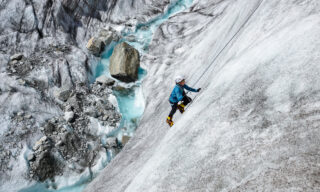
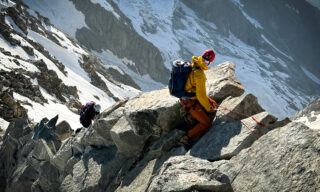
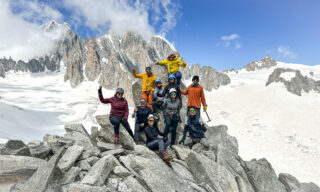
Historical photographs from previous LHO Mont Blanc courses show routes and conditions at the time they were taken. They do not represent current terrain or a guaranteed itinerary. Guides select objectives and routes using current conditions and team readiness.





WHO THIS COURSE IS FOR
This course is for fit, active people seeking a first structured alpine climbing experience; strong hikers who can train consistently and manage long ascent and descent days; and participants willing to learn progressively, follow guide decisions and value the full course even if Mont Blanc is not achievable that week.
LEARN MORE
DO NOT JOIN YET IF
Do not join yet if you cannot currently manage six to eight hours of uphill and downhill movement with a pack; you are starting from no hiking or endurance base; you are unwilling to turn around or accept an alternative objective when a guide decides readiness or conditions are insufficient; your sole measure of value is reaching the summit; or you have not arranged appropriate insurance. If injury, health or interrupted training makes readiness uncertain, speak to LHO and an appropriate medical professional before booking.
LEARN MORE
A completely transformative experience both mentally and physically!! Highly recommended for anyone looking to push the limits even if it ends in a few tears 😂😂😂
A completely transformative experience both mentally and physically!! Highly recommended for anyone looking to push the limits even if it ends in a few tears 😂😂😂
Noor Arar · LHO internal feedback form

I don’t know where to begin, but this trip has been one of the best life experiences I have had. The organization was on point, and I never felt worried about anything as Rami went above and beyond to accommodate all of us. When I read that there will be “professional photos taken” I expected 1-2 photos taken. However, I received tons of beautiful photos taken by Rami. He basically jumped around from team to team to make sure all of our photos were taken, and that ways a lot. The program itself has a great build up, which I really appreciated. I enjoyed the training as much as the journey to the summit of Mont Blanc. The guides were wonderful. My favorite day was the day we pushed to the summit, the feeling of accomplishment is indescribable. If you are thinking of signing up for this trip, do not think twice, you’ll have the time of your life! This will definitely not be my last trip with LHO
I don’t know where to begin, but this trip has been one of the best life experiences I have had. The organization was on point, and I never felt worried about anything as Rami went above and beyond to accommodate all of us. When I read that there will be “professional photos taken” I expected 1-2 photos taken. However, I received tons of beautiful photos taken by Rami. He basically jumped around from team to team to make sure all of our photos were taken, and that ways a lot. The program itself has a great build up, which I really appreciated. I enjoyed the training as much as the journey to the summit of Mont Blanc. The guides were wonderful. My favorite day was the day we pushed to the summit, the feeling of accomplishment is indescribable. If you are thinking of signing up for this trip, do not think twice, you’ll have the time of your life! This will definitely not be my last trip with LHO
EXPANDAhmed Al Monsouri · LHO internal feedback form

I’ve known members of the LHO community since the company was founded and have been wanting to join and be part of that community ever since. And after a long wait, my first and most recent trip with LHO has been to summit the Mont Blanc. Though I’ve hiked several mountains this has been my first alpine climbing experience and definitely not the last one. It has been one full of learnings, exploring and testing my limits on many levels. The team were very accommodating to our needs ensuring that everything ran smoothly including the logistics of the whole trip. I also like the fact that they consider every person a part of the LHO community once you are onboard. I do hope to experience and be part of more adventures in the future!!
I’ve known members of the LHO community since the company was founded and have been wanting to join and be part of that community ever since. And after a long wait, my first and most recent trip with LHO has been to summit the Mont Blanc. Though I’ve hiked several mountains this has been my first alpine climbing experience and definitely not the last one. It has been one full of learnings, exploring and testing my limits on many levels. The team were very accommodating to our needs ensuring that everything ran smoothly including the logistics of the whole trip. I also like the fact that they consider every person a part of the LHO community once you are onboard. I do hope to experience and be part of more adventures in the future!!
EXPANDAisha Alnaama · LHO internal feedback form

Grateful to Rami, entire LHO team and mountain guides for showing us what we were capable of achieving. Their expertise and support made it a dream come true. Rami is genuine, we will return! 🏔️🙌 #MontBlancAdventure
Grateful to Rami, entire LHO team and mountain guides for showing us what we were capable of achieving. Their expertise and support made it a dream come true. Rami is genuine, we will return! 🏔️🙌 #MontBlancAdventure
EXPANDHema Patel · LHO internal feedback form

Great trip. Rami n team did tremendous job! Pushing my limits beyond.
Great trip. Rami n team did tremendous job! Pushing my limits beyond.
Brackmann · LHO internal feedback form
Extraordinary trip for Extraordinary adventurers, started with technical mountain courses with professional guides and end with summited the top of Mont Blanc, LHO are amazing team, taking care of everything and make sure all the clients are comfortable & happy.
Extraordinary trip for Extraordinary adventurers, started with technical mountain courses with professional guides and end with summited the top of Mont Blanc, LHO are amazing team, taking care of everything and make sure all the clients are comfortable & happy.
EXPANDFaiza · LHO internal feedback form

This trip completely changed my perspective on life. It taught me that there is so much more to life than I had imagined. I met some beautiful human beings along the way and now I can't wait for my next adventure with LHO.
This trip completely changed my perspective on life. It taught me that there is so much more to life than I had imagined. I met some beautiful human beings along the way and now I can't wait for my next adventure with LHO.
EXPANDFitness Critic · LHO internal feedback form

This is my second time to join this Mont Blanc Summit trip. The first time was very windy so unfortunately we couldn't summit, just 300m away. But this time, although weather conditions were even more unpredictable, we pushed through with the support and encouragement of the team leader and mountain guides and in the end all reached the top of the Alps. I couldn't describe how grateful I am to the guides who pushed my limit and carried me through the tough moments. This is an unforgettable trip that I'll treasure forever.
This is my second time to join this Mont Blanc Summit trip. The first time was very windy so unfortunately we couldn't summit, just 300m away. But this time, although weather conditions were even more unpredictable, we pushed through with the support and encouragement of the team leader and mountain guides and in the end all reached the top of the Alps. I couldn't describe how grateful I am to the guides who pushed my limit and carried me through the tough moments. This is an unforgettable trip that I'll treasure forever.
EXPANDCatherine · LHO internal feedback form

Great trip. You never cease to impress and support. looking forward to more! Big Love
Great trip. You never cease to impress and support. looking forward to more! Big Love
Romy Habre · LHO internal feedback form
Great well-rounded trip with a lot of experiences to prepare you for alpinism. I would like to move the spotlight to the unsung hero Bader. He was working behind the scenes, on the scene, and towards future scenes. He was both the foundation and the ceiling. Wherever or whatever you need, just call Bader. He's got you covered like a warm wool blanket in arctic winter. Truly an exemplary display of supreme competence and reliability. A visionary, role model, and an anchor.
Great well-rounded trip with a lot of experiences to prepare you for alpinism. I would like to move the spotlight to the unsung hero Bader. He was working behind the scenes, on the scene, and towards future scenes. He was both the foundation and the ceiling. Wherever or whatever you need, just call Bader. He's got you covered like a warm wool blanket in arctic winter. Truly an exemplary display of supreme competence and reliability. A visionary, role model, and an anchor.
EXPANDMohammad Al Ramahi · LHO internal feedback form
Reflecting on this journey, I am filled with gratitude for the connections made outdoors. I’m taking home not just memories, but also a few extra pounds of laughter, questionable moves and delicious baby food. Each moment spent with the team has enriched my life in ways I never anticipated. I look forward to carrying these cherished moments with me always. Thank you LHO.
Reflecting on this journey, I am filled with gratitude for the connections made outdoors. I’m taking home not just memories, but also a few extra pounds of laughter, questionable moves and delicious baby food. Each moment spent with the team has enriched my life in ways I never anticipated. I look forward to carrying these cherished moments with me always. Thank you LHO.
EXPANDNada Omar · LHO internal feedback form

This was an incredible week, a truly life changing week and the team of guides will become eternal friends. The preparation of staying at altitude and doing the ridges were incredibly hard and I probably underestimated how fit you need to be to do this. Nevertheless, the preparation was perfect for attempting to summit Mont Blanc. Unfortunately, we were not able to summit because of the weather, but the week will be forever actually in my mind as one of the greatest weeks of my life. Rami is inspiring. And the cost of the trip was worth every penny. It was a life changing experience for me and I hope to do many more trips with the company in the future.
This was an incredible week, a truly life changing week and the team of guides will become eternal friends. The preparation of staying at altitude and doing the ridges were incredibly hard and I probably underestimated how fit you need to be to do this. Nevertheless, the preparation was perfect for attempting to summit Mont Blanc. Unfortunately, we were not able to summit because of the weather, but the week will be forever actually in my mind as one of the greatest weeks of my life. Rami is inspiring. And the cost of the trip was worth every penny. It was a life changing experience for me and I hope to do many more trips with the company in the future.
EXPANDTahir Hussain · LHO internal feedback form

From the moment I landed in Geneva till the last hour of the trip, everything was perfect. Going to the Alps had been a dream of mine for a long time, and LHO made it one of the most memorable experiences of my life. Rami greeted us with utmost generosity, and the team bonded with each other in no time! Everything ranging from accommodation to transportation was carefully planned and seamlessly executed. The guides Philip and Fred were very professional and played a big part in our success. I can go on for hours talking about my experience, but to sum it up, I learnt that it’s all about the journey rather than the summit. Learning from professionals like Rami, Fred and Philip was a real blessing as an 18 year old going into the mountaineering world. The team spirit and mentality during this climb truly reflects the real meaning of mountaineering. If you’re looking to get a taste of alpinism, don’t think twice, go with LHO. The experiences and memories will stay with you for a long long time!
From the moment I landed in Geneva till the last hour of the trip, everything was perfect. Going to the Alps had been a dream of mine for a long time, and LHO made it one of the most memorable experiences of my life. Rami greeted us with utmost generosity, and the team bonded with each other in no time! Everything ranging from accommodation to transportation was carefully planned and seamlessly executed. The guides Philip and Fred were very professional and played a big part in our success. I can go on for hours talking about my experience, but to sum it up, I learnt that it’s all about the journey rather than the summit. Learning from professionals like Rami, Fred and Philip was a real blessing as an 18 year old going into the mountaineering world. The team spirit and mentality during this climb truly reflects the real meaning of mountaineering. If you’re looking to get a taste of alpinism, don’t think twice, go with LHO. The experiences and memories will stay with you for a long long time!
EXPANDNareg Panossian · LHO internal feedback form
Use these questions to decide whether you are ready to take the next step:
If you want help assessing the fit, discuss your experience with the LHO team before booking. If your questions are resolved, use the current departure list above to review availability and begin your booking. The aim is to arrive informed, prepared and ready to contribute to the team’s mountain experience.
Is this suitable for a first-time alpine climber?
Yes, provided you arrive fit, prepared and comfortable with long mountain days. The course teaches foundational alpine skills, but it is not suitable for someone who is unfit, unprepared or starting from no hiking and endurance base.
What fitness do I need?
You should be able to sustain six to eight hours of uphill and downhill movement with a pack, ideally on consecutive days, and retain enough control for a long descent. Use the dedicated Mont Blanc training guide for the detailed preparation framework.
Do I need previous crampon or rope experience?
No previous crampon or rope experience is required for the published Learn New Skills profile. The course teaches foundational crampon movement, ice-axe handling, rope-team travel and glacier movement. You must still arrive with the physical base and mountain-day resilience needed to learn and perform at altitude.
Does booking guarantee a Mont Blanc summit attempt?
No. Progression to the Mont Blanc phase depends on fitness, technical readiness, acclimatisation, weather, mountain conditions, access and guide judgement. An individual or the team may be redirected, turned around or given an alternative objective.
Who decides whether we continue or turn around?
The IFMGA mountain guides make the operational decisions on route, timing, rope teams, alternative objectives and turnaround. Participants must be willing to follow those decisions promptly.
Which route does the course use?
The planned ascent uses the Goûter route. Access, transport, hut operations, conditions and objective hazards can change, so the published route and itinerary remain conditional. For detailed route and preparation context, see our complete guide to climbing Mont Blanc.
What are the main hazards?
The course involves altitude, cold, fatigue, crevasses, exposed terrain, rapidly changing weather and rockfall, including in the Grand Couloir. Guiding, timing and preparation manage risk but cannot remove it.
What happens if conditions or readiness do not support a Mont Blanc attempt?
The guides may change the timing or route, select another suitable mountain objective, stop the attempt or return to the valley. No specific alternative summit is guaranteed.
Any required accommodation for an alternative summit is arranged after the guide selects the objective, subject to availability and conditions.
How many clients are there per guide, and what is the maximum group size?
Each departure has a maximum of six participants. IFMGA-certified mountain guides lead the six guided mountain days. Ratios mean one guide to the stated maximum number of participants:
LHO never guides Mont Blanc at 1:6 or 1:3.
The LHO Team Leader supports trip coordination. One day of DSLR photography is included, provided by either a mountain guide or the Team Leader. Meet the IFMGA mountain guides who work with LHO in Chamonix. The roster represents LHO’s guide pool; the guide assigned to a specific departure is confirmed closer to departure.
What insurance do I need?
Insurance is not included. Your policy should cover the countries visited, guided mountaineering, the maximum altitude, medical treatment, rescue, repatriation and cancellation. Check the policy wording and exclusions before travel.
When is a Mont Blanc departure confirmed, and are the hut reservations secured?
Our Mont Blanc course requires a minimum of two participants. We make the final decision based on group size no later than 60 days before departure.
Before we confirm that a departure will run, we secure the required hut reservations for the planned Mont Blanc itinerary. A confirmed departure does not guarantee a Mont Blanc summit attempt or summit: progression remains subject to participant readiness, conditions and guide judgement.
Who pays for additional costs if the guides change the itinerary?
For this Mont Blanc course, LHO covers additional accommodation, transport and guiding costs arising from guide-directed changes to the whole group’s itinerary, including a change to an alternative summit. These costs are included in your course price and are not passed on to participants.
Individual departures or itinerary deviations applying to one participant remain subject to the trip exclusions. Any additional accommodation, transport, support or other costs arising from those individual arrangements are the participant’s responsibility.
Do I receive a refund or credit if Mont Blanc is not attempted or reached?
If the course runs, no refund or credit is provided solely because Mont Blanc is not attempted or reached. Booking the course does not guarantee a Mont Blanc summit attempt or summit.
If LHO cancels the departure, the cancellation provisions in our booking terms apply.
Who reviews and signs off on this page?
LHO’s published content is reviewed and signed off by Pavlos Tsiantos, a certified IFMGA mountain guide who works with LHO, unless otherwise stated. This includes the mountain facts, route descriptions, guide ratios and risk wording on this page. You can check his qualification in the official IFMGA register.
Does LHO climb Mont Blanc at a 1:6 guide ratio?
No. The 1:6 maximum applies only to the first guided mountain day, a dedicated fundamentals session with no summit objective. The next two moving alpine training days operate at a maximum of 1:3, and the entire three-day Mont Blanc phase operates at 1:2.
PAYMENT PLANS AVAILABLE
£4675
DOWNLOAD YOUR TRIP GUIDEBOOK


INQUIRE NOW
This adventure is only available as a private trip and is customized to your requirements, experience and skill level. To get started, please fill out the form below. We’ll be in touch soon to put it together for you.
"(Required)" indicates required fields
CONTACT US
We’re passionate about guiding you to epic adventures and beyond. If you have any questions at all, don’t hesitate to reach out. We’d love to hear from you.