Outdoor Skills & Safety | BY Rami Rasamny | PUBLISH DATE: January 21 2026 | READ TIME: 3 mins | UPDATED DATE: September 11 2026
Technical Skills for Climbing Mont Blanc

DOWNLOAD YOUR Climb Mont Blanc GUIDEBOOK
By Rami Rasamny, Founder of Life Happens Outdoors Short answer: a guided Mont Blanc programme may teach and assess crampon use, ice axe handling, rope-team movement and glacier travel. These skills support efficient movement in alpine terrain, but learning them does not guarantee readiness, safe conditions or a summit. This checklist covers technical skills for […]
By Rami Rasamny, Founder of Life Happens Outdoors
Short answer: a guided Mont Blanc programme may teach and assess crampon use, ice axe handling, rope-team movement and glacier travel. These skills support efficient movement in alpine terrain, but learning them does not guarantee readiness, safe conditions or a summit.
This checklist covers technical skills for a guided Mont Blanc programme. For a wider preparation plan, read our Mont Blanc training guide. To assess whether a course could be right for you, read our beginner-readiness guide.
Watch the video
The video introduces the type of instruction used on the Mont Blanc Summit Course. Watching it can help you recognise the equipment and language. It cannot demonstrate that you can perform a skill reliably in mountain conditions.
For the live itinerary, inclusions and departures, review the Mont Blanc Summit Course.
Technical-skills checklist
Crampon movement
You should be able to place your feet securely, keep the points clear of clothing and move without crossing or catching your feet. The exact technique changes with the angle, surface and guide instruction.
Ice axe handling
You should know how to carry and use an ice axe for balance and security as instructed. Self-arrest practice can be part of skills training, but it is not a substitute for avoiding a fall or following the guide’s movement instructions.
Rope-team movement
You should understand pace, spacing and why slack or sudden movement affects the other people on the rope. Good rope-team movement requires attention and immediate response to guide instructions.
Glacier travel
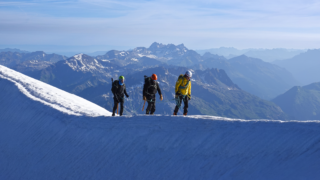
Guided glacier travel includes moving in the required rope system, maintaining spacing and understanding that the guide may change the system as terrain and conditions change. Introductory instruction does not make someone independently competent to lead glacier travel.
Mixed terrain and scrambling
Mont Blanc preparation may include snow, rock and transitions between them. You need controlled footwork, balance and the ability to change equipment without losing focus.
Equipment transitions
Harnesses, helmets, crampons, layers and other equipment need to be adjusted efficiently. Organisation matters because delays and mistakes affect the whole rope team.
Instruction and assessment boundaries
An appropriate course can introduce these foundations and give you time to practise them on guided mountain days. The guide will observe how you learn, move and respond as fatigue increases.
Performing a movement once is not the same as performing it reliably. The guide may adapt the pace, terrain, objective or plan according to individual readiness, group ability, access, weather or mountain conditions.
Where difficulty and route decisions belong
This checklist does not decide whether Mont Blanc is easy, difficult or suitable for you. Use How Hard Is It to Climb Mont Blanc? for the combined difficulty assessment and Is Mont Blanc a Technical Summit? for technicality.
For routes, huts, duration, cost and the wider planning sequence, use the Mont Blanc planning guide.
Frequently asked questions
Do I need previous technical mountaineering experience?
Not necessarily before joining an appropriate guided course. You do need the fitness to learn under fatigue, the willingness to follow instruction and the ability to demonstrate the required movements before a larger objective is attempted.
Is watching the video enough preparation?
No. Video can provide orientation, but technical movement needs supervised practice in suitable terrain.
Do these skills guarantee a Mont Blanc attempt or summit?
No. Readiness, access, weather, mountain conditions and guide judgement may change the objective.
Come Back Different.
CONTINUE YOUR RESEARCH







ABOUT THE AUTHOR

Rami Rasamny
Rami Rasamny is the founder of Life Happens Outdoors, a premium adventure travel company that uses the outdoors as a catalyst for human transformation. His work brings people into the mountains not only for challenge, but for clarity, confidence, and connection. He believes that when people answer the call to adventure truthfully, they come back different.