









Trip Planning for Treks & Climbs | BY Rami Rasamny | PUBLISH DATE: November 10 2026 | READ TIME: 8 mins | UPDATED DATE: November 10 2026
How Do You Get Down from Kilimanjaro After the Summit?
DOWNLOAD YOUR Climb Kilimanjaro GUIDEBOOK
Reaching Uhuru Peak is not the end of the walking. Learn how LHO’s current Machame descent continues to camp and the park gate, what the terrain asks of tired legs and how to prepare.
On Life Happens Outdoors’ current Machame itinerary, getting down from Kilimanjaro is a two stage return journey after the summit turnaround. The team descends from Uhuru Peak to Barafu for food and rest, continues to a lower overnight camp near the rainforest, then walks out to the national park gate the following morning.
Reaching the summit is therefore not the end of the walking. A substantial descent remains on tired legs, across changing ground, with the guide team still managing pace, health, food, water and the movement of the group. The exact timing varies with the team, trail conditions and guide decisions, so this guide explains the sequence rather than promising a universal timetable.
This article was reviewed for Kilimanjaro accuracy by Emmanuel Matinde Asseno, Tanzanian Mountain Guide, Licence No. 037979, and Wilderness First Responder. Reviewed November 2026.
The summit turnaround is the start of the return
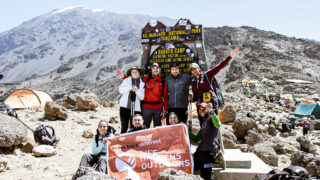
Uhuru Peak is the highest point of the journey, but it is not a place to settle in for a long rest. The team takes the time that conditions and guide decisions allow for photographs, a short celebration and a check on how everyone is feeling. Then the direction changes.
That change can feel surprisingly abrupt. For hours, every step has been focused on reaching the summit. Once you turn around, the task becomes controlled movement back to lower altitude and proper recovery. You may feel relieved, emotional or energised, but you are also carrying the fatigue of summit night.
This is why a good summit strategy includes the descent from the beginning. Food, water, warm layers, gloves and communication still matter. The team continues to move together according to the guide plan. If you want to understand the hours before the turnaround, start with our guide to what Kilimanjaro summit night feels like.
How LHO’s Kilimanjaro descent is organised
The sequence below follows the current published LHO Machame itinerary. Other Kilimanjaro routes can use different descent arrangements, camps and exit gates. Even on the same route, weather, trail conditions and the needs of the team can change the day.
From Uhuru Peak back to Barafu
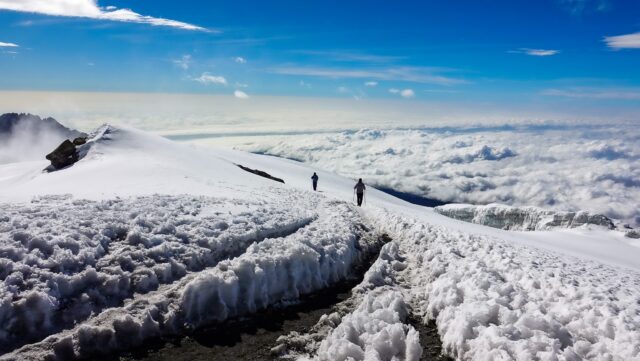
The first objective is to leave the summit area and return to Barafu. This reverses the final part of the summit route, moving from the crater rim and high alpine environment back towards the camp where the team prepared for the summit attempt.
The ground is steep, high and exposed to changing weather. Parts of the upper route can be loose or rocky, and tiredness can change how confident your steps feel. This is a time to listen closely to the guides, keep a controlled rhythm and say early if you feel unwell or unsteady.
Barafu provides an important pause. The current itinerary includes food and rest there before the team continues lower. It is a recovery point within the same long mountain day, not the end of the descent.
From Barafu to the overnight camp
After eating and resting, the team continues down towards an overnight camp near the edge of the rainforest. The landscape changes as altitude is lost. The trail moves away from the stark summit environment towards ground with more vegetation, while the cumulative load on legs and feet continues to build.
The current LHO itinerary records the complete summit day as 16 kilometres, with 1,250 metres of ascent and 2,800 metres of descent. Those are total day figures. They include the climb from Barafu to Uhuru Peak and the return to the overnight camp, so they should not be read as a stage by stage timing or a promise of how your day will feel.
By the time the team reaches camp, the priority is simple: eat, drink, settle into the tent and recover. The sense of relief can be strong, but one final walking stage remains the next morning.
From the overnight camp to the park gate
The final morning begins much lower on the mountain. The current itinerary lists 8.6 kilometres and 1,444 metres of descent from camp to the gate, and describes the walk as around three hours. Treat that as the published itinerary rather than a guaranteed personal time. Pace, trail conditions, stops and the movement of the group all matter.
The descent continues through rainforest to the national park gate. There, the mountain team completes the exit process before the group returns to the hotel. Only then do showers, a proper rest and the final team dinner come into view.
What the ground can feel like on tired legs
Kilimanjaro’s descent is not one uniform trail. The upper mountain asks for careful foot placement on steep, loose and rocky ground. Lower down, the route becomes greener, but forest paths can still be uneven and may be wet or muddy after rain.
The physical demand also changes. Uphill walking asks you to keep producing force against gravity. Downhill walking repeatedly asks your legs to control your body as it drops. After summit night, that braking work can make thighs, knees, ankles and feet feel more tired than expected.
You do not need to rush because the trail points down. A steady pace, short deliberate steps and honest communication are more useful than trying to stay with someone else’s speed. The guide team may adjust spacing, breaks and group order according to the ground and how people are moving.
Do trekking poles help on the descent?
Many trekkers value poles for balance and rhythm on long descents, particularly when their legs are tired. Their usefulness still depends on the terrain, the way they are adjusted and whether you have practised with them before the trip.
Poles should not encourage you to lean heavily forward or move faster than you can control. Adjustments that work on an open trail may not suit every rocky or crowded section, so follow the guide team’s instruction on the mountain.
Choose and practise with your setup before departure. Our comparison of folding and telescoping trekking poles explains the practical differences without turning this article into an equipment guide.
What happens if someone needs to turn around earlier?
An early turnaround is a guide led decision, not a failure and not a standard route with one fixed sequence. What happens next depends on the person’s condition, their location, the weather, the available team support and the current operating plan.
If you feel unwell, weak or unable to move steadily, tell a guide immediately. Do not hide a problem because the summit feels close or because someone else appears to be coping well.
The guide team will decide what happens next based on the person’s condition, location, weather, available support and current operating plan. Follow that instruction and keep communicating as circumstances change. Do not assume that a vehicle, stretcher, helicopter or a particular transfer time will always be available.
How to prepare for the way down
Train for controlled downhill walking
A Kilimanjaro plan should prepare you to descend after a long ascent, not simply to reach a high point. Include progressive downhill walking in your training, ideally on varied ground and as part of back to back walking days. Build gradually so your muscles, joints and feet have time to adapt.
Use our eight week Kilimanjaro training plan for the full preparation structure. If you have an injury, health condition or uncertainty about training load, seek advice from a suitably qualified professional who understands your circumstances.
Practise with the kit you will actually use
Wear your planned footwear on long training walks, including descents. Learn how your socks, lacing and foot care respond after several hours. If you will use poles, practise deploying, adjusting and carrying them before the climb.
Keep the items you may need during the descent accessible rather than buried in your main duffle. The exact daypack setup should follow the current LHO kit guidance and the briefing for your departure. Our Kilimanjaro packing list owns the complete clothing and equipment advice.
Plan mentally for the full mountain day
It is easy to imagine the summit photograph as the finish line. A more useful mental picture includes the return to Barafu, the continuation to the overnight camp and the final morning to the gate.
That does not make the summit less meaningful. It makes the plan more honest. You can celebrate the highest point while keeping enough attention for the safe, patient work that follows.
A practical descent checklist
- Train for sustained downhill walking as well as ascent.
- Practise in the footwear and pole setup you intend to use.
- Keep essential layers, gloves, water, food and personal items accessible.
- Expect summit day to continue well beyond the summit turnaround.
- Tell a guide early if you feel unwell, unsteady or unable to keep moving comfortably.
- Follow the guide team’s pace and decisions rather than another trekker’s speed.
- Leave the day after the mountain flexible enough for recovery and changing travel needs.
- Review the current trip itinerary before departure because route and camp arrangements can change.
The descent is part of the achievement
Getting down from Kilimanjaro is not an afterthought or a quick return once the summit photograph is taken. It is a planned part of the current Machame itinerary, completed in stages with food, rest, an overnight camp and continued guide support.
The most useful preparation is to respect the whole journey. Train for the downhill load, know where your essential kit is, practise with your poles, communicate honestly and keep following the team plan after the direction changes.
To see how the summit and descent fit into the complete journey, review the current LHO Climb Kilimanjaro itinerary.
CONTINUE YOUR RESEARCH







ABOUT THE AUTHOR

Rami Rasamny
Rami Rasamny is the founder of Life Happens Outdoors, a premium adventure travel company that uses the outdoors as a catalyst for human transformation. His work brings people into the mountains not only for challenge, but for clarity, confidence, and connection. He believes that when people answer the call to adventure truthfully, they come back different.