Trip Planning for Treks & Climbs | BY Rami Rasamny | PUBLISH DATE: July 13 2026 | READ TIME: 16 mins | UPDATED DATE: September 23 2026
Gokyo Lakes vs Everest Base Camp: Which Trek Is Right for You?

DOWNLOAD YOUR Gokyo Lakes Trek GUIDEBOOK
Choose the Gokyo Lakes Trek if you want quieter trails, turquoise glacial lakes, wide mountain panoramas, and a varied circuit through the Everest region. Choose the classic Everest Base Camp route if reaching Base Camp itself, following the historic Khumbu trail, and experiencing Everest expedition culture are central to your goal. Still considering routes beyond […]
Choose the Gokyo Lakes Trek if you want quieter trails, turquoise glacial lakes, wide mountain panoramas, and a varied circuit through the Everest region. Choose the classic Everest Base Camp route if reaching Base Camp itself, following the historic Khumbu trail, and experiencing Everest expedition culture are central to your goal.
Still considering routes beyond these two? Compare Nepal treks by duration, altitude and difficulty, including Annapurna Base Camp, Mardi Himal and Three Passes.
Neither route is automatically better or easier. Gokyo generally offers more solitude and broader scenery, while Everest Base Camp carries greater historical and emotional significance. The right choice depends on what you want to experience in Nepal rather than which trek is more famous.
Our Nepal trekking and mountaineering hub provides a broader comparison of Gokyo, Everest Base Camp, Annapurna Base Camp, Island Peak, and other Himalayan adventures.
Gokyo Lakes vs Everest Base Camp at a glance
| Comparison point | Gokyo Lakes Trek | Everest Base Camp Trek |
| Main route focus | The Gokyo Valley, turquoise glacial lakes, Gokyo Ri, and the possible crossing of Renjo La Pass. | The historic Khumbu route, Tengboche, the Khumbu Glacier, Everest Base Camp, and the optional ascent of Kala Patthar. |
| Crowds | Quieter after leaving the shared trail beyond the Namche and Khumjung area. | Busier throughout much of the main route, particularly during the main trekking seasons. |
| Mountain views | Wide panoramic views of Everest, Lhotse, Makalu, Cho Oyu, the lakes, and the surrounding glaciers. | Closer views of Ama Dablam, Nuptse, Pumori, the Khumbu Glacier, and the upper Everest landscape. |
| Highest major objective | Gokyo Ri at approximately 5,357 metres or Renjo La at approximately 5,360 metres. | Kala Patthar at approximately 5,545 metres when included, with Everest Base Camp at approximately 5,364 metres. |
| High pass | Renjo La may be included and can be the most demanding day of the journey. | The standard route does not require a high pass crossing. |
| Overall difficulty | Challenging because of altitude, consecutive trekking days, and the possible Renjo La crossing. | Challenging because of sustained altitude, repeated trekking days, moraine, and accumulated fatigue. |
| Signature experience | Standing above the Gokyo Lakes with four of the world’s highest mountains visible across the horizon. | Reaching Everest Base Camp and walking through the landscape associated with Everest expeditions. |
| Best suited to | Trekkers who value scenery, quieter trails, route variety, and a circuit style journey. | Trekkers who value the symbolism of Base Camp, trekking history, and the classic Everest route. |
| LHO itinerary length | 16 days, including Kathmandu preparation, acclimatisation, the mountain route, and return logistics. | 16 days, including Kathmandu preparation, acclimatisation, the mountain route, and return logistics. |
Within the current Life Happens Outdoors programme, both routes are structured as 16 day journeys and are offered at the same price point. This reflects the fact that Gokyo is not a shortened or reduced version of the Everest experience. It is a different journey that requires the same commitment to acclimatisation, logistics, preparation, and support.
Why choose Gokyo instead of Everest Base Camp?
The strongest reason to choose Gokyo is that the route gives you the scale and drama of the Everest region without remaining on its busiest trail throughout the journey. You still experience Lukla, the suspension bridges, Namche Bazaar, Sherpa villages, high altitude tea houses, and views of Everest, but beyond the Namche and Khumjung area the route turns west into the quieter Gokyo Valley.
The experience is shaped by an entire landscape rather than one final destination. The lakes, glaciers, surrounding summits, villages, Gokyo Ri, and Renjo La each provide a distinct stage of the journey.
Gokyo is particularly well suited to trekkers who value:
Panoramic views of the Everest region
Quieter walking after leaving the main trail
A journey through lakes, valleys, glaciers, villages, and mountain passes
A challenging trek without a technical climbing objective
A circuit that avoids retracing the entire approach route
Gokyo should not be described as empty, undiscovered, or secret. It is an established Himalayan trekking route with tea houses and recognised mountain objectives, but it receives less concentrated traffic than the classic EBC corridor.
What does the Gokyo trek route look like?
Most Gokyo Lakes itineraries begin with the journey to Lukla and follow the same lower trail used by Everest Base Camp trekkers. The route passes through Phakding, enters Sagarmatha National Park near Monjo, and climbs to Namche Bazaar, where a second night is normally used for acclimatisation before the two routes begin to separate.
From Namche, a carefully paced route continues through places such as Khumjung, Phortse Tenga, Dole, and Machhermo before reaching Gokyo village beside the lakes.
From Gokyo, trekkers can follow several route styles:
Return towards Namche through the Gokyo Valley
Cross Renjo La and descend through Lumdeng and Thame
Cross Cho La and connect with the Everest Base Camp route
The Life Happens Outdoors Gokyo Lakes Trek crosses Renjo La to create a varied circuit through the quieter western side of the Khumbu. The route then descends through Lumdeng and Thame before reconnecting with the lower trail.
What are the main highlights of the Gokyo Lakes Trek?
The Gokyo Lakes
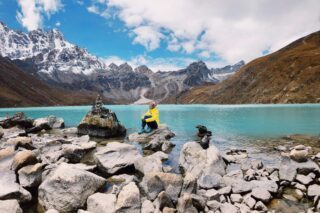
The Gokyo Lakes form a chain of glacial lakes set high beneath some of the largest mountains on Earth. Their turquoise colour contrasts with the grey moraine, snow covered summits, and broad Himalayan landscape surrounding them, while the changing light can make the water appear deep blue, green, or almost silver at different times of the day.
Gokyo village sits beside the third lake and becomes the main base for exploring the area. Arriving here feels different from reaching a single monument because the whole valley becomes the destination.
The optional Gokyo Ri trek
Gokyo Ri rises above the village to approximately 5,357 metres and provides one of the widest mountain panoramas in the Everest region. From the summit, trekkers can see Everest, Lhotse, Makalu, and Cho Oyu, together with the lakes and the vast glacial landscape below.
The ascent is not technical in normal conditions, but it is physically demanding because of the altitude. Even a moderate slope can feel serious above 5,000 metres.
Climbing Gokyo Ri is optional but strongly recommended. The trekking team should confirm the timing and plan based on the weather, trail conditions, available time, and how the group is responding to the altitude.
The upper Gokyo Valley
The upper valley feels open, quiet, and dominated by the enormous south face of Cho Oyu. The journey into the valley reveals a gradual transition from forest and river terrain to alpine pasture, moraine, lakes, and glacial landscapes, which helps the trek feel like a complete mountain journey rather than a walk towards one final landmark.
Renjo La Pass
Renjo La connects Gokyo with the quieter western side of the Khumbu and reaches approximately 5,360 metres. The climb is sustained, while the initial descent towards Lumdeng is steep and can be tiring.
Snow or ice may make the crossing more serious, and ropes may occasionally be used to manage particular sections safely. Renjo La should therefore be treated as a significant mountain day rather than a guaranteed sightseeing stop, with experienced local guides assessing the weather, trail, group, and pass conditions before committing to the crossing.

Is Gokyo harder than Everest Base Camp?
Gokyo with Renjo La can be harder than the classic Everest Base Camp route on its most demanding day. Everest Base Camp can feel equally difficult overall because of the number of nights spent at altitude, the glacial moraine, the repeated trekking days, and the accumulated fatigue of the journey.
Neither route normally requires technical climbing skills. Both require good walking fitness, appropriate acclimatisation, steady pacing, and the ability to recover across consecutive days.
Gokyo may feel harder when:
The itinerary includes Renjo La
Snow or ice affects the high pass
You find steep descents difficult
Your body is adapting slowly to altitude
You have limited experience on rough mountain trails
Everest Base Camp may feel harder when:
Sustained altitude affects your recovery
Repeated walking days create cumulative fatigue
You find glacial moraine tiring
The busier environment affects your ability to rest
Reaching Base Camp and Kala Patthar creates a demanding final sequence
The honest conclusion is that neither is an easy alternative to the other. Life Happens Outdoors gives both journeys 16 days because each requires proper preparation, gradual acclimatisation, and enough time for the body to adjust to the environment.
Prepared first time trekkers can complete either journey, but Gokyo should never be chosen on the assumption that it is simply an easier Everest Base Camp trek. For a fuller explanation of the classic route, read our guide to Everest Base Camp trek difficulty.
Is Gokyo less crowded than Everest Base Camp?
Gokyo is generally less crowded than the classic Everest Base Camp route after the trails separate beyond the Namche and Khumjung area. The lower section between Lukla and Namche remains busy because it is shared by trekkers, climbers, porters, local residents, animals, and groups travelling towards several Everest region destinations.
Once the route turns into the Gokyo Valley, the trail usually becomes calmer, with fewer large groups, smaller settlements, and longer periods where the landscape becomes the main focus. Quieter does not always mean that accommodation is easier to secure, since there are fewer tea houses in parts of the Gokyo Valley and the available rooms can still fill during popular trekking periods.
The most accurate description is that Gokyo feels less commercially concentrated. It remains an established tea house trek, but the experience becomes more remote and reflective.
Is the scenery better at Gokyo or Everest Base Camp?
Gokyo generally offers the stronger panoramic mountain views. From Gokyo Ri, you can see Everest, Lhotse, Makalu, Cho Oyu, the lakes, and the surrounding glacial terrain within one broad landscape, helping you understand how the summits, valleys, and glaciers of the region connect.
Everest Base Camp offers a different form of scenery and meaning. The route includes Tengboche, Ama Dablam, the upper Khumbu, the Khumbu Glacier, expedition history, and the experience of reaching the base of the world’s highest mountain.
Everest itself is not clearly visible from the main Base Camp area because surrounding mountains obscure much of it. The optional Kala Patthar ascent provides the classic close view of Everest above the upper Khumbu.
There is no objective winner. Gokyo is often more satisfying for people who want visual variety and wide mountain views, while EBC is often more meaningful for those who feel connected to the history and symbolism of Base Camp.
What are the tea houses and trail experience like?
Both routes use family run tea houses rather than tents. Rooms are normally simple, and shared bathroom facilities become more common as you move higher, while meals generally include trekking staples such as dal bhat, rice, noodles, soup, potatoes, eggs, porridge, and bread.
Namche has the widest choice of accommodation, cafés, shops, bakeries, and places to rest. Once you enter the Gokyo Valley, the villages become smaller and the tea houses become simpler.
This change is part of the character of the route because Gokyo feels more remote precisely as the settlements and infrastructure become less concentrated. Life Happens Outdoors uses stronger available tea houses in Phakding and Namche, where improved comfort can support rest and acclimatisation, while accommodation higher in the valley is shaped by what the mountain communities can realistically provide.
How does the cultural experience differ?
Both routes pass through Sherpa communities and use family run tea houses, but the atmosphere changes as the trails separate. The classic Everest Base Camp route follows the main Khumbu corridor through places such as Tengboche, Dingboche, and Lobuche, where trekking and mountaineering have shaped village life for generations.
The Gokyo route turns west into smaller settlements where there are fewer large groups and less concentrated tourism infrastructure. This can create a quieter rhythm and more time to appreciate the villages, monasteries, working landscapes, and daily life of the valley.
This does not make one route more culturally authentic than the other. Both pass through living Sherpa communities with their own history and relationship with the mountains. The difference is that Everest Base Camp feels more connected to expedition culture, while Gokyo often feels calmer and less commercially concentrated.
Who should choose Gokyo?
Choose Gokyo if you are more interested in the wider mountain journey than reaching one famous destination. It is particularly rewarding for photographers, quieter travellers, returning Nepal trekkers, and people who want the challenge of a high Himalayan circuit.
Gokyo may be right for you when:
You want some of the broadest views of the Everest region
You prefer quieter trails and smaller settlements
You enjoy circuit style journeys
You are comfortable choosing scenery over the symbolism of Base Camp
You want a serious trek without progressing into technical climbing
For someone who has already completed a major Himalayan trek and wants to progress further, Gokyo may also form part of a longer journey towards an objective such as the Lobuche East expedition.
Want the quieter circuit with lakes, Gokyo Ri and Renjo La? Explore the Gokyo Lakes Trek.
Who should choose Everest Base Camp?
Choose the Everest Base Camp Trek if reaching Base Camp has personal meaning for you. The route is especially suited to trekkers who feel connected to Everest history and would regret leaving Nepal without reaching the famous destination.
The classic route may be right for you when:
Standing at Everest Base Camp is an important goal
You want to follow the most historic trekking corridor in the Khumbu
Tengboche, the Khumbu Glacier, and Everest expedition culture interest you
You prefer not to cross a high pass such as Renjo La
You would regret visiting the Everest region without reaching Base Camp
Neither decision is more legitimate or more adventurous. The right route is the one that reflects what you genuinely want to experience rather than the destination you feel expected to choose.
Is reaching Base Camp the goal that first drew you to Nepal? Explore the Everest Base Camp Trek.

What does a Gokyo Lakes itinerary include?
A well designed Gokyo Lakes itinerary must provide enough time to acclimatise in Namche and gain altitude gradually through the valley. The number of days matters, but the arrangement of overnight elevations, rest periods, acclimatisation walks, and higher objectives matters more.
A representative Gokyo Lakes itinerary may include:
Arrive in Kathmandu and meet the team.
Complete the trip briefing, equipment checks, and final preparation.
Travel to Lukla and trek to Phakding.
Trek from Phakding to Namche Bazaar.
Complete an acclimatisation walk and sleep in Namche for a second night.
Leave the main EBC trail and enter the Gokyo Valley through Khumjung and Phortse Tenga.
Continue gradually towards Dole.
Trek to Machhermo and use the shorter day for recovery.
Walk past the lower lakes and reach Gokyo village.
Complete the optional but recommended ascent of Gokyo Ri when conditions and the group allow.
Cross Renjo La and descend towards Lumdeng when the pass is suitable.
Continue through the western valley to Thame.
Return through Namche towards Monjo.
Walk back to Lukla.
Return to Kathmandu according to the confirmed aviation plan.
Depart Kathmandu or continue with personal travel.
The LHO itinerary includes one helicopter sector between Kathmandu and Lukla, which may be used on the way into the mountains or on the return depending on weather, airport operations, and the plan that provides the smoothest journey for the group. The other direction is normally completed by fixed wing flight.
This does not remove the uncertainty of Himalayan aviation, but it provides greater flexibility around one of the most disruption prone parts of an Everest region itinerary. For a closer examination of different route lengths, read how long the Gokyo Lakes Trek takes.
When is the best time to trek to Gokyo?
The main trekking seasons are spring, from March to May, and autumn, from October into early December. These periods generally provide the best balance of visibility, functioning tea houses, manageable temperatures, and more stable mountain conditions.
Spring can bring milder temperatures and colour at lower elevations, while autumn is often chosen for clear views and quieter conditions once the main Everest climbing season has ended. Conditions at Renjo La can still change quickly during either season, with snow, wind, or ice potentially affecting whether the crossing is suitable on a particular day.
Winter offers quieter trails but colder nights, shorter daylight hours, and a greater chance that snow will affect the high route. The summer monsoon brings cloud, rain, flight disruption, and reduced mountain visibility.
The correct season should therefore be considered alongside the route. A journey to Gokyo village is not affected by conditions in exactly the same way as an itinerary that depends on crossing Renjo La or Cho La.
Do you need more preparation for Gokyo than for EBC?
The overall fitness requirements are similar, but a Gokyo route including Renjo La places greater emphasis on climbing and descending steep terrain. Training should focus on sustained walking rather than speed, with the goal of arriving able to walk for several hours, recover overnight, and repeat the effort across many consecutive days.
A useful preparation programme should include:
Long walks that gradually increase in duration
Regular hill walking or stair climbing
Leg and core strength work
Descending practice to prepare your knees
Walking on consecutive days
Carrying the footwear and backpack you intend to use
Consistent attention to sleep, nutrition, and recovery
No sea level training programme can guarantee how your body will respond to altitude. What you can control is your fitness, pacing, itinerary, hydration, communication, and willingness to rest or descend when your body is not adapting normally.
Our high altitude preparation guide explains how to arrive better prepared without assuming that fitness alone protects you from altitude problems. Knowing how to recognise altitude sickness symptoms is equally important because symptoms should be communicated early so the trekking team can respond before a manageable problem becomes more serious.
At Life Happens Outdoors, we design our Himalayan itineraries around acclimatisation, gradual progression, guide observation, and realistic mountain conditions. The aim is not to move through the route as quickly as possible, but to give trekkers the strongest opportunity to experience it safely and fully.
Is the Gokyo Lakes Trek worth it?
The Gokyo Lakes Trek is worth it for anyone who values panoramic scenery, quieter trails, varied terrain, and a more reflective Everest region experience. Its value comes from the combination of experiences rather than one final photograph, as you cross suspension bridges, acclimatise in Namche, enter a quieter valley, walk beside glacial lakes, climb above 5,000 metres, and potentially complete a high pass circuit.
Gokyo will not replace Everest Base Camp for someone whose central dream is to reach Base Camp itself. For many other trekkers, however, the Gokyo route reveals more of what they hoped to find in the Himalayas.
Frequently asked questions
Is Gokyo better than Everest Base Camp?
Gokyo is better for panoramic mountain views, turquoise lakes, quieter trails, and a varied circuit experience. Everest Base Camp is better for trekking history, the classic Khumbu route, and the emotional significance of reaching Base Camp. The right choice depends on whether scenery and solitude matter more to you than the famous destination.
Is Gokyo harder than Everest Base Camp?
Gokyo with Renjo La may have a harder single trekking day because of the sustained pass ascent, steep descent, and possible snow. Everest Base Camp involves more sustained fatigue from repeated days at altitude and the rough terrain around Gorak Shep and Base Camp. Both are challenging, nontechnical high altitude treks that require appropriate preparation.
Is Gokyo less crowded than Everest Base Camp?
Gokyo is normally quieter after the route leaves the main Everest Base Camp corridor. The trail from Lukla to the Namche area remains busy because several Everest region routes share it, while Gokyo village and the limited tea houses can still become busy during the main trekking seasons.
How many days do you need for the Gokyo Lakes Trek?
The required time depends on whether the route returns through the same valley, crosses Renjo La, or connects with Everest Base Camp through Cho La. The LHO journey is 16 days including Kathmandu, preparation, acclimatisation, the mountain circuit, and return logistics. Read the dedicated Gokyo Lakes Trek duration guide for a fuller comparison.
Can a beginner trek to Gokyo?
A prepared beginner can complete Gokyo, but it should not be treated as an easy introduction to trekking. You should be comfortable with long walking days and commit to structured training before departure. A first time high altitude trekker should choose a gradual itinerary and receive honest guidance about whether a Renjo La crossing is appropriate.
Can you combine Gokyo with Everest Base Camp?
Gokyo can be connected with Everest Base Camp by crossing Cho La into the upper Khumbu. This creates a longer and more demanding route that includes the lakes, Gokyo Ri, Everest Base Camp, and potentially Kala Patthar. It is best suited to trekkers with more time, stronger fitness, and an interest in a complete Everest region circuit.
How much does a Gokyo Lakes Trek cost?
The cost depends on itinerary length, guide and porter support, aviation, accommodation, meals, permits, contingency, and what is included in Kathmandu. A lower headline price may exclude meals, stronger accommodation, weather support, or important logistics, so compare complete inclusions rather than judging a Gokyo trek only by its advertised price.
What is the best time for the Gokyo Lakes Trek?
The main seasons are March to May and October into early December. These months usually offer the best balance of visibility, trail access, tea house availability, and manageable temperatures. Conditions on Renjo La must still be assessed at the time because snow and wind can affect the pass during any season.
What Comes Next
Gokyo does not have to replace Everest Base Camp. Trekkers with more time and stronger fitness can connect the Gokyo Valley with the main Everest Base Camp route by crossing Cho La.
Our guide to Everest Base Camp via Gokyo Lakes explains how the combined route works, how much additional challenge it introduces, and who should consider it instead of either standalone trek.
The combined route is different from the current Life Happens Outdoors Gokyo Lakes Trek, which crosses Renjo La and returns through Lumdeng and Thame. If reaching Base Camp is the goal that first drew you to Nepal, explore the Life Happens Outdoors Everest Base Camp Trek.
If you are still deciding, speak to the Life Happens Outdoors team. We will help you consider your fitness, experience, available time, and personal reasons for travelling to Nepal.
Both routes ask for preparation, patience, and respect for altitude, but they offer different ways to experience the Khumbu and come back different.
This article was reviewed for trekking accuracy by Shiva Raj Bastakoti, a Nepalese Trekking Guide licensed by Nepal’s Department of Tourism (Licence No. 2997).
Expert review
Reviewed by
Dr. Nima Namgyal Sherpa
Mountaineering guide and expedition doctor
Dr. Nima is LHO’s high-altitude and wilderness medicine reviewer. He has reviewed the altitude-related medical and physiological guidance in this article.
CONTINUE YOUR RESEARCH






ABOUT THE AUTHOR

Rami Rasamny
Rami Rasamny is the founder of Life Happens Outdoors, a premium adventure travel company that uses the outdoors as a catalyst for human transformation. His work brings people into the mountains not only for challenge, but for clarity, confidence, and connection. He believes that when people answer the call to adventure truthfully, they come back different.