




BY Rami Rasamny | January 08 2026
What Makes the Everest Base Camp Trek Epic

Rami Rasamny
Some places do not just impress you. They change your internal temperature. They make you walk a little slower, breathe a little deeper, and realise how loud life can be until the mountains quiet everything down.
The Everest Base Camp Trek is that kind of journey.
It is epic because it stacks unforgettable moments on top of each other: the intensity of landing at Lukla Airport, the first proper sight of Everest from the hills above Namche, the hum of monasteries and prayer wheels, the warmth of Sherpa villages, and the feeling of earning every metre with your own two feet.
Before you read on, watch our YouTube video: What Makes the Everest Basecamp Trek Epic. Then come back here and use this article as your deeper guide, and a way to imagine yourself inside the Khumbu Valley.
If you are already feeling the pull, explore our Everest Base Camp Trek trip page and see how we curate this journey from start to finish with expert local guides, an LHO Team Leader, and expedition photography included.
Quick highlights of the Everest Base Camp Trek
• Flying into Lukla Airport
• Sherpa culture and teahouse life in the Khumbu
• Namche Bazaar acclimatisation and cafés
• Tengboche monastery
• Sagarmatha National Park landscapes
• Everest Base Camp altitude milestone
• Kala Patthar viewpoint
The moment it becomes real: Lukla Airport
Most Everest Base Camp treks begin with one of the most iconic transitions in adventure travel: flying into Lukla Airport.
You lift off from the city, and not long after you are threading through Himalayan terrain toward an airstrip that feels stitched into the mountainside. The landing is not something you tolerate. It is something you remember.
At Life Happens Outdoors, we plan the journey around the realities of Himalayan flying, including weather decisions and possible delays, so the experience stays calm even when the mountains do what mountains do.
Then you step out into a village that is alive, vibrant, and unmistakably the gateway to a sacred high altitude world.
Culture is not a side dish here. It is the trail.
From the first days, the Khumbu makes one thing clear: this is not just a trek through scenery. It is a trek through living culture.
You pass carved stones, stupas, and shrines. You feel Tibetan influence in the calligraphy and architecture. You walk through villages where faith is visible, not performative. The rhythm of life feels slower and more deliberate, and that shift starts working on you long before you reach Base Camp.
This is one of the reasons the trail is so special: you are not observing a culture from the outside. You are being welcomed into it.
Namche Bazaar: the heartbeat of the Himalayas
Namche Bazaar is one of the most memorable places on the entire route. It is a Sherpa town tucked into a natural amphitheatre, and reaching it feels like a milestone you earn.
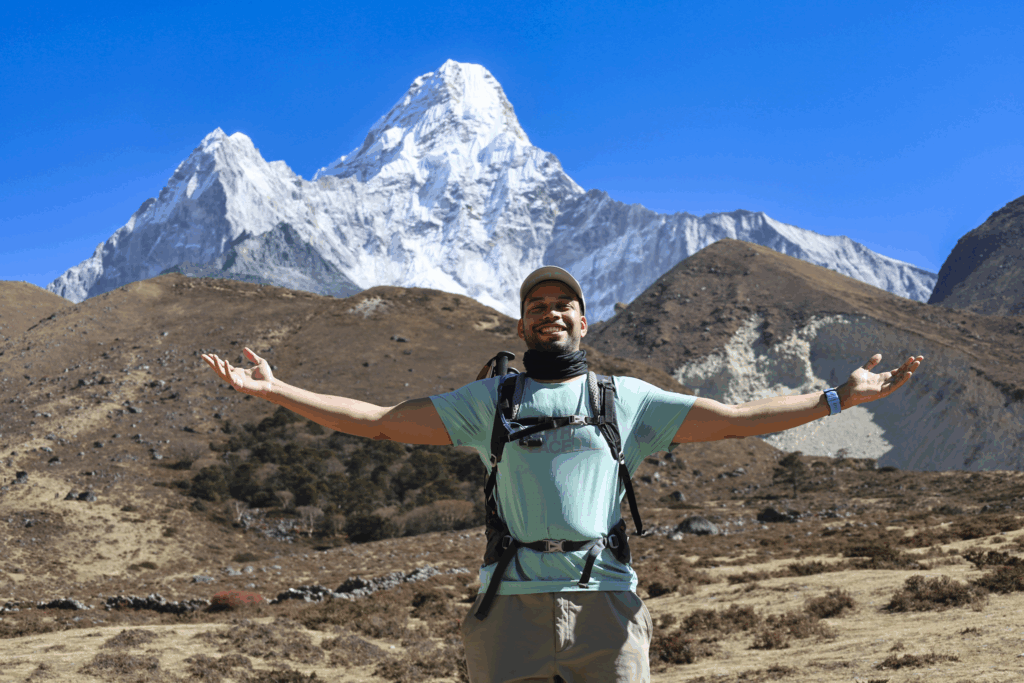
The trail to Namche is a steady climb that rewards you with your first real sense of scale. You cross suspension bridges, move through pine forest, and on clear days you get that early glimpse of Everest that makes people go quiet.
Then Namche hits you with contrast: tradition and modern life coexisting in a way that feels uniquely Himalayan.
On our itinerary, Namche is also where you start learning the deeper story. Take time to explore, settle into the altitude, and connect the dots between Sherpa heritage, the mountaineering history of the region, and what it means to move through the Himalayas with respect.
The bakeries and coffee shops are part of the magic
People do not expect this the first time they hear it, but the Everest Base Camp trail has cafés, bakeries, and cosy teahouses that become part of the experience.
It is not about luxury. It is about comfort in a place that feels impossibly remote.
A warm drink after a cold day. A laugh with your team. A familiar smell of coffee when you are far from everything you know. These small moments are often the ones people remember most clearly because they sit right beside the hard effort.
Mountains that do not just sit in the background
Everest is the headline, but the full skyline is the experience.
One of the most powerful parts of the Everest Base Camp Trek is that the mountains keep revealing themselves in layers. The angle changes. The light changes. The weather moves. The same peak can feel completely different from one day to the next.
You do not just see mountains here. You live inside them.
Kala Patthar is the view most people remember forever
If there is one name that comes up again and again when people talk about the best viewpoint on the Everest Base Camp Trek, it is Kala Patthar.
It is not a technical climb. It is a steady push upward, usually done when conditions are best, and it delivers the kind of panoramic Himalayan view that makes the whole journey click into place. For many trekkers, this is the moment the scale becomes real: the big peaks, the glaciers, the sharp edges of the Khumbu, and the sense that you have walked into one of the most legendary landscapes on earth.
If Everest Base Camp is the milestone, Kala Patthar is often the emotional peak.
Tengboche: where the trail becomes spiritual
If you have ever seen films or documentaries about Everest, you have probably seen Tengboche.
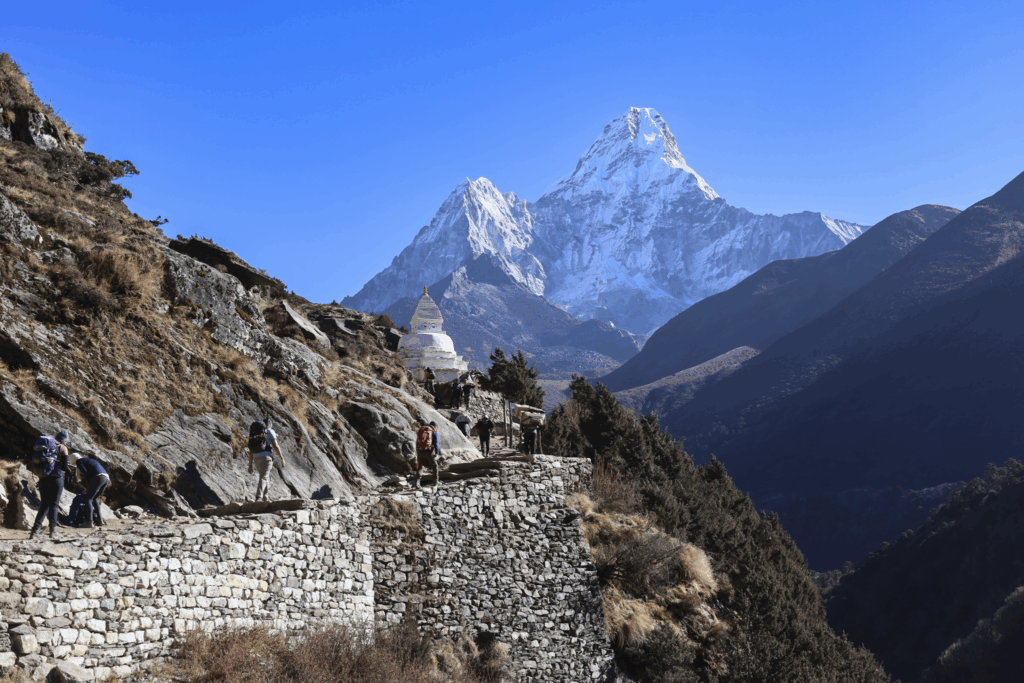
The monastery here is one of the region’s sacred places. Climbers come for blessings before heading higher, and trekkers come to experience a different kind of altitude: the kind that lifts your attention.
This is one of the places where the trek stops being only physical. It becomes personal. You notice what you usually rush past in normal life. You listen differently. You carry yourself differently.
You are walking inside a protected Himalayan world
The Everest region is part of a protected landscape that is globally recognised for its natural beauty and cultural heritage. That matters because it frames the journey properly.
You are not walking through a backdrop. You are walking through a living place where nature, culture, and community life have coexisted for generations, and where the mountains are treated with genuine reverence.
The challenge is real, and that is why it gives so much back
Everest Base Camp sits at over 5,000 metres above sea level. That number is not there to intimidate you. It is there to remind you that this trek is a process.
Altitude changes everything: your sleep, your appetite, your pacing, and your mindset. The people who thrive here are not the ones who push hardest. They are the ones who move steadily, listen to their bodies, and respect the acclimatisation process.
At Life Happens Outdoors, we do not treat Base Camp as a box to tick. We treat it as a journey that deserves respect, built around smart acclimatisation, calm pacing, and the quality of each day on the trail.
The history of the trail is written in footsteps
The Everest Base Camp route is not a modern invention. It is a living corridor through the Khumbu, shaped by Sherpa communities, spiritual landmarks, and decades of mountaineering history.
You feel that history in the names, the stories, the prayer flags, and the quiet confidence of the people who call these valleys home.
And you feel it in yourself too. Because by the time you are deep into the trek, you stop thinking only about what you are trying to reach, and start paying attention to who you are becoming.
What makes it truly epic: the way you come back
There is a moment on this trek when your world gets smaller in the best way.
Eat, walk, breathe, rest, repeat.
The noise falls away. Your confidence grows. Your relationships deepen. You learn that you can do hard things, not through force, but through steadiness.
That is the real gift of Everest Base Camp. The place is legendary, but the transformation is personal.
Watch the video, then take the next step
If you have not watched the video yet, go press play on What Makes the Everest Basecamp Trek Epic.
Then explore our Everest Base Camp Trek trip page, review the itinerary, and see if you want to experience the Khumbu with an LHO Team Leader guiding the journey and expedition photography included so you can relive it for years.
FAQ
How long is the Everest Base Camp trek?
Most people complete the Everest Base Camp Trek over multiple trekking days plus travel days, with at least one acclimatisation day built in. For our exact day by day plan, see our Everest Base Camp Trek trip page.
How hard is the Everest Base Camp trek?
It is a sustained multi day trek where altitude is the main challenge. With smart pacing, acclimatisation, and solid preparation, it is achievable for many fit hikers who respect the process.
How much does the Everest Base Camp trek cost?
Cost varies widely depending on inclusions like local flights, permits, guide support, accommodation standards, and meals. For the exact inclusions and current pricing for our curated experience, see our Everest Base Camp Trek trip page.
What is the Everest Base Camp trek itinerary?
There are several common route structures, but the details vary by acclimatisation strategy and overall trip length. For our full itinerary and inclusions, see our Everest Base Camp Trek trip page.
When is the best time to do the Everest Base Camp trek?
Most trekkers aim for the main trekking seasons when weather is generally more stable and visibility is stronger. If you want to match the best window to your schedule, check the trip page for upcoming dates and seasonal notes.
What are the top highlights of the Everest Base Camp Trek?
Flying into Lukla Airport, acclimatising in Namche Bazaar, visiting Tengboche monastery, walking through the Khumbu in a protected Himalayan landscape, reaching Everest Base Camp, and taking in the iconic viewpoint from Kala Patthar.

About The Author
Rami Rasamny is the founder of Life Happens Outdoors, a premium adventure travel community dedicated to transforming lives through curated outdoor experiences. A mountaineer and entrepreneur, Rami has led teams on some of the world’s most challenging peaks, from the Alps to the Himalayas. His mission is to make adventure accessible, transformative, and safe for all who seek to push their limits and Come Back Different.
About Life Happens Outdoors
At Life Happens Outdoors, we believe in the power of nature to transform lives. As proud members of the Adventure Travel Trade Association (ATTA) and the World Travel & Tourism Council (WTTC), our team of certified guides and outdoor professionals is committed to the highest standards of safety, sustainability, and excellence.
Discover more about our story and mission on our Meet LHO page, or explore our curated adventures such as the Tour du Mont Blanc Trek, the Climb of Kilimanjaro, and Chasing the Northern Lights.