Scale Breaker Nepal
Our LHO Ama Dablam Expedition is a comprehensive Himalayan climbing experience built around safety, education, and serious preparation. Ama Dablam is one of the most beautiful mountains in the world, but it is also a demanding technical expedition that requires strong movement skills, good acclimatisation, clear decision making, and the right support structure. The expedition is managed by an LHO Team Leader, either from Ama Dablam Base Camp or from Kathmandu depending on the season and number of climbers, in close collaboration with our NNMGA certified climbing guide team. From technical training and acclimatisation rotations to summit window management and expedition support, every part of the itinerary is designed to help climbers arrive at the mountain prepared, informed, and ready for the challenge ahead.

TRIP TYPE
Climbing and Mountaineering

DURATION
25 Days

DESTINATION
Nepal
1
Your LHO Team Leader manages the expedition and supports the group, while our NNMGA certified Ama Dablam climbing guide leads the technical training, summit strategy, rope systems and mountain safety.
2
Your Ama Dablam journey is documented across the Khumbu trail, Base Camp, rotations, high camps, and summit moments, giving you a lasting record of one of the most beautiful climbs in the Himalayas.
3
Your expedition includes one helicopter sector between Kathmandu and Lukla to reduce the risk of flight disruption, selected Khumbu tea houses and superior accommodation in Phakding and Namche.


WHAT'S INCLUDED IN THIS TRIP
WHAT'S NOT INCLUDED IN THIS TRIP
DAY 1: ARRIVAL IN KATHMANDU AND AMA DABLAM EXPEDITION WELCOME BRIEFING
Kathmandu is the gateway to the Himalayas and the starting point of our Ama Dablam Expedition. It is vibrant, colourful, chaotic, and full of life, which is why we love beginning the journey here.
On arrival, you will be met by an LHO representative at Tribhuvan International Airport and transferred to our centrally located hotel. Kathmandu airport can feel like an adventure in itself, so we will send detailed arrival instructions before the trip to help you move through the airport smoothly.
Your LHO Team Leader will be waiting to receive you at the hotel, help you settle in, and make sure you have everything you need for the expedition ahead. If you arrive early, your Team Leader will share recommendations for restaurants, coffee shops, heritage sites, and markets so you can make the most of your first day in Kathmandu.
Our first official event is a team dinner at 7:30 pm hosted by your LHO Team Leader and local lead guide. This is where we meet the group, set expectations, answer questions, and begin building the rhythm of the expedition together. Although Kathmandu nightlife is tempting, we recommend an early rest so you can recover from your travels before the journey begins.
DAY 2: KATHMANDU CITY TOUR, GEAR CHECK AND LUKLA FLIGHT PREPARATION
Our first full day together gives us time to explore Kathmandu, check our gear, and prepare properly before heading into the Khumbu. We will visit nearby cultural sites such as Durbar Square and the Monkey Temple, while also getting our first taste of Nepali cuisine during a team lunch.
This is also the day we review equipment and make sure everyone is prepared for the trail, Base Camp, rotations, and the technical demands of Ama Dablam. The expedition is managed by your LHO Team Leader, who works closely with our NNMGA certified climbing guide team and wider LHO support structure to keep the journey organised from the start.
Because aviation into the Everest region is highly weather dependent, the exact Lukla travel plan is confirmed close to departure. Your itinerary includes one helicopter sector between Kathmandu and Lukla and one fixed wing domestic flight sector between Kathmandu and Lukla. The helicopter may be used on the way into Lukla or on the way back from Lukla, depending on weather, airport operations, and the plan that gives the group the smoothest overall journey.
Your LHO Team Leader will confirm the plan in Kathmandu and make sure everyone is clear before we leave for the mountains. If flights are operating from an alternative airport outside Kathmandu, we may move closer to that airport the night before departure so the team can rest properly rather than waking extremely early for a long transfer.
DAY 3: TRAVEL TO LUKLA AND TREK TO PHAKDING
Distance: 8.7 KM | Ascent: 364 M | Descent: 521 M | Max Altitude: 2,860 M
Our day starts after breakfast as we make our way to the airport for the journey into Lukla, the gateway to the Everest region. Depending on conditions, this sector may be operated by helicopter or fixed wing flight. Your expedition includes one helicopter sector between Kathmandu and Lukla, used either inbound or outbound, and one fixed wing domestic flight sector for the other direction.
This gives us more flexibility around one of the most delay prone parts of the Ama Dablam Expedition while keeping the itinerary sensibly priced. Patience is still part of Himalayan travel, but the included helicopter sector gives us a stronger operational tool when conditions around Lukla are difficult.
Once in Lukla, we meet our porter team, who will collect the duffle bags and help move the expedition into trail mode. Lukla is one of the most important Sherpa villages in the Khumbu, both as a transport hub and as the gateway to the sacred high altitude valleys above.
The trek to Phakding is mostly downhill, passing through alpine forest, villages, Buddhist shrines, prayer wheels, mani walls, and the first signs of the Tibetan Buddhist character of the region. We stay near the Khumbu River, formed by the glaciers of the towering mountains above us.
In Phakding, we use one of the stronger available tea houses in the village, giving you a more comfortable first night on the trail while keeping you connected to the atmosphere of the Khumbu. Depending on our arrival time, there may be an opportunity to explore the village before dinner.
DAY 4: TREK FROM PHAKDING TO NAMCHE BAZAAR
Distance: 9.1 KM | Ascent: 1,095 M | Descent: 380 M | Max Altitude: 3,440 M
Our second day on the trail takes us to Namche Bazaar, one of the most famous high altitude towns in the world. The trail follows the river, passes through forest and farming villages, and gradually introduces us to the scale of the Khumbu Valley.
Our first main objective is Monjo, the official entrance to Sagarmatha National Park. After the permit checkpoint, we descend through stone steps and carved rocks before stopping for lunch at the last village before the sustained ascent to Namche.
The climb to Namche is the first real physical test of the expedition. Our trekking team will set a slow, steady pace so we can manage the ascent efficiently without wasting energy unnecessarily. Slow and steady is the name of the game here.
We cross the famous Tenzing Hillary Suspension Bridge and join the winding trail through pine forest toward Namche Bazaar. On a clear day, there is a viewpoint where we may get our first distant glimpse of Everest.
The reward is our arrival in Namche, a remarkable Sherpa town surrounded by towering Himalayan peaks. In Namche, we use one of the stronger available tea house options in the village, giving the group a more comfortable base for rest, acclimatisation, and recovery before the expedition moves deeper into the Khumbu. Dinner will be at our tea house.
DAY 5: NAMCHE BAZAAR ACCLIMATISATION AND FIRST EVEREST VIEWS
Distance: 5.5 KM | Ascent: 503 M | Descent: 503 M | Max Altitude: 3,700 M
We stay in Namche Bazaar for a second night, which means no repacking and no major move today. This is an acclimatisation day, not a rest day in the ordinary sense. The goal is to climb higher, expose the body to altitude, and then return lower to sleep.
After breakfast, we climb toward the top of Namche and visit the Sherpa museum, where we learn about Sherpa culture, Himalayan mountaineering history, and sustainability work supported by tourism in the region.
From there, we continue to a high viewpoint above the village. On a clear day, the views of Everest, Lhotse, and Ama Dablam are extraordinary. This is also the first moment where the team can visually understand the landscape ahead and begin to feel the scale of the expedition.
There may be an opportunity for tea at the Everest View Hotel before descending back to Namche for lunch. The afternoon is free to explore the markets, coffee shops, bakeries, and mountain stores. This second night in Namche is one of the places where our accommodation selection matters most, giving you a stronger chance to rest, recover, and enjoy the village before the journey becomes more remote.
DAY 6: TREK FROM NAMCHE BAZAAR TO TENGBOCHE MONASTERY
Distance: 9.4 KM | Ascent: 901 M | Descent: 454 M | Max Altitude: 3,860 M
oday we trek from Namche Bazaar toward Tengboche Monastery, one of the most important spiritual landmarks in the Everest region. If you have watched documentaries about Himalayan climbing, there is a good chance you have seen this monastery. Many climbers visit Tengboche to receive a blessing before attempting the major peaks of the Khumbu.
After breakfast, we follow the trail out of Namche past the Sherpa museum and continue along the wide path that looks deep into the valley. This section offers beautiful views, Buddhist stupas, mountain ridges, and a growing sense that we are moving away from the busier lower villages.
The trail eventually descends into the forest and reaches the river. We usually stop for tea during the descent and then have lunch near the riverside. After lunch and a short rest, we begin the long ascent to Tengboche at a manageable pace set by our trekking team, helping the group arrive feeling strong.
If timing allows, we visit the monastery when it opens to visitors in the afternoon. This is one of the great cultural moments of the approach to Ama Dablam. Dinner will be at our tea house.
DAY 7: TREK FROM TENGBOCHE TO AMA DABLAM BASE CAMP
Distance: 8.7 KM | Ascent: 968 M | Descent: 242 M | Max Altitude: 4,600 M
Today we cross into the true high altitude environment and make our way to Ama Dablam Base Camp at around 4,600 meters. This is the day the expedition begins to feel real.
After breakfast, we descend into rhododendron forest. The rhododendron is the national flower of Nepal, and this forest often feels like a border between worlds as we move from the monastery environment toward the mountain itself.
We cross an iconic suspension bridge with Ama Dablam rising above us, then begin climbing through stone steps and village trails. The route eventually reaches Pangboche, one of the most important villages in this part of the Khumbu and our lunch stop for the day.
From Pangboche, we descend toward the valley floor that separates Ama Dablam from the main Everest trail. After crossing the river, we begin the gradual ascent toward Base Camp. The trail moves through small forest, yak grazing fields, sandy sections, and open slopes before reaching the plateau where our camp is situated.
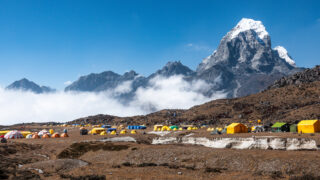
Ama Dablam Base Camp sits beneath the impressive south face of the mountain, with a stream passing through the area and extraordinary views all around. Upon arrival, we check into camp and get acquainted with the facilities. Your LHO Team Leader and expedition team will be on hand to help you settle into Base Camp, understand the facilities, and prepare for the rhythm of the days ahead.
DAY 8: AMA DABLAM BASE CAMP REST DAY AND TECHNICAL SKILLS TRAINING
Our first full day at Ama Dablam Base Camp is dedicated to rest, recovery, briefing, and skills development. This is where the expedition changes from trekking approach to climbing preparation.
After breakfast, we conduct a full expedition briefing with the summit in view. This helps the team understand the route, the rotations, the camps, the technical sections, and the challenge ahead.
After lunch, we move to nearby training rocks to begin building the Ama Dablam specific skills required for the climb. The technical training is led by the NNMGA certified climbing guide team, who will develop the skills we need for fixed ropes, jumars, abseiling, crampon movement, ice axe use, and the specific demands of Ama Dablam.
Training on this first day is deliberately limited in time and scope. The goal is to build confidence and clarity without overexerting the body while it is still adapting to the altitude. After dinner, we conduct a full briefing on our first rotation to Camp 1 before turning in for the night.
DAY 9: AMA DABLAM ACCLIMATISATION ROTATION TO CAMP 1
Distance: 5.1 KM | Ascent: 968 M | Descent: 242 M | Max Altitude: 5,100 M
Our aim today is to reach Camp 1 at around 5,100 meters. This is part of our acclimatisation strategy and gives the team its first real experience of sleeping higher on the mountain.
Reaching Camp 1 does not usually require technical climbing, so we leave most of our technical equipment at Base Camp and travel light. Your NNMGA certified climbing guide team and LHO Team Leader will brief the group on what to pack, what to leave behind, and how to approach the rotation efficiently.
The trail exits Base Camp and begins ascending across the grassy hills around the mountain. Ama Dablam stays close on our left for the first few hours as we traverse south, then gradually reapproach the mountain from the east along the ridge above Base Camp.
The route moves through a series of hills and troughs, giving the day a moderate overall rhythm. After around three hours, the trail turns north toward Ama Dablam. Some expeditions use an intermediate camp in this area, but we generally avoid it when conditions allow because it is not necessary if the team maintains a slow, steady pace.
After a picnic lunch, we continue along the ridge until Camp 1 comes into view. The final section is the steepest and most challenging, with a fixed rope usually in place to assist movement into camp. Once we arrive, we check into our tents, prepare for the evening, and have dinner.
For safety, we do not recommend single occupancy tents above 5,000 meters. It is important to check on one another and remain alert to any symptoms of altitude exposure. The guide team and LHO Team Leader will brief the group on what to watch for, how to communicate concerns, and how to look after each other during the night.
DAY 10: AMA DABLAM CAMP 1 ACCLIMATISATION AND HIGH ALTITUDE REST
We start the day slowly after breakfast. The aim is to spend a second night at Camp 1, allowing the body more time to adapt to the altitude.
In some cases, it may be better to descend and recover at Base Camp instead. The NNMGA certified climbing guide team, in coordination with the LHO Team Leader and expedition support structure, will decide the best course of action based on the team’s condition, acclimatisation response, route conditions, and the expected forecast.
If we stay at Camp 1 for the second night, we may head out for a short walk to slightly higher altitude. We will not go far without technical equipment because the most technical section of Ama Dablam lies between Camp 1 and Camp 2.
This short movement gives us a closer look at the summit route above and helps the team develop a deeper appreciation for the mountain. It is common to see other teams climbing higher on the mountain or returning from the summit, which makes this an important learning and observation day.
Lunch and dinner will be at Camp 1. The expedition team will monitor the group regularly for symptoms of concern at altitude throughout the day and night.
DAY 11: DESCEND FROM AMA DABLAM CAMP 1 TO BASE CAMP
Distance: 5.1 KM | Ascent: 11 M | Descent: 1,194 M | Max altitude: 5,100 M
After breakfast, we begin retracing our steps from Camp 1 back to Ama Dablam Base Camp. It may be possible to leave some items at Camp 1 that we will not need until the summit rotation. The guide team and LHO Team Leader will advise the group on what can safely be left behind.
We descend using the fixed ropes as we exit the camp and rejoin the dry trail. From there, we follow the familiar path back toward the temporary camp area below before the trail switches west for the direct descent across the hills to Base Camp.
The descent usually takes around two hours. Lunch will be served hot at Base Camp, followed by rest and recovery. Depending on the energy of the team, we may continue with some light afternoon technical training.
This day is important because it allows the body to benefit from the climb high, sleep lower rhythm of acclimatisation. Dinner will be at Base Camp.
DAY 12: AMA DABLAM BASE CAMP REST DAY, ROPE TRAINING AND SUMMIT WINDOW BRIEFING
Today is a Base Camp rest and preparation day. After breakfast, we return to our training area for a morning of rope work, abseiling, fixed rope movement, and skills development.
Training is split into manageable sessions so we do not overexert ourselves in one go. The goal is not to become tired. The goal is to sharpen the systems that will matter when we move higher on the mountain.
Lunch will be served hot at Base Camp. In the evening, we conduct a full briefing for the summit window ahead. This itinerary allows a broad summit window, giving the team time to acclimatise properly and wait for acceptable weather and route conditions.
Weather windows will be monitored through our Kathmandu support team, the Base Camp team, and the NNMGA certified climbing guide team, using local and regional information to support decision making. Until the guide team confirms that conditions are suitable, we remain at Base Camp, continue training, and maintain climbing readiness.
Although some expeditions conduct an acclimatisation rotation to Camp 2, we believe the risks often outweigh the benefit of a marginal gain in altitude. As a result, any second rotation will usually be limited to Camp 1. Dinner will be at Base Camp.
DAY 13 TO DAY 20: AMA DABLAM SUMMIT WINDOW, CAMP 1, CAMP 2 AND SUMMIT PUSH
Distance: 13 KM | Ascent: 2,122 M | Descent: 2,122 M | Max Altitude: 6,812 M
When the weather window presents itself, we begin the climbing phase of Ama Dablam. This section of the expedition is intentionally held as a flexible summit window rather than a fixed daily schedule. Weather, route conditions, wind, snow, team energy, acclimatisation, and mountain traffic can all affect the final plan.
The expedition is managed by your LHO Team Leader, either from Ama Dablam Base Camp or through the wider LHO support structure in Kathmandu, depending on the season and number of climbers. The technical climbing is led by our NNMGA certified climbing guide team, who manage the rope systems, camp movement, summit strategy, weather decisions, safety calls, and descent.
Our first day of climbing is a return to Camp 1. After breakfast, we conduct a final gear check with the NNMGA certified climbing guide team and LHO Team Leader to make sure everything needed for the summit rotation has been packed. There is no rush to depart early. We have the day to move slowly and deliberately toward camp.
There are no gold medals for first arrivals. The aim of the day is to conserve energy for when it matters. We stop for a picnic lunch at our usual place before following the switchback toward the final section that ascends to Camp 1. The guide team and LHO Team Leader will remind the group to rest as much as possible, keep the heart rate down, and eat properly. Every meal is fuel for the days ahead. We will once again share tents for safety reasons. The night is spent at Camp 1.
On the following day, we also begin without rushing. The route to Camp 2 is short, but it is technical and exposed. After breakfast, we put on harnesses and helmets before exiting camp along the direct ridge line that leads toward Camp 2.
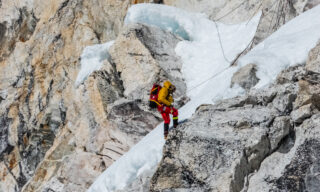
Camp 2 sits on top of a rocky spur along the ridge line known to mountaineers as a gendarme. Shortly after leaving the tents, we reach the first fixed rope and clip in. The fixed rope is there for safety and support. It is not there to climb on your behalf, and it does not replace the need for balance, sure footedness, focus, and careful movement.
The ascent follows the trail just below the ridge. The exposure on the right becomes more intense with every step, although the path itself remains wide enough to move carefully. The rock walls to the left grow higher as we ascend until the trail turns toward the technical wall climb into Camp 2.
This section is known as the Yellow Tower. The climbing is around 4a, which is technically manageable, but the altitude, heavy pack, exposure, and fixed rope movement make it a serious challenge. The fixed ropes assist the movement, but they do not replace climbing the wall properly.
The NNMGA certified climbing guide team will remain close throughout the technical sections, advising on rope movement, footwork, spacing, and safe passage through the terrain. Once we climb above the Yellow Tower, we arrive at Camp 2, one of the most spectacular high camps of any mountain in the world.
Upon arrival, we check into our tents and rest. Lunch will be in our tents. It is important to rest as much as possible throughout the day. When leaving the tent to use the toilet or take pictures, caution is essential because the campsite is surrounded by steep drops and exposed terrain.
During dinner, the climbing guide team will conduct the final summit briefing and confirm the departure time for the climb, which is typically around midnight. We also rearrange our packs based on summit needs and leave behind anything we will not use for the push.
The summit push begins shortly after midnight. We have a light early breakfast before starting the climb. Before departure, the guide team will remind everyone to keep quick energy snacks accessible. It is important to follow this advice because eating becomes harder once the summit push begins.
The climb begins with a descending exit out of Camp 2. Shortly after, the route follows an ascending corridor similar to the Yellow Tower, but with less incline. Depending on snow conditions, we may not need crampons immediately on this section.
Once we exit the corridor, we reach a series of ice features. This is typically where crampons go on. The vertical pitches of ice are short but sustained before giving way to an exposed traverse beneath Camp 3. The access to the Camp 3 plateau is one of the most physically demanding parts of the climb because of its sustained incline.
This is where technique matters. It is important to rely on your crampons, legs, balance, and steady movement rather than exhausting yourself by pulling too much with your arms or jumar. Steady and sustainable is the strategy for this section and the mountain above.
Although there is often a setup at Camp 3, we do not usually spend the night there because it can drain energy and overexpose the team to high altitude unnecessarily. Our strategy is to limit exposure as much as possible and rely on Camp 3 only as an emergency backup if needed.
We pause briefly for a snack at Camp 3 before beginning the final ascent along the south face of Ama Dablam. This section can look overwhelming because of its size, but it is often less technically difficult than the lower climbing sections. Here, we use crampons and ice axe technique to move along the steep trail beside the giant ice serac known as the Dablam.
The route stays close to the southeast ridge before traversing across the face and topping out near the centre of the summit plateau. Reaching the summit of Ama Dablam is extraordinary. On a clear day, Everest appears directly ahead, surrounded by Lhotse, Shishapangma, Cho Oyu, Makalu, and sometimes even distant views toward Kanchenjunga and Manaslu.
Although we would love to spend as much time as possible on the summit, we need to remember that there is still a long descent ahead. Every minute at high altitude costs energy. We will be efficient with photos, take a snack, and then begin descending along the fixed ropes.
Descending is usually faster than climbing, but it still requires full concentration. We abseil along the fixed rope systems until we reach the Camp 3 area, where we check that everyone has enough snacks and water for the return to Camp 2.
From there, we descend the ice features beneath Camp 3, carefully traverse the exposed ridge toward the corridor, and continue down the multiple pitches over ice and snow until we reach easier ground. Depending on snow conditions, the guide team may decide that crampons can be removed lower down.
We then follow the short ascent back into Camp 2, where we have lunch and rest. In most cases, the aim is to continue down to Camp 1 on the same day. Sometimes, it may be safer or more sensible to remain at Camp 2 to regain energy overnight. That decision is made by the NNMGA certified climbing guide team in coordination with the LHO Team Leader, based on weather, timing, team energy, route conditions, and safety.
The descent from Camp 2 is easier than the ascent because we mainly abseil the Yellow Tower with limited climbing. At the bottom of the Yellow Tower, we rejoin the traverse below the ridge. As the trail becomes easier, the risk of mistakes can actually increase, so full concentration is required until we reach Camp 1.
Once at Camp 1, we have the opportunity to take a proper break and rest. If we spent the night at Camp 2 on the way down, Camp 1 may only be a brief lunch stop. If we continued past Camp 2 on summit day, then we will have dinner and sleep at Camp 1 for the night.
Descending from Camp 1 follows the route we know well by now. We descend the fixed rope section onto the dry trail for the last time before continuing along the trail for the final hours back to Ama Dablam Base Camp.
Once back at Base Camp, we have dinner, rest, and enjoy our last night beneath Ama Dablam. Depending on how the summit window has unfolded, the remaining days in this section may be used for weather contingency, recovery, descent timing, equipment organisation, or expedition closeout. The purpose of holding this as a summit window is to give the team the best possible chance of making safe, patient, and well judged decisions on the mountain.
DAY 21: DESCEND FROM AMA DABLAM BASE CAMP TO TENGBOCHE
Distance: 9.4 KM | Ascent: 307 M | Descent: 1,027 M | Max Altitude: 4,600 M
Our final morning at Ama Dablam Base Camp is always bittersweet. The day starts slowly, and rightly so. After the summit phase, the body is in recovery mode, and the team deserves time to leave the mountain properly.
After breakfast, we pack our duffle bags and send them down the valley with the porters. We then say goodbye to the climbing team, Base Camp staff, and the camp that has been our home beneath one of the most beautiful mountains in the world.
This time, Ama Dablam is behind us as we reconnect with the descending trail toward the river that separates the mountain from the main Everest trail. Once we cross the river, there is a brief ascent to Pangboche, where we stop for lunch and rest.
After lunch, we continue along the steps into the rhododendron forest and ascend toward Tengboche, our usual home for the evening. If the team is moving well, it may be possible to continue beyond Tengboche and shorten the following day. The trekking team will assess the group’s condition, timing, and weather before confirming the final stop.
Dinner will be at our tea house.
DAY 22: TREK FROM TENGBOCHE TO NAMCHE BAZAAR AND MONJO
Tengboche is the last truly remote village along this part of the trail, and nothing makes that contrast clearer than leaving the monastery behind and passing through Namche Bazaar later in the day. Both places are beautiful in their own way, but they feel completely different. Tengboche carries the quiet atmosphere of the upper Khumbu, while Namche brings us back into the movement, colour, and trade of the lower valley.
The trail begins with a long descent to the valley floor before crossing a series of suspension bridges and ascending through pine forest toward the junction between the Khumbu and Gokyo valleys. We stop at a tea house in the forest for a break before continuing toward the high point of the day. This is the final major ascent of the expedition.
As we approach Namche, we begin to see small market stalls along the trail and the familiar sight of donkey caravans, which gradually replace the yaks used higher up the valley. From there, it is a short walk into Namche Bazaar, where we stop for lunch.
Depending on our pace, there may be time to roam around before we continue our descent through the forest, cross the Tenzing Hillary Suspension Bridge, and reach the valley floor where the village of Monjo awaits.
Our night will be spent at a tea house in Monjo.
DAY 23: TREK FROM MONJO TO LUKLA AND FINAL NIGHT ON THE TRAIL
The end of the trail is the Sherpa village of Lukla, home to Tenzing Hillary Airport. Monjo is only a few hours from Lukla, which gives us some flexibility if weather conditions suggest that flying out earlier may be the better plan.
Because the expedition includes one helicopter sector between Kathmandu and Lukla, the final aviation plan will depend on how the inbound journey was operated and what conditions allow. If the helicopter sector has not yet been used, it may be used from Lukla to Kathmandu to reduce the risk of delay. If it was used on the way in, the return from Lukla is usually by fixed wing flight, subject to weather and airport operations.
Assuming conditions are favourable, we start slowly after breakfast and take our time moving through the villages along this final section of the trail. We passed through many of them on the way up, but the mindset is different now. With the main objective behind us, there is more space to enjoy the rhythm of the valley, the tea houses, the people, and the final steps of the expedition.
Lunch will be in Phakding along the trail, with plenty of opportunities to stop for tea and coffee along the way. The final push to Lukla is a mild challenge as we ascend a series of stairs and village trails toward the entrance of town.
The afternoon is free to explore the coffee shops, pubs, markets, and stores. We spend our last night on the trail at a local tea house in Lukla, where we also share our final trail dinner.
DAY 24: RETURN FROM LUKLA TO KATHMANDU
Hot showers await us on our return to Kathmandu. Depending on how the journey into Lukla was operated, today may involve either the included helicopter sector from Lukla to Kathmandu or the fixed wing flight back toward Kathmandu. The decision is made according to weather, airport operations, and the best available plan for the group.
Patience is key when it comes to aviation in Nepal, although including one helicopter sector gives us more flexibility around one of the most unpredictable parts of the expedition. Depending on when we move, lunch may be in Lukla, Kathmandu, or the alternative airport sometimes used to manage Lukla air traffic into Kathmandu.
Wherever we finally land, the LHO team will do everything possible to get you to the hotel smoothly so you can shower, rest, and enjoy Kathmandu before our farewell dinner.
DAY 25: DEPARTURE FROM KATHMANDU AFTER THE AMA DABLAM EXPEDITION
The last day together is dedicated to airport transfers and farewells. Breakfast is included before departure.
Please make sure to provide the correct departure details when completing your Team Details Form before the trip begins so the transfer arrangements can be planned properly. We usually arrange your airport shuttle around 3 hours before departure, so please stay close to the hotel at the confirmed time to avoid delays.
For those departing later in the day, the LHO team will be happy to recommend places to visit or help arrange a city tour if you were not able to join one earlier in the trip. Your LHO Team Leader will be available in Kathmandu to support departure arrangements. Please communicate any changes to your flight details as soon as possible so the final transfer plans can be updated smoothly.





OUR COMMITMENT
We are dedicated to ensuring that everyone involved in our services receives a fair living wage in their respective countries. We invest in our team members, fostering upward mobility within the adventure travel industry, expanding educational opportunities, and offering support wherever we can. By joining an LHO adventure you are directly impacting the incredible people and the remote communities that make these life-changing experiences possible.
LEARN MORE
HEALTH & SAFETY GUIDELINES
We do our best to ensure your wellbeing on LHO adventures. That's why the facilities we use throughout our trips are required to meet our health and safety standards. We also follow the laws and protocols of every country that hosts our adventures. This extends to national regulations requiring Covid-19 testing, vaccination certificates, mask wearing or any other local guidelines that may apply. Contact us for the most up to date protocols related to your destination.
LEARN MOREWill my Ama Dablam Expedition be led by an LHO Team Leader?
Yes. Your Ama Dablam Expedition is managed by an LHO Team Leader, who supports the group, coordinates the rhythm of the expedition, and works closely with the NNMGA certified climbing guide team. Depending on the season and number of climbers, the Team Leader may manage the expedition from Ama Dablam Base Camp or from Kathmandu through the wider LHO expedition support structure. The technical climbing itself is led by our NNMGA certified guides, whose expertise in fixed ropes, exposed terrain, camp movement, summit strategy, weather decisions, safety calls, and descent is central to the expedition.
Who leads the Ama Dablam summit climb?
The Ama Dablam summit climb is led by our NNMGA certified climbing guides. They manage the technical training, equipment checks, fixed ropes, Yellow Tower, Camp 2 movement, ice sections, summit timing, spacing, weather decisions, safety calls, and descent. The LHO Team Leader manages the wider expedition and works closely with the climbing team, but the technical mountain leadership sits with the NNMGA certified guides because Ama Dablam is a serious technical Himalayan climb.
What's the accommodation like on the trip?
For the nights spent in Kathmandu, we use carefully selected accommodation that blends international standards and local tradition. You can expect a good level of general comfort including private toilets, comfortable beds, garden areas, easy access to main markets and walking areas, front desk, concierge, restaurant and breakfast area.
On the Ama Dablam trail, we stay in tea houses. These are basic family-run accommodations that are very much part of the experience when trekking in the Himalayas. They consist of shared bathrooms, showers, and a restaurant. We do not sleep in tents at any point on this adventure.
At Ama Dablam Base Camp and the forward camps along the mountaineering portion of this expedition, we will be staying in technical tents.
Do you recommend camel back bladders for water?
For the trekking portion, camel backs, also known as water bladders, are recommended for this trek. Basically, it’s a sack of water that’s put into the backpack and comes with a straw that can be clipped to the shoulder strap for easy access to water without having to pull the bottle out of the backpack to drink.
For the mountaineering portion of this expedition, we recommend only using reusable water bottles and leaving the bladder at base camp. Please be sure to have enough capacity for 3 liters.
How can I charge my devices and power banks? Do tea houses charge for using electrical outlets?
It’s possible to charge electronics at the tea houses. Just keep in mind that power outlets are usually limited and demand for them is huge. Use any charging opportunity to fill up your power banks. Most tea houses will charge a fee between 200 to 500 Rupees to fill up a power bank.
At the base camp charging is not possible. Our last opportunity to charge will be at the last tea house. Consider having enough power bank capacity for three days without recharging.
How much should I carry as spending cash?
We recommend around 200 USD. This does not include any discretionary tip you may wish to leave. Our tipping recommendation on this experience is 350 USD.
PAYMENT PLANS AVAILABLE
FROM £7300


INQUIRE NOW
This adventure is only available as a private trip and is customized to your requirements, experience and skill level. To get started, please fill out the form below. We’ll be in touch soon to put it together for you.
"(Required)" indicates required fields
CONTACT US
We’re passionate about guiding you to epic adventures and beyond. If you have any questions at all, don’t hesitate to reach out. We’d love to hear from you.
JOIN THE LIFE HAPPENS OUTDOORS COMMUNITY!
Get £100 off your next adventure!
Sign Up To The Newsletter