EARLY BIRD! Challenging Nepal
Our LHO Gokyo Lakes Trek is carefully crafted to provide an authentic, safe, and enriching experience in one of the most breathtaking regions of the Himalayas. From selected accommodation on and off the trail to cultural immersion, meals, expert Khumbu guides, LHO Team Leader support in Kathmandu, and a thoughtfully designed acclimatisation plan, every detail is taken care of so your only focus is arriving in Nepal ready to experience the Gokyo Lakes. The itinerary also includes one helicopter sector between Kathmandu and Lukla, used either inbound or outbound depending on weather and flight operations, helping reduce the risk of disruption around one of the most unpredictable airport links in Nepal.

TRIP TYPE
Trekking

DURATION
16 Days

DESTINATION
Nepal
1
An all inclusive Gokyo Lakes trek featuring selected tea houses, the unforgettable climb to Gokyo Ri, the crossing of Renjo La Pass, built in weather contingency, and LHO Team Leader support.
2
Trip photography is included throughout the experience, giving you a lasting record of the lakes, passes, villages, and mountain moments that make the Gokyo route unforgettable.
3
Your trip includes one helicopter sector between Kathmandu and Lukla, used either inbound or outbound depending on conditions, to reduce the risk of Lukla flight disruptions.


2026
DATE & STATUS
PRICE
TEAM LEADER
AVAILABILITY
2027
DATE & STATUS
PRICE
TEAM LEADER
AVAILABILITY
WHAT'S INCLUDED IN THIS TRIP
WHAT'S NOT INCLUDED IN THIS TRIP
DAY 1: WELCOME TO WILD KATHMANDU
Kathmandu is an incredible, vibrant, and wild city that we’ve fallen in love with. That’s why we’re always so excited to receive you on the first day and share the gateway to the Himalayas with you.
On arrival day, you’ll be met by an LHO representative at the airport and driven to our centrally located hotel by private transfer. Navigating Kathmandu airport can be an adventure in and of itself, so you’ll receive a text with detailed instructions on how to efficiently make your way to us.
Your LHO Team Leader will be waiting to receive you at our hotel, help you settle in, and make sure you have everything you need for the adventure ahead. If you arrive early, your Team Leader will share a curated list of restaurants, coffee shops, heritage sites, and markets so you can make the most of your first day in Kathmandu.
Our first official event is a team dinner at 7:30 pm hosted by your LHO Team Leader and local lead guide. This is where we meet the group, set expectations, answer questions, and begin building the rhythm of the journey together.
DAY 2: EXPLORING THE GATEWAY TO THE HIMALAYAS
Our first full day together gives us an opportunity to discover the magical city of Kathmandu, check our gear, and get to know each other before we head out to the trail. We’ll visit the nearby sites of Durbar Square and the Monkey Temple as well as get our first taste of Nepali cuisine during our team lunch.
Because aviation into the Everest region is highly weather dependent, the exact Lukla travel plan is confirmed close to departure. Your itinerary includes one helicopter sector between Kathmandu and Lukla and one fixed wing domestic flight sector between Kathmandu and Lukla. The helicopter may be used on the way into Lukla or on the way back from Lukla, depending on weather, airport operations, and the plan that gives the group the smoothest overall journey.
Your LHO Team Leader will confirm the plan in Kathmandu and make sure everyone is clear before we leave for the mountains.
DAY 3: TASHI DELEK
Distance: 8.7 KM | Ascent: 364 M | Descent: 521 M | Max Altitude: 2,860 M
Our day starts after breakfast as we make our way to the airport for the journey into Lukla, the gateway to the Everest region. Depending on conditions, this sector may be operated by helicopter or fixed wing flight. Your trip includes one helicopter sector between Kathmandu and Lukla, used either inbound or outbound, and one fixed wing domestic flight sector for the other direction. This gives us more flexibility around one of the most delay prone parts of the Gokyo Lakes experience.
Once in Lukla, we’ll be met by our porter team who will collect our duffle bags and take them to a local tea house where we’ll have lunch and prepare ourselves for the trek to Phakding. Lukla is one of the most vibrant villages in the Khumbu region. It’s an important hub of local and regional commerce as well as the border to the sacred high-altitude regions. Above Lukla, animal slaughter is religiously banned. That’s why we don’t recommend choosing any meat or chicken options above Lukla.
The trail begins at the entrance of the village and is actually mostly descending in the alpine forests and through the many towns that dot this section of the trail. The Tibetan influence and Buddhist character of the area are immediately apparent in the calligraphy, architecture, and religious stupas and shrines.
In Phakding, we use one of the stronger available tea houses in the village, giving you a more comfortable first night on the trail while keeping you connected to the atmosphere of the Khumbu. Depending on our arrival time, it may be possible to explore the coffee shops and market streets of the village before dinner.
DAY 4: NAMCHE BAZAAR
Distance: 9.1 KM | Ascent: 1,095 M | Descent: 380 M | Max Altitude: 3,440 M
Our second day on the trail will be a full-on ascent to an impressive altitude of 3,445 meters, arriving at one of the most vibrant and remote high-altitude towns on the planet: Namche Bazaar. The trail begins by following the river and passes through the alpine forests. The trail is once again dotted by a series of villages and farming communities that add an incredible element of rural life to the walk.
Our first main objective is reaching the town of Monjo. This is the official entrance to the Sagarmatha National Park. There is a brief checkpoint where we present your permits to the authorities. Once through, we’ll descend a series of staircases flanked by Tibetan calligraphy carved into the rocks. We’ll stop for lunch at the last village in the valley before the direct ascent to Namche Bazaar. The trail to Namche is predominantly ascending and sustained. Our trekking team will set a slow, steady pace so we can manage the ascent to Namche efficiently without wasting energy unnecessarily.
Slow and steady is the name of the game here as we make our way up a series of stairs, cross the epic Tenzing-Hillary suspension bridge, and join the winding trail through the pine forest that leads to the village entrance. There’s a viewpoint of Everest halfway up to the top. On a clear day, this offers the first opportunity to see the world’s highest summit, albeit from afar. We’ll also use this as an opportunity to take a break and use the serviced bathrooms available there.
The reward at the end of our ascent is our arrival in the incredible Sherpa town of Namche, nestled between the towering summits of the high Himalayas.
In Namche, we use one of the stronger available tea house options in the village, giving the group a more comfortable base for rest, acclimatisation, and recovery before we move deeper into the Khumbu.
After checking into our tea house, we’ll have plenty of opportunities to explore the markets, coffee shops, and bars that give this place so much life. This will be our home for the next two nights. Dinner will be at our tea house.
DAY 5: FIRST SIGHT OF EVEREST
Distance: 5.5 KM | Ascent: 503 M | Descent: 503 M | Max Altitude: 3,700 M
We’ll be staying in Namche Bazaar for a second night. That means we don’t have to repack our bags or check out from the Tea House. Our day will slowly start after breakfast. We’ll climb to the top of the town and visit the Sherpa museum where we can learn about the Sherpa culture, mountaineering history of the region, and about new sustainability practices that your visit to the region helps finance.
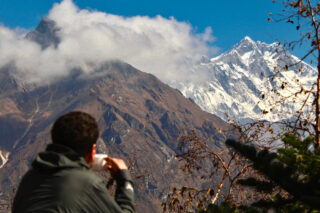
From there, we’ll trek to the hilltop high above the village to acclimatize by exposing ourselves to higher altitudes. The hilltop offers a jaw-dropping view of Everest, Lhotse, and Ama Dablam, three of the most iconic summits on the planet. We’ll be able to see all the way up the Khumbu valley and get a visual representation of what lies ahead of us.
This second night in Namche is one of the places where our accommodation selection matters most, giving you a stronger chance to rest, recover, and enjoy the village before the route becomes quieter and more remote.
DAY 6: ENTERING THE GOKYO VALLEY
Distance: 10 KM | Ascent: 895 M | Descent: 592 M | Max Altitude: 3,965 M
Our journey begins with an ascent from Namche to the Syangboche airstrip, a site that offers sweeping views of the surrounding valleys and peaks. The summits visible include Kande, Thamserku, Ama Dablam, Lhotse, and eventually Mount Everest as well!
As we continue, the trail leads us to Khumjung, the largest village in the Khumbu region, known for its traditional Sherpa houses and the famous Khumjung Monastery. Walking through the village, you’ll feel the rich cultural heritage that pervades this high-altitude settlement. Leaving Khumjung behind also means leaving the crowds of trekkers and climbers that dot the traditional Everest Base Camp route. From here, our trail becomes far less crowded and far more remote.
The trail then contours around the lower slopes of Khumbila, a sacred mountain for the Sherpas, passing through serene birch forests where the air is crisp and filled with the scent of the wilderness. Reaching a stupa on a rocky ridge at 3,992 meters, we pause to take in the breathtaking panoramic views. This is the gateway to the Gokyo Valley, at the end of which is the impressive south face of Cho Oyu, the world’s 6th highest mountain.
We usually pause for lunch here before beginning our descent into the tranquil woodlands surrounding Phortse Tenga, nestled quietly by the river. This is our home for the evening, and what an incredible home it is. The sound of the river against the view of the rhododendron forest makes it one of the most tranquil spots to sleep anywhere in the Khumbu region.
DAY 7: YAK FIELDS & SUMMIT VISTAS
Distance: 3.5 KM | Ascent: 480 M | Descent: 0 M | Max Altitude: 4,050 M
To ensure proper acclimatisation, our journey to Gokyo is paced over three days. After breakfast, we’ll depart Phortse Tenga and embark on a sustained and steep ascent through the forest that quickly begins to thin as we gain altitude. It won’t take long before the incredible landscape opens up to reveal spectacular vistas of towering peaks such as Kantega, Thamserku, and the majestic Ama Dablam. With modest pacing and well-timed breaks, the ascent can be quite manageable and made easier by the incredibly rewarding environment that we find ourselves in. The trail contours high above the valley, providing a bird’s-eye view of the lush, green pastures and deep ravines below. The sacred mountain of Tabuche dominates the opposite bank of the valley to our right, and its beautiful ridge line connecting to Cholaste summit moves alongside us a few thousand meters into the sky.
Before long, the trail passes through the yak herding settlements of Tongba and Gyele, where the presence of these hardy animals adds a rustic charm to the journey. This is usually our lunch spot, although which of the two we stop in depends entirely on the pace of the team and the weather conditions of the day. As we approach Dole, the landscape transforms into an alpine wonderland with rolling meadows and distant snow-capped mountains creating a picture-perfect backdrop. Here, the tea houses are much more spread out and all boast incredible views. Sunsets in the Gokyo Valley are second to none and, weather permitting, this is our first opportunity to experience it.
DAY 8: TREK TO MACHHERMO
Distance: 5.2 KM | Ascent: 441 M | Descent: 80 M | Max Altitude: 4,427 M
Our day begins with a steep climb, the trail winding upward alongside the valley high above the river. The path is rugged, traversing sandy spurs and rocky outcrops that both challenge and inspire. As we progress, the views become increasingly dramatic, with Machhermo Peak and Kaju Ri along the left side of the valley and Cholatse dominating the right side among the dozens of other jagged peaks rising majestically around us.
After the initial climb, the trail follows what the locals call “Nepali Flat.” This implies hilly terrain that ascends and descends haphazardly without any overall change in altitude. We’ll follow the Nepali Flat until we reach Machhermo, a picturesque village set against a stunning backdrop of towering mountains. At the end of the Machhermo Valley is Machhermo Peak, towering high above the village. The serenity of this place, coupled with the sweeping panoramic vistas, makes this yet another unique place to rest, recover, and spend some time alone with the highest mountains on the planet. The village itself is a charming collection of stone houses and tea lodges. There are usually a few wild yaks around as well!
We usually arrive relatively early on this day, giving us time to allow our bodies to recover and acclimatise for the high-altitude environment that lies ahead. Dinner will be hosted at our tea house in the village.
DAY 9: GOKYO!!
Distance: 7.3 KM | Ascent: 442 M | Descent: 67 M | Max Altitude: 4,756 M
Today’s trek takes us along a ridge, where the valley begins to widen, offering expansive views that stretch for miles. After breakfast, we head out in a northbound direction, where the trail leads us to Pangka, a peaceful spot where the beauty of the landscape is accentuated by the clear, crisp air. Here, the tranquility of the surroundings provides a perfect moment to pause and soak in the serene atmosphere. At a fork in the trail, we choose the path to Gokyo on the left, while the right path leads to the Cholaste base camp across the river.
After a brief descent, we climb to a large cave area known as Nilibuk, a place steeped in ancient myths and natural wonder. The cave, with its intriguing formations and historical significance, invites a sense of curiosity and exploration.
Continuing on, we arrive at the first of Gokyo’s five enchanting turquoise lakes, each one more mesmerizing than the last, set against the towering backdrop of snow-capped peaks, the highest of which is Cho Oyu. The pristine waters of these glacial lakes reflect the stunning panorama, creating a breathtaking and otherworldly scene. The landscape here is truly a testament to the raw beauty of the high Himalayas, with its rugged terrain, vibrant hues, and majestic peaks that seem to touch the sky.
As we make our way through this ethereal environment, the awe-inspiring vistas and serene surroundings remind us of the remarkable journey we are on and the incredible natural wonders that await us at every turn. Our evening is spent in the lakeside town of Gokyo. There are few words that can truly capture just how magnificent this place is.
DAY 10: GOKYO RI - THE BEST VIEW IN THE HIMALAYAS
Distance: 3.3 KM | Ascent: 590 M | Descent: 590 M | Max Altitude: 5,360 M
Before dawn, we begin our hike to Gokyo Ri (5,357m), a challenging ascent that rewards us with one of the most breathtaking panoramic views in the Himalayas. The trek is moderately inclined, but at these altitudes, even gradual ascents can feel very challenging. Although climbing Gokyo Ri is optional, we highly recommend it.
Our trekking team will confirm the plan, timing, and pace for Gokyo Ri based on weather, trail conditions, and how the group is feeling at altitude.
As the trail ascends, the width of the mountain begins to shrink, culminating in a pinnacle at the top, which typically takes around three hours to reach. Once there, the views are jaw-dropping. Everest, Lhotse, Cho Oyu, and Makalu are just a few of the famous summits that open up in front of us. We can even see the famous South Col of Mount Everest, where climbers pitch Camp Four before making their ascent to the summit.
As the sun rises, the peaks of Everest, Lhotse, Makalu, and Cho Oyu are bathed in a golden glow, a sight that leaves a lasting impression. Once we’ve enjoyed ourselves and taken loads of pictures, we’ll make our way back down to the tea house. The rest of the day is free for you to rest, relax, or take an optional exploratory walk around the Gokyo region, a landscape filled with natural wonders and tranquil beauty. We recommend recovering as much as possible because the next day, trekking over the pass into the Khumbu Valley, is the most objectively challenging day of the trip.
DAY 11: RENJO LA PASS
Distance: 12 KM | Ascent: 631 M | Descent: 1,044 M | Max Altitude: 5,370 M
After breakfast, we start early for the longest and most demanding part of our trek. A three-hour climb, tackled at a slow, steady, and sustained pace, brings us to the top of Renjo La Pass (5,360m), where we are greeted with yet another incredible view of Everest, Lhotse, Makalu, Baruntse, and the shimmering Gokyo Lakes below. The panoramic vista from the pass offers a breathtaking tableau of snow-capped peaks and pristine lakes, making every step of the arduous climb worthwhile.
The pass itself may be snow-covered, requiring careful navigation and the occasional use of ropes. Renjo La Pass is a summit in its own right, and reaching it is a great achievement.
This is where local mountain knowledge matters most. Our trekking team will assess the conditions on the pass, manage spacing, and guide the group through the safest available line on the day.
The descent from Renjo La is steep initially, with the trail zigzagging down the mountain’s rugged face. Trekking poles are essential to safely descend and protect the knees. As we carefully make our way down, the terrain gradually eases, and we are welcomed by the serene and isolated settlement of Lumdeng, our home for the evening.
DAY 12: AS REMOTE AS IT GETS
Distance: 10 KM | Ascent: 109 M | Descent: 666 M | Max Altitude: 4,343 M
With the toughest days behind us, today’s trek to Thame feels more relaxed. The trail descends through yak grazing pastures and the quaint village of Marulung, where the rhythm of pastoral life offers a stark contrast to the rugged wilderness we’ve traversed. Here, the sight of yaks grazing peacefully and the simple, rustic charm of village life provide a serene and calming atmosphere.
As we continue, the landscape gradually transitions from the high, barren alpine terrain to lush, verdant valleys. The trail winds its way along the river, and the sound of flowing water accompanies us as we trek. Thame itself is steeped in history, once a crucial junction on an ancient trade route between Tibet and Nepal. The village is renowned for its association with famous Everest summiteers, including Tenzing Norgay and Apa Sherpa, and its rich cultural heritage.
Upon arrival in Thame, you’ll feel the palpable sense of history and tradition that has shaped this remarkable community. The village is home to one of the oldest monasteries in the region, Thame Monastery, which sits perched on a hillside overlooking the village. The monastery, with its ancient murals and prayer wheels, provides a glimpse into the deep spiritual roots of the local Sherpa culture.
DAY 13: THE HUSTLE AND BUSTLE OF VILLAGE LIFE RETURNS
Distance: 14.5 KM | Ascent: 474 M | Descent: 1,426 M | Max Altitude: 3,797 M
Thame is the last truly remote village along the trail. After breakfast, we’ll head out for a long descending day towards Namche Bazaar and then onwards to Monjo. The trail starts with a long descent along the Bhote Koshi River, followed by a few sections of Nepali flat as we approach Namche Bazaar from the northwest.
As we approach Namche, we’ll start to see small market stalls along the trail and the familiar sight of donkey caravans, which are replaced by yaks at higher altitudes. We can’t pass through the town without stopping, so we’ve designated it as our lunch spot. Depending on our pace, it may be possible to roam around before we continue our descent through the forest, across the Tenzing-Hillary Suspension Bridge, and finally to the valley floor where the town of Monjo awaits. Our night will be spent at a tea house in the town.
DAY 14: THE GATEWAY TO REALITY
Distance: 12.6 KM | Ascent: 722 M | Descent: 715 M | Max Altitude: 2,835 M
The end of the trail is the Sherpa village of Lukla, home to the Tenzing-Hillary airport. Monjo is within a few hours of Lukla. This gives us the option of catching a flight out on this day instead of the next, should we find that weather may obstruct flights on the following day. Assuming that the conditions are favorable, we’ll start slowly after breakfast and take our time to visit and enjoy the many villages that are along this section of the trail. Yes, we did pass through them on the way up, but the mindset was different. It’s so much more enjoyable to have this experience once the objective of the adventure is behind us. Lunch will be in Phakding along the trail, and we’ll have plenty of opportunities to stop for tea and coffee. The final push to Lukla is a mild challenge as we ascend a series of stairs and village trails to the entrance of the town. The afternoon is free to explore the coffee shops, pubs, markets, and stores. We’ll spend our last night on the trail at a local Tea House, where we’ll also share our last trail dinner.
Because the trip includes one helicopter sector between Kathmandu and Lukla, the final aviation plan will depend on how the inbound journey was operated and what the weather allows. If the helicopter sector has not yet been used, it may be used from Lukla to Kathmandu to reduce the risk of delay. If it was used on the way in, the return from Lukla is usually by fixed wing flight, subject to weather and airport operations.
DAY 15: FLIGHT BACK TO KATHMANDU
Hot showers await us on our return to Kathmandu. Depending on how the journey into Lukla was operated, today may involve either the included helicopter sector from Lukla to Kathmandu or the fixed wing flight back toward Kathmandu. The decision is made according to weather, airport operations, and the best available plan for the group. Patience is still part of Himalayan travel, but including one helicopter sector gives us more flexibility around one of the most unpredictable parts of the Gokyo Lakes journey. Depending on when we move, lunch will either be in Lukla, Kathmandu, or the alternative airport sometimes used to direct Lukla air traffic that is inbound to Kathmandu. Wherever we finally land, we’ll do our best to get you to the hotel as soon as possible so that you can shower, rest, and enjoy Kathmandu before our farewell dinner.
DAY 16: NAMASTE!
The last day together is dedicated to airport transfer and farewells. Breakfast is included on the day. Please make sure to provide us with the correct departure details when filling out your Team Details Form before the first day of the trip so that arrangements can be made.
We’ll be arranging your shuttle 3 hours before departure, so please make sure to be near the hotel at the time so as not to be late. For those of us departing late, we’re happy to recommend places to visit or arrange for a city tour if you weren’t able to attend it on the first day.
Your LHO Team Leader will be available in Kathmandu to support departure arrangements. Please communicate any changes to your flight details as soon as possible so the final transfer plans can be updated smoothly.



OUR COMMITMENT
We are dedicated to ensuring that everyone involved in our services receives a fair living wage in their respective countries. We invest in our team members, fostering upward mobility within the adventure travel industry, expanding educational opportunities, and offering support wherever we can. By joining an LHO adventure you are directly impacting the incredible people and the remote communities that make these life-changing experiences possible.
LEARN MORE
HEALTH & SAFETY GUIDELINES
We do our best to ensure your wellbeing on LHO adventures. That's why the facilities we use throughout our trips are required to meet our health and safety standards. We also follow the laws and protocols of every country that hosts our adventures. This extends to national regulations requiring Covid-19 testing, vaccination certificates, mask wearing or any other local guidelines that may apply. Contact us for the most up to date protocols related to your destination.
LEARN MORE
This was the best trekking trip I've ever had! No words for the scenery every single day, it just got better and better! Clear view of a bunch of 8000m peaks including Everest is definitely a highlight. Not to say the Gokyo lakes are so serene. Can't ask for more really!!
This was the best trekking trip I've ever had! No words for the scenery every single day, it just got better and better! Clear view of a bunch of 8000m peaks including Everest is definitely a highlight. Not to say the Gokyo lakes are so serene. Can't ask for more really!!
EXPANDCatherine Choy
Will my Gokyo Lakes trek be led by an LHO Team Leader?
Yes. Your trek is shaped by an LHO Team Leader, who will be present and available for Kathmandu based events, including arrival, the welcome briefing, team dinners, and departure support. Their role is to set the tone of the experience, support the group, and help create the seamless logistics, rhythm, and attentive care Life Happens Outdoors is known for. On the trail, you are guided by our expert Khumbu trekking team, whose deep local knowledge of the Gokyo Valley, tea houses, weather, altitude, culture, Renjo La Pass, and mountain conditions brings the journey to life. This gives you the best of both worlds: the warmth and standards of LHO, with the confidence of people who know these trails intimately.
Is a helicopter transfer included on the Gokyo Lakes trek?
Yes. Our Gokyo Lakes trek includes one helicopter sector between Kathmandu and Lukla, used either on the way into the mountains or on the way back from Lukla depending on weather, flight operations, and the best plan for the group. The other airport sector is usually completed by fixed wing domestic flight. This gives us more flexibility around Lukla, where delays are common, while avoiding the unnecessary cost of using helicopters both ways.
This included helicopter sector applies only to Kathmandu to Lukla or Lukla to Kathmandu. Any helicopter return from higher on the trail remains a separate optional add on, subject to weather, landing conditions, aircraft availability, and the confirmed itinerary.
Where are the Gokyo Lakes?
The Gokyo Lakes are located at the end of the Gokyo Valley in the Everest region of the Nepali Himalayas. Nestled within Sagarmatha National Park, this stunning chain of glacial lakes sits at high altitude and forms the heart of the Gokyo Lakes trek, offering breathtaking views of the surrounding peaks, including Cho Oyu and Everest.
How are the Gokyo Lakes reached?
The Gokyo Lakes are reached via a scenic trek that begins in Lukla, the same starting point as the Everest Base Camp trek. The Gokyo Lakes trek and EBC route share the trail for the first four days until reaching Namche Bazaar. From there, the path branches west into the serene Gokyo Valley, eventually leading to the lakes, which sit at the valley’s end just below the impressive south face of Cho Oyu. This route is a key highlight of the Gokyo Valley trek and offers a quieter, less crowded alternative to the classic Everest route.
What are some of the highlights of this trail?
The Gokyo Lakes trek is packed with unforgettable moments from start to finish. It begins with the thrilling flight into Lukla, followed by the iconic crossing of the Tenzing-Hillary Suspension Bridge. You’ll spend two acclimatization nights in vibrant Namche Bazaar before leaving the main Everest trail behind and entering the peaceful, less-traveled Gokyo Valley.
As the trail winds deeper into the mountains, you’ll experience the region’s true remoteness, witness the dramatic south face of Cho Oyu, and arrive at the breathtaking Gokyo Lakes. From there, a pre-dawn ascent of Gokyo Ri rewards you with arguably the best panoramic view of Mount Everest. The adventure continues as you cross the stunning Renjo La Pass, one of the most scenic high passes in the Gokyo Valley trek circuit.
How high is Gokyo Ri?
Gokyo Ri stands at an altitude of approximately 5,357 meters (17,575 feet) above sea level. Climbing Gokyo Ri is one of the key highlights of the Gokyo Ri trek, offering unmatched panoramic views of four 8,000-meter giants—Mount Everest, Lhotse, Makalu, and Cho Oyu—as well as a bird’s-eye view of the turquoise Gokyo Lakes Nepal below.
How is the Gokyo Lakes trek different from Everest Base Camp?
The Gokyo Lakes trek explores a quieter side of the Everest region, moving through the Gokyo Valley instead of following the classic route all the way to Everest Base Camp. It includes the turquoise Gokyo Lakes, the climb to Gokyo Ri, and the dramatic crossing of Renjo La Pass, with some of the best panoramic views of Everest, Lhotse, Makalu, and Cho Oyu. It is ideal for trekkers who want the scale of the Khumbu with fewer crowds, more variety, and a deeper feeling of remoteness.
How hard is the Gokyo Lakes Trek?
The Gokyo Lakes trek is considered challenging, primarily due to its high altitude, steep ascents, and long descents. While you don’t need to be an elite athlete, a good level of physical fitness is essential to fully enjoy and succeed on this Gokyo Valley trek.
This is a life-changing journey, and taking your preparation seriously will make it all the more rewarding. Expect to carry a light backpack (under 5kg), while navigating rugged terrain and gaining altitude steadily—especially on the climb to Gokyo Ri and crossing Renjo La Pass.
How should I prepare for the Gokyo Lakes Trek?
To prepare, build your hiking endurance and overall fitness through a focused training routine. Here are some key areas to work on:
Aerobic Fitness: Run, hike, stair climb, or bike regularly to improve cardiovascular endurance.
Strength Training: Focus on legs and core with squats, lunges, and deadlifts.
Flexibility and Mobility: Include stretching or yoga to reduce injury risk.
Interval Training: Use HIIT to boost stamina and recovery.
We recommend dedicating at least 2 to 3 days per week to trek-specific training in the lead-up to your Gokyo Lakes trekking experience.
Is it possible to add mountaineering summits to the Gokyo Lakes trek?
Yes, it’s possible to combine the Gokyo Lakes trek with mountaineering objectives for those seeking a greater challenge. The most accessible summits along this route are Lobuche East and Kyajo Ri. These peaks can be added before or after exploring the Gokyo Valley, offering a seamless extension to your Gokyo Lakes trekking adventure while maintaining proper acclimatization and maximizing your time in the high Himalayas.
What is the accommodation like on the Gokyo Lakes trek?
During the Gokyo Lakes trek, accommodation varies between Kathmandu hotel stays and mountain tea houses. In Kathmandu, we use carefully selected properties that blend comfort, location, and local character, with easy access to the main markets, restaurants, and walking areas.
On the trail, we stay in tea houses, which are family run mountain lodges and a central part of trekking in the Himalayas. Tea houses become simpler as we move higher and deeper into the Gokyo Valley, but we select the best available standard where possible. In Phakding and Namche, where the accommodation options are stronger, we use higher quality tea houses to give you better comfort, atmosphere, and recovery early in the journey. You should still expect simple mountain accommodation, shared facilities in many places, and fewer comforts at higher altitude, but our selection is designed to give you the strongest experience the route realistically allows.
In the mountains, our Gokyo trek uses some of the best available tea houses—clean, welcoming, and chosen for their location, quality, and atmosphere—ensuring a safe and comfortable stay throughout your time on the trail.
On the Everest trail, we stay in tea houses. These are basic family-run accommodation that are very much part of the experience when trekking in the Himalayas. They consist of shared bathrooms, showers and a restaurant. We do not sleep in tents at any point on this adventure.
How can I charge my devices and power banks? Do tea houses charge for using electrical outlets?
Yes, it’s possible to charge your devices at tea houses during the Gokyo Lakes trek, but access to power outlets can be limited, especially at higher altitudes. With many trekkers needing to charge phones, cameras, or power banks, outlets are often in high demand—so take advantage of every opportunity to top up your batteries.
Most tea houses charge a small fee, usually between 200 to 500 Nepali Rupees (between $2 and $5 USD), to charge a power bank or device. We recommend bringing multiple power banks and keeping them charged whenever possible throughout your Gokyo trek.
How much should I carry as spending cash?
For the Gokyo Lakes trek, we recommend bringing around $200 USD in spending cash. This will cover personal expenses such as snacks, charging fees at tea houses, hot showers, and small souvenirs along the trail.
Please note that this amount does not include tips. Our suggested tipping amount for this experience is $250 USD.
PAYMENT PLANS AVAILABLE
FROM £3,425
£3,151
on selected dates only
DOWNLOAD YOUR TRIP GUIDEBOOK


INQUIRE NOW
This adventure is only available as a private trip and is customized to your requirements, experience and skill level. To get started, please fill out the form below. We’ll be in touch soon to put it together for you.
"(Required)" indicates required fields
CONTACT US
We’re passionate about guiding you to epic adventures and beyond. If you have any questions at all, don’t hesitate to reach out. We’d love to hear from you.
JOIN THE LIFE HAPPENS OUTDOORS COMMUNITY!
Get £100 off your next adventure!
Sign Up To The Newsletter